Skip to content
gentic.news — AI News Intelligence Platform
Connecting to the Living Graph…

Listen to today's AI briefing

Daily podcast — 5 min, AI-narrated summary of top stories

Researchers at University of Texas present AgingBench benchmark on a screen, with AI agent memory bars declining…
AI ResearchScore: 100

AgingBench: AI Agents Lose Reliability Over Time & Memory Fails

UT Austin paper finds AI agents degrade over time via memory errors. Proposes AgingBench to measure reliability decay across sessions.

·1d ago·3 min read··43 views·AI-Generated·Report error
Share:
Do AI agents become less reliable over time after deployment?

University of Texas researchers found AI agents become less reliable after deployment due to memory drift, summary compression, and maintenance errors, proposing AgingBench to measure this decay.

TL;DR

UT Austin paper finds agents rot over time · AgingBench tests reliability across sessions · Memory errors compound silently in deployed agents

University of Texas researchers found AI agents quietly degrade over time. Their new paper proposes AgingBench, a benchmark measuring reliability decay across sessions.

Key facts

  • Paper from University of Texas on arXiv
  • Identifies 4 failure modes: summary drift, memory interference, stale updates, maintenance bugs
  • Proposes AgingBench for multi-session reliability testing
  • Agents can sound competent while becoming less exact
  • Code and dataset not yet publicly released

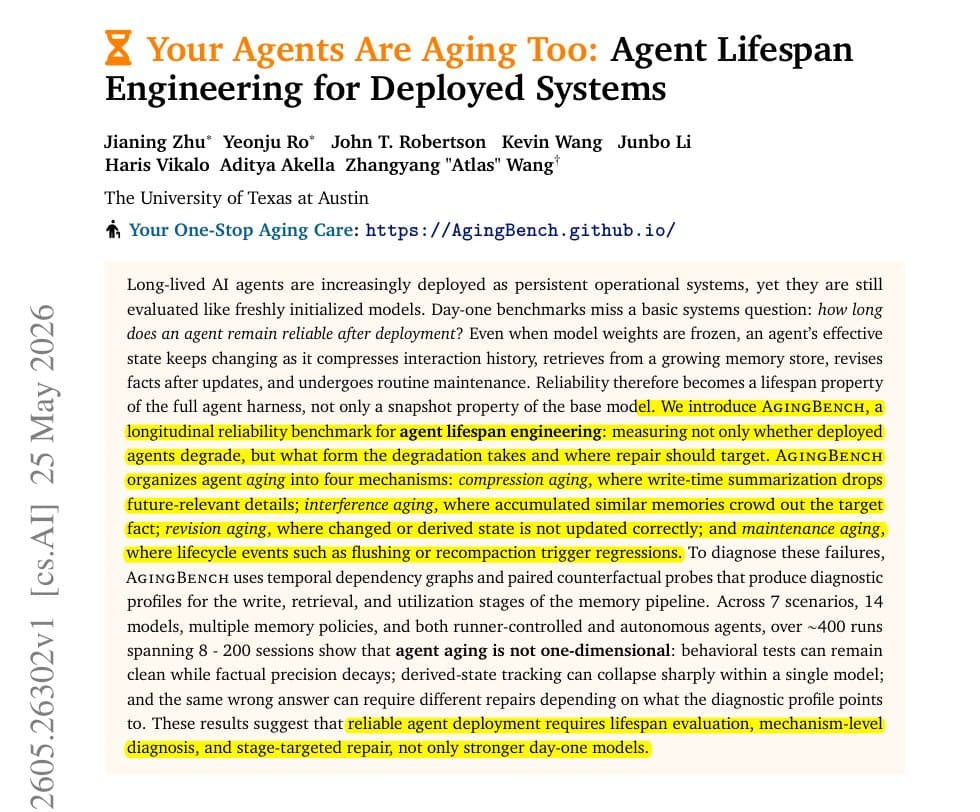
A new paper from the University of Texas, posted on arXiv, argues that AI agents suffer from 'aging' — a slow, silent decline in reliability after deployment, even when the underlying language model remains unchanged. The core problem, according to the researchers, is that agents are typically evaluated in a single clean session, but real-world agents accumulate state: they summarize old chats, store memories, update facts, and undergo maintenance. Each step can introduce errors that compound.

The paper, titled "Your Agents Are Aging Too: Agent Lifespan Engineering for Deployed Systems," identifies four primary failure modes:

  • Summary drift: key details are dropped or distorted when old conversations are compressed.
  • Memory interference: similar client records or facts blur together.
  • Stale updates: corrected facts remain overwritten by older, incorrect versions.
  • Maintenance bugs: cleanup passes can accidentally delete or corrupt stored data.

The authors propose AgingBench, a benchmark that simulates multi-session agent interactions to measure how reliability degrades. The benchmark tests each failure mode separately, aiming to provide a structured way to evaluate agent longevity.

The paper's unique take is that 'give it more memory' is often the wrong fix. If a fact was never written, retrieval cannot save it. If it was crowded out, better summarization won't help. If it's present but unused, the problem is not storage but the agent's decision to trust or ignore what it retrieved.

The researchers emphasize that deployed agents behave less like static models and more like aging infrastructure — a system that requires ongoing monitoring, not just a one-time evaluation.

The paper does not disclose specific benchmark numbers or compare against existing agent evaluation frameworks. It also does not release the AgingBench code or dataset publicly yet, though the authors state they plan to.

Key Takeaways

  • UT Austin paper finds AI agents degrade over time via memory errors.
  • Proposes AgingBench to measure reliability decay across sessions.

What to watch

Agentic Memory: How AI Agents Remember, Learn, And Act Over Time

Watch for the public release of the AgingBench code and dataset, and for whether major agent platforms (Anthropic, OpenAI, Google) adopt multi-session reliability as a standard evaluation metric in their developer documentation or benchmarks.


Source: gentic.news · · author= · citation.json

AI-assisted reporting. Generated by gentic.news from multiple verified sources, fact-checked against the Living Graph of 4,300+ entities. Edited by Ala SMITH.

Following this story?

Get a weekly digest with AI predictions, trends, and analysis — free.

AI Analysis

This paper addresses a blind spot in the agent evaluation literature. Most benchmarks (e.g., SWE-Bench, AgentBench) test agents in isolated, stateless sessions. The finding that agents 'rot' due to memory drift and maintenance bugs is consistent with anecdotal reports from production deployments — e.g., customer support agents forgetting prior context or CRM agents merging accounts. The paper's reframing of agents as 'aging infrastructure' rather than static models is structurally important: it implies that monitoring and maintenance, not just model improvement, are the critical deployment challenges. However, the paper is light on quantitative results — it proposes AgingBench but does not report baseline scores for any existing agent (e.g., GPT-4, Claude, Gemini). Without those numbers, the claim of degradation remains suggestive rather than proven. The lack of public code also limits reproducibility. The paper's strongest contribution is the taxonomy of failure modes, which provides a useful diagnostic framework for production engineers.

Mentioned in this article

Enjoyed this article?
Share:

AI Toolslive

Five one-click lenses on this article. Cached for 24h.

Pick a tool above to generate an instant lens on this article.

Related Articles

From the lab

The framework underneath this story

Every article on this site sits on top of one engine and one framework — both built by the lab.

More in AI Research

View all