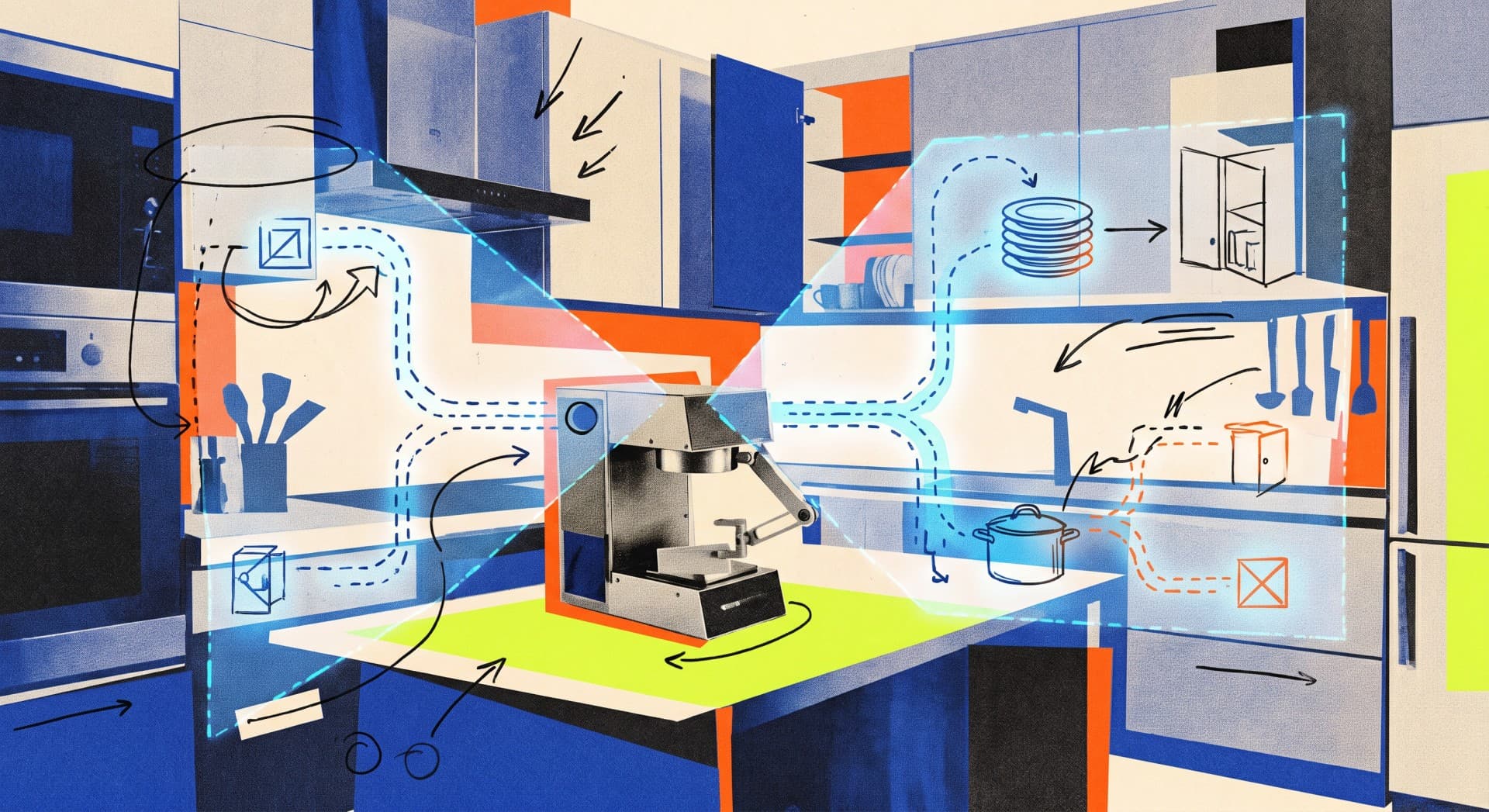
BAAI's Orca world model matches the specialized π0.5 on five robotics tasks without ever seeing a single action label. Trained on 125,000 hours of video, it predicts abstract world states instead of tokens or pixels.
Key facts
- 125,000 hours of video used for training.
- Matches π0.5 on five robotics tasks.
- 4 billion parameters in the largest version.
- Only one-tenth of video data used so far.
- 160 million event descriptions in dataset.
The Beijing Academy of Artificial Intelligence (BAAI) has released Orca, a world foundation model that rethinks how AI understands physical dynamics. According to The Decoder, Orca predicts abstract internal representations of the next world state, not the next token, video frame, or robot action. This breaks from the dominant paradigm of language models, video generators, and robot controllers that specialize in narrow prediction tasks.
Two training modes, one frozen core
Orca combines "unconscious learning" from raw videos without captions and "conscious learning" with verbal instructions. The model sees an image and predicts the next in an abstract space, picking up motion patterns, occlusions, and scene dynamics. For conscious learning, videos are split into segments labeled with state-change descriptions, and the model trains on video question-answering tasks.
The pre-trained language-image model Qwen3.5 serves as the base, remaining frozen after training. Separate output modules convert the internal state: Qwen3.5's language head for text, Stable Diffusion 3.5 for images with small upstream adapters, and a from-scratch "Action Expert" control module for robot actions. The team argues that a well-trained internal world state can serve as a shared base for very different tasks.
Scaling and benchmark results
The training dataset includes 125,000 hours of video footage, 160 million event descriptions, and 11.5 million question-answer pairs. Videos span four views: first-person everyday interactions, third-person object handling, robot recordings without action data, and naturally occurring scenes. Only one-tenth of the video data went into the current 4-billion-parameter version.
Orca was trained at 0.8B and 4B parameters. Training loss drops steadily with more data and larger models. On five robotics benchmarks, Orca matches the specialized π0.5, a system trained with explicit action labels. The technical report emphasizes that intelligence shouldn't be defined by specialized prediction models but by general world understanding.
Unique take: The data scarcity play
Robotics faces a chronic data shortage because collecting action labels is expensive and hard to scale. Orca's approach—learning world dynamics from unlabeled video—could bypass this bottleneck entirely. If BAAI scales to the full 1.25 million hours of available video, the performance gap against label-dependent systems may widen significantly, challenging the assumption that action labels are necessary for robotics foundation models.
What to watch
Watch for BAAI scaling Orca to the full 1.25 million hours of video data and whether performance on robotics benchmarks widens the gap against label-dependent systems. Also monitor for open-source release of the Action Expert module.

Source: the-decoder.com