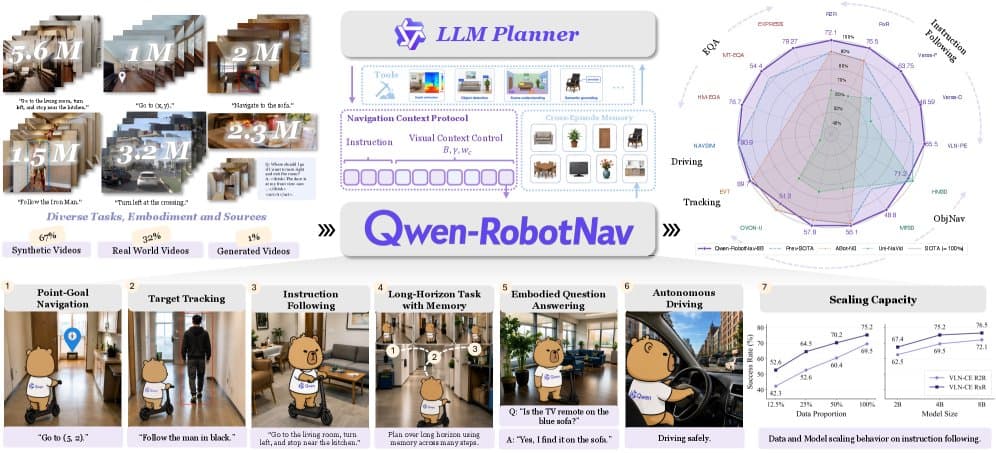
Alibaba's Qwen Team released Qwen-RobotNav, a 2B–8B parameter model unifying robot navigation. It handles VLN, ObjectNav, tracking, and autonomous driving via a configurable observation protocol, deploying zero-shot to real-world quadruped robots.
Key facts
- Qwen-RobotNav is a 2B–8B parameter model from Alibaba's Qwen Team.
- Unifies VLN, ObjectNav, tracking, and autonomous driving tasks.
- Deploys zero-shot to real-world quadruped robots.
- Uses a configurable observation protocol for sensor flexibility.
- No training dataset size or compute costs were disclosed.
Alibaba's Qwen Team released Qwen-RobotNav, a 2B–8B parameter model unifying robot navigation. According to @HuggingPapers, the model handles Vision-Language Navigation (VLN), Object Navigation (ObjectNav), object tracking, and autonomous driving through a configurable observation protocol. The model deploys zero-shot to real-world quadruped robots with agentic planners, suggesting a significant step toward generalist robotic control.
What the Model Unifies

Qwen-RobotNav consolidates four distinct navigation tasks into a single architecture: VLN (following natural-language instructions to navigate), ObjectNav (finding specific objects), object tracking (following a target through space), and autonomous driving (navigating structured environments). The configurable observation protocol lets the model accept different sensor inputs—cameras, LiDAR, or depth maps—without retraining, enabling deployment across platforms.
Zero-Shot Deployment to Quadrupeds
The model's zero-shot capability to real-world quadruped robots is notable. Most prior work requires fine-tuning on robot-specific data or sim-to-real transfer. Qwen-RobotNav uses agentic planners—likely a learned policy or LLM-based reasoning module—to translate navigation outputs into motor commands, bypassing task-specific controllers. Alibaba's Qwen Team did not disclose training dataset size or compute requirements, but the 2B–8B parameter range suggests substantial pretraining.
Comparison to Prior Art
Existing navigation models like ViNG (Google, 2021) or CLIP-Nav (2022) typically handle one task—e.g., ObjectNav—and require per-robot fine-tuning. Qwen-RobotNav's unification across VLN, ObjectNav, tracking, and driving in a single model mirrors the broader industry trend toward generalist robotics models, such as Google's RT-2 or Meta's Habitat. However, Qwen-RobotNav's explicit support for quadruped deployment and agentic planners sets it apart. No benchmark scores were provided, making direct comparison difficult.
Unique Take: The Configurable Observation Protocol
The key innovation is the configurable observation protocol, which decouples sensor input from task logic. This allows the same model to handle camera-only VLN, LiDAR-heavy autonomous driving, or hybrid setups without architectural changes. This is structurally similar to multimodal LLMs' ability to accept text, images, or audio, but applied to robotics—a domain where sensor fusion remains a hard problem.
What to watch
Watch for benchmark results on VLN-CE or Habitat ObjectNav to quantify Qwen-RobotNav's zero-shot gap vs. task-specific models. Also watch for Alibaba's open-source release of training code or dataset, which would accelerate adoption. The agentic planner design could influence future robotics LLMs.
[Updated 09 Jul via the_decoder]
Competitor Mistral has entered the robotics space with Robostral Navigate, an 8B model that guides robots through unknown environments using only a single RGB camera [per The Decoder]. Trained in simulation and refined with reinforcement learning (CISPO), it achieves 76.6% on the R2R-CE benchmark—a direct performance metric that Qwen-RobotNav has not yet disclosed. Mistral has not announced an availability date.