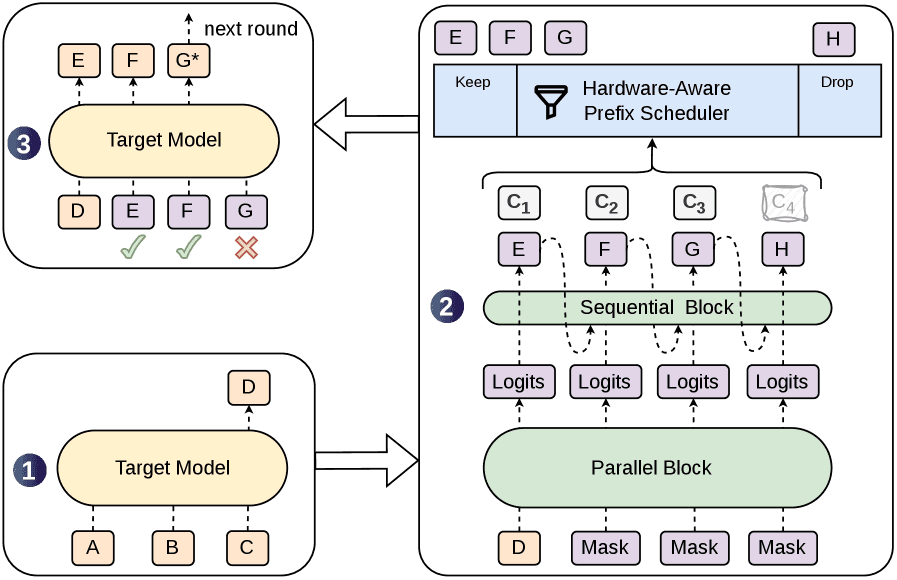
DeepSeek released DSpark, a speculative decoding framework. It unifies high-throughput parallel generation with adaptive, load-aware verification to accelerate LLM inference.
Key facts
- DeepSeek released DSpark speculative decoding framework.
- Unifies high-throughput parallel generation with adaptive verification.
- No benchmark numbers or performance metrics disclosed.
- No arXiv preprint or GitHub repository linked yet.
- Continues DeepSeek's pattern of open-sourcing inference tools.
DeepSeek has released DSpark, a speculative decoding framework that aims to improve LLM inference efficiency by combining high-throughput parallel generation with adaptive, load-aware verification. The approach targets the latency and throughput bottlenecks common in serving large language models, particularly for applications requiring real-time or near-real-time responses.
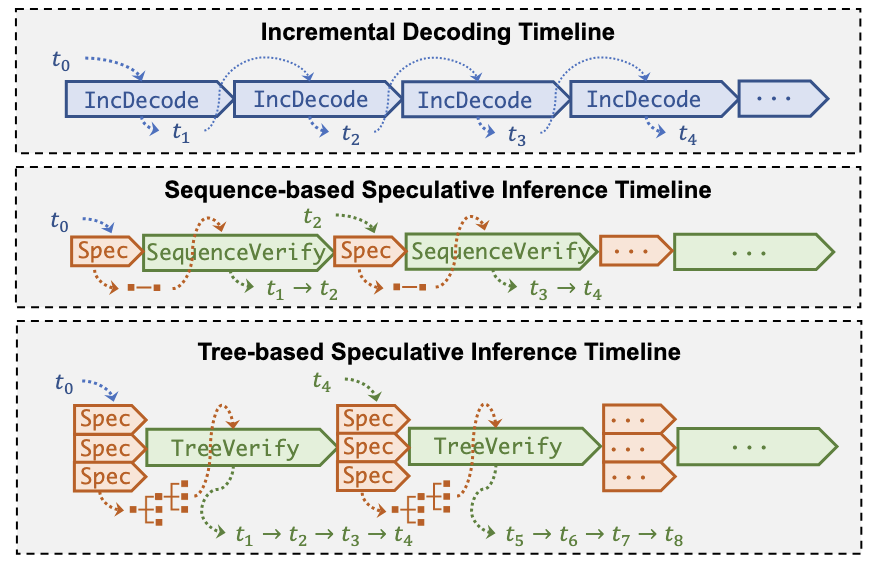
Speculative decoding is a known technique for accelerating autoregressive generation by using a smaller, cheaper draft model to propose multiple tokens, which a larger target model then verifies in parallel. DSpark extends this paradigm by making the verification step adaptive based on current system load, potentially reducing wasted computation during low-load periods and scaling up verification throughput under high demand.
According to @HuggingPapers, the framework unifies parallel generation with load-aware verification, but the announcement did not include benchmark numbers, performance metrics, or comparisons against existing speculative decoding methods such as those from Google (SpecInfer) or Meta (Speculative Decoding with Big Little Models). DeepSeek's blog post or technical report may contain more details, but as of this writing, no arXiv preprint or GitHub repository has been linked.
This release continues DeepSeek's pattern of open-sourcing inference optimization tools, following their earlier work on FlashMLA-style attention and MoE routing. The narrow focus on verification adaptivity is a novel twist, but without quantitative results, it remains unclear whether DSpark delivers meaningful gains over prior art.
What the announcement leaves unsaid
The lack of performance data makes it difficult to assess DSpark's practical value. Key questions include: What is the wall-clock speedup on standard benchmarks like MT-Bench or MMLU? How does the adaptive verification compare to fixed-window verification in terms of token acceptance rate? What draft model architectures were tested? DeepSeek did not disclose these details.
For engineers evaluating DSpark for production use, the absence of latency and throughput numbers is a significant gap. The framework may be best suited for scenarios with variable request loads, such as API serving or interactive chat applications, where adaptive load-aware verification could smooth out latency spikes.
Comparison to prior work
Speculative decoding has been widely studied since Leviathan et al. 2022 and Chen et al. 2023. Google's SpecInfer and Meta's implementation both use fixed verification windows. DSpark's innovation is making the verification step load-aware, which could improve resource utilization in multi-tenant serving environments. However, prior work has shown that even fixed-window verification already achieves near-optimal throughput for many workloads. The marginal benefit of adaptivity may be small outside of extreme load variation scenarios.
DeepSeek has not released code or a technical report, so the community cannot independently verify claims or reproduce results. Until benchmarks and open-source code are provided, DSpark should be viewed as an early-stage research contribution rather than a production-ready tool.
Key Takeaways
- DeepSeek released DSpark, a speculative decoding framework unifying parallel generation with adaptive verification.
- No benchmarks disclosed yet; the approach targets inference latency and throughput.
What to watch
Watch for DeepSeek to publish an arXiv preprint or GitHub repository with benchmark results. If DSpark shows >20% latency reduction over standard speculative decoding on MT-Bench or MMLU, it could become a reference implementation for load-aware inference serving.