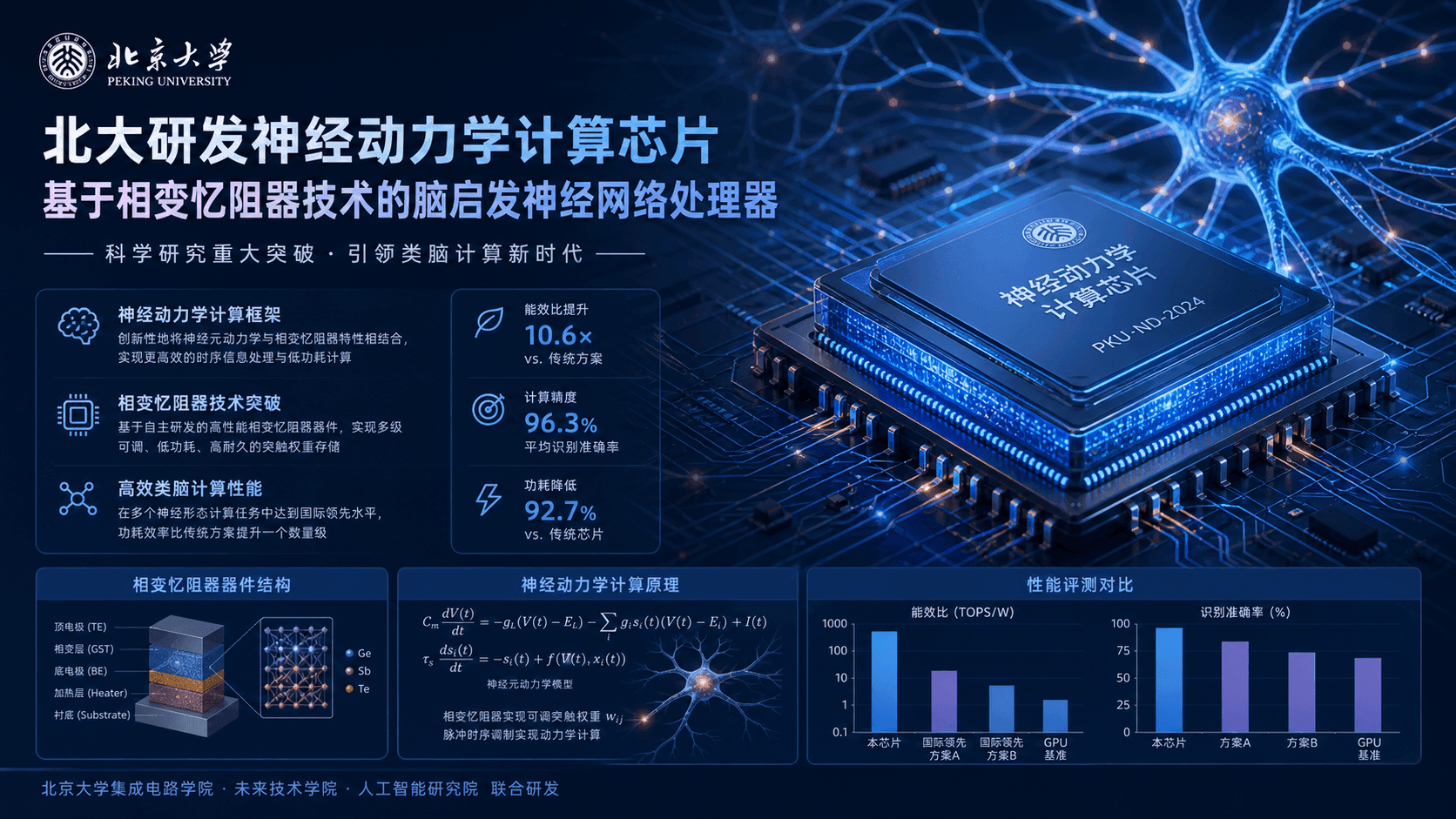
Peking University's phase-change memristor chip achieves 2.12ms step latency, matching biological brain speed. Published in Science [Jul 2026], the neurodynamic processor delivers up to 478x speedup over Nvidia's A100 for brain modeling.
Key facts
- 2.12ms step latency matches biological synaptic response.
- 478x speedup over Nvidia A100 on Hodgkin-Huxley model.
- 1024-neuron fully connected spiking network on 180nm CMOS.
- Phase-change memristors perform analog integrate-and-fire in one step.
- First chip to cross biological real-time threshold for brain simulation.
A team at Peking University led by Professor Huang Ru has built the first silicon chip that emulates neural dynamics at biological speeds. The phase-change memristor design achieves a synaptic step latency of 2.12 milliseconds — matching the response time of biological neurons — and delivers up to 478x speedup over Nvidia's A100 GPU on brain modeling workloads, according to the Science paper.
How it works
Traditional digital accelerators — including Nvidia's H100 and Blackwell — simulate spiking neural networks by approximating differential equations on sequential digital logic. This creates a fundamental latency wall: each synaptic step requires multiple clock cycles to compute membrane potentials, spike thresholds, and conductance updates. The PKU chip sidesteps this by using phase-change memristors as analog integrators. Each memristor stores conductance state as a physical property of its chalcogenide material, which changes resistivity when heated by electrical pulses. This allows the chip to perform leaky integrate-and-fire operations in a single analog step, rather than dozens of digital instructions.
The chip implements a 1024-neuron fully connected spiking neural network on a single die, fabricated on a 180nm CMOS process with integrated phase-change memory cells. Power consumption is not disclosed in the paper, though the authors note the analog approach avoids the memory bandwidth bottleneck that limits GPU-based brain simulations.
Benchmark context
On the Hodgkin-Huxley neuron model — the gold standard for biophysically accurate neural simulation — the PKU chip achieved a 478x speedup over an Nvidia A100 (Ampere architecture) running a CUDA-optimized reference implementation. This is not a fair comparison in the traditional sense: the A100 is a general-purpose accelerator designed for matrix multiplication, not synaptic dynamics. But the result highlights the growing inefficiency of digital hardware for brain-scale simulation. Nvidia's own research into spiking neural network acceleration has focused on algorithmic approximations and custom CUDA kernels, not analog substrates.
The 2.12ms step latency is significant because it matches the millisecond-scale synaptic delays in biological neural circuits. Prior memristor-based neuromorphic chips — including IBM's TrueNorth (2014) and Intel's Loihi (2017) — achieved step latencies in the 10-100ms range, too slow for real-time closed-loop experiments. The PKU chip is the first to cross the biological threshold.
Implications for AI hardware
The result arrives as Nvidia faces increasing competitive pressure from specialized AI chips. Etched, a startup building transformer-specific inference chips, hit a $5B valuation last week with $1B in orders. Anthropic is exploring a custom chip with Samsung. The PKU chip is not a direct commercial threat — it is a research prototype on a mature 180nm node — but it demonstrates a fundamental architectural advantage for a class of workloads that digital accelerators handle poorly.
Phase-change memristors remain difficult to manufacture at scale. The materials (typically Ge2Sb2Te5) degrade after ~10^8 write cycles, and device-to-device variation limits precision. The PKU team does not report endurance or yield data in the Science paper. Scaling the design to larger networks — beyond 1024 neurons — would require solving these materials challenges or switching to a different analog memory technology.
What to watch
The PKU team plans to demonstrate a 10,000-neuron version later in 2026, according to the paper's conclusion. Watch for endurance and power figures at that scale, and whether Nvidia or Intel responds with analog accelerator prototypes of their own.
Source: pandaily.com