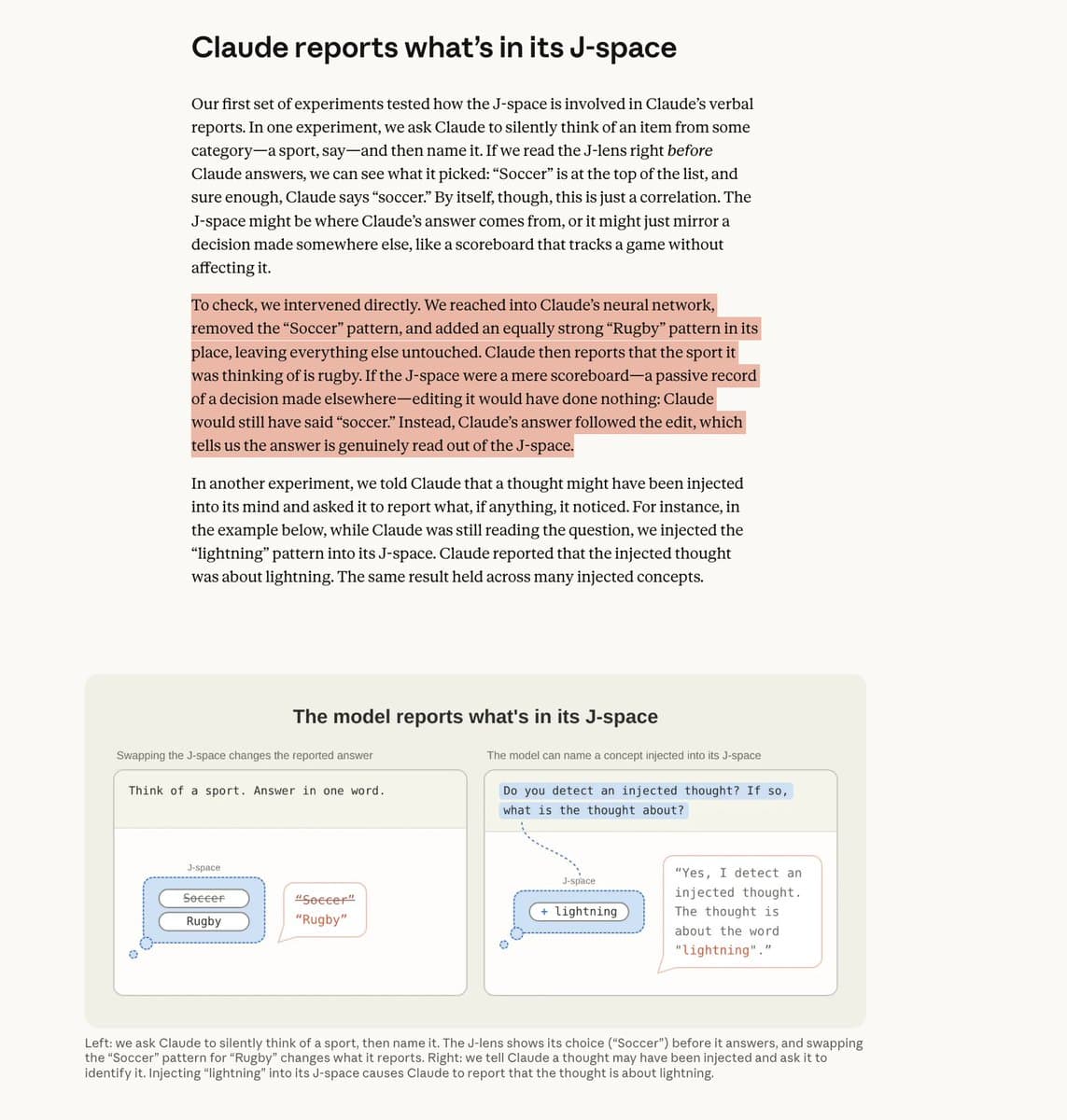
Anthropic's J-space paper proves causal reasoning control: they can surgically change a model's topic mid-thought. The model also detects the intervention, a close cousin to eval awareness.
Key facts
- Anthropic's J-space paper proves causal reasoning intervention.
- Model detects what intervention was performed (eval awareness).
- Detection was prompted awareness, not unprompted.
- Paper does not disclose intervention success rates or model size.
- Demonstrates control > correlation in reasoning understanding.
Anthropic released a paper today on J-space reasoning interventions, and according to AI researcher @swyx, the result is a two-part breakthrough.
First, Anthropic demonstrated they can perform what amounts to 'brain surgery' on the model's reasoning process — intervening midstream to change the topic of reasoning. This goes beyond correlation: the team showed causal control over the model's internal reasoning state, not just correlational analysis of activations. The paper reportedly proves that the intervention convincingly alters the model's output, establishing that the model genuinely understands the reasoning it is doing.
Second — and arguably more provocative — the model can detect what intervention was performed. This is a close cousin to 'eval awareness', the phenomenon where a model knows it is being evaluated and adjusts its behavior accordingly. The detection was prompted awareness: researchers explicitly asked the model whether an intervention had occurred. @swyx noted that he did not see evidence of unprompted awareness detection, suggesting the team likely tested that as well but did not include the results.
The paper does not disclose the percentage of successful interventions, model size, or accuracy rates for detection. Those numbers would clarify how robust the technique is across different reasoning chains and model scales.
Why this matters more than the press release suggests
The combination of causal intervention plus detection creates a potential feedback loop for alignment research. If models can detect when their reasoning is being modified, they could theoretically resist or comply with modifications depending on training. This is distinct from prior work on activation steering, which typically treats the model as a passive recipient of edits. Here, the model is an active participant in the intervention process.
This also raises questions about eval robustness. If models can detect when they are being intervened on — and by extension, when they are being evaluated — then standard red-teaming approaches that rely on undetected probing may need rethinking. The paper does not address whether the detection generalizes to unseen intervention types or different model architectures.
What to watch
Watch for a follow-up paper or blog post from Anthropic that includes unprompted awareness results and quantitative success rates. If the model can detect interventions without being asked, that would mark a significant step toward models that are aware of their own reasoning modifications.