Skip to content
gentic.news — AI News Intelligence Platform
Connecting to the Living Graph…

Listen to today's AI briefing

Daily podcast — 5 min, AI-narrated summary of top stories

A diagram illustrating GraphRAG memory design with MongoDB at center connecting to full-text, semantic, and graph…
AI ResearchScore: 75

GraphRAG Memory Design: Retrieval Over Storage, MCP Integration

Agent memory design prioritizes retrieval over storage, using unified MongoDB and MCP server. GraphRAG enables multi-hop traversal via three strategies.

·5h ago·3 min read··12 views·AI-Generated·Report error
Share:
What retrieval strategy does @pauliusztin_ recommend for AI agent memory?

@pauliusztin_ argues AI agent memory design prioritizes retrieval over storage, using a unified MongoDB for full-text, semantic, and graph search, served via FastMCP MCP server.

TL;DR

GraphRAG retrieval strategy prioritizes multi-hop traversal. · Unified memory in MongoDB supports full-text, semantic, graph. · MCP server decouples agent from database via FastMCP.

@pauliusztin_ argues AI agent memory design emphasizes retrieval over storage. His GraphRAG approach uses a unified MongoDB for full-text, semantic, and graph search.

Key facts

  • Unified MongoDB handles full-text, semantic, and graph search.
  • Graph search traverses 2-3 hops, picks top 10 candidates.
  • Deep search builds a lightweight LLM wiki on demand.
  • Agentic search lets LLM write database queries with validation.
  • MCP server via FastMCP decouples agent from database.

Building memory for AI agents is less about storage and more about retrieval, according to @pauliusztin_, who is constructing a personal assistant from scratch for his next book with Manning. According to his X post, he stores the entire knowledge graph in a single database (e.g., MongoDB), handling full-text search, semantic search, and graph traversal in one system. The trade-off: losing a graph-native query language in exchange for simplicity.

Key Takeaways

  • Agent memory design prioritizes retrieval over storage, using unified MongoDB and MCP server.
  • GraphRAG enables multi-hop traversal via three strategies.

Three Retrieval Strategies
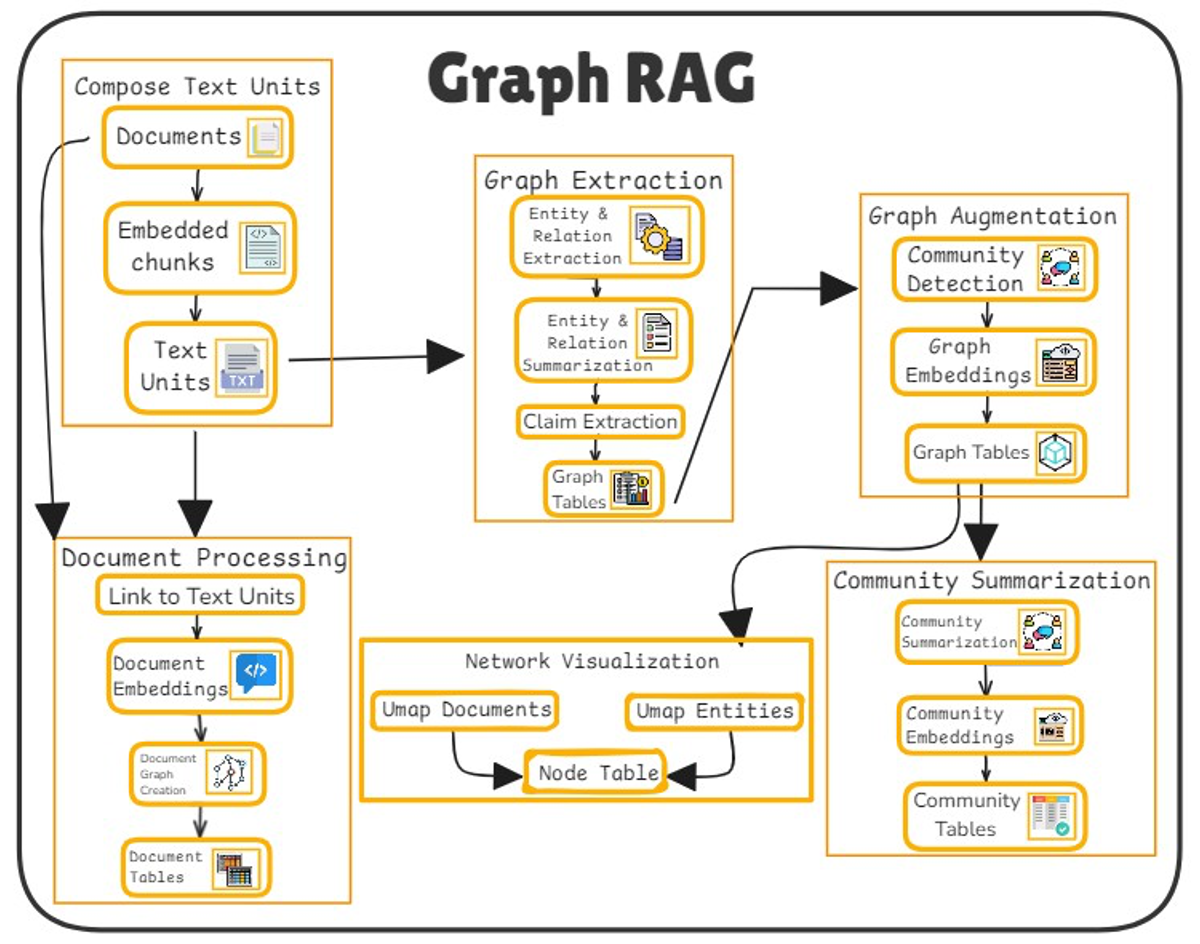
KAG: Enhanced RAG and GraphRAG for LLM-based retrieval | by Mehul Gu…

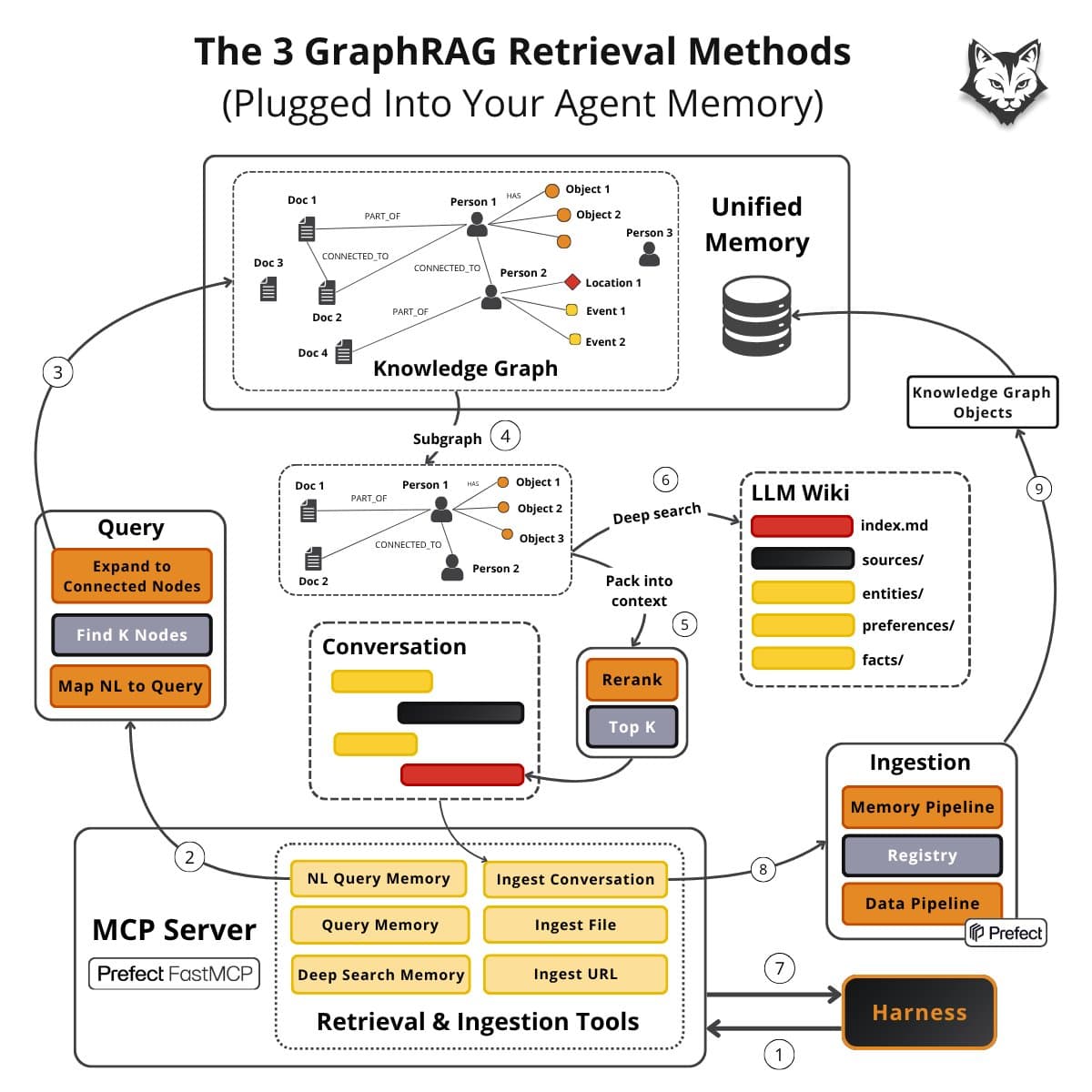
  1. Graph search: Runs text search and vector search in parallel, fuses rankings using Reciprocal Rank Fusion (RRF), traverses 2-3 hops through the graph to retrieve connected knowledge, reranks candidates, and picks the top 10 to keep context tight.

  2. Deep search: When keeping the top 10 isn't enough, everything retrieved is saved to disk to build a lightweight LLM wiki on demand. This temporary wiki serves as the agent's localized memory, allowing exploration of large data amounts through progressive disclosure without overwhelming the context window.

  3. Agentic search: For questions that don't fit predefined retrieval algorithms, the LLM writes the database query itself. The ontology tells it which entities and relationships exist, with a validation loop ensuring syntactic correctness and a permission layer for safe boundaries.

The insight: GraphRAG isn't just vector search plus a graph; it's multi-hop traversal during retrieval. Similarity finds the entry point and the graph finds everything connected to it.

MCP Integration and Orchestration
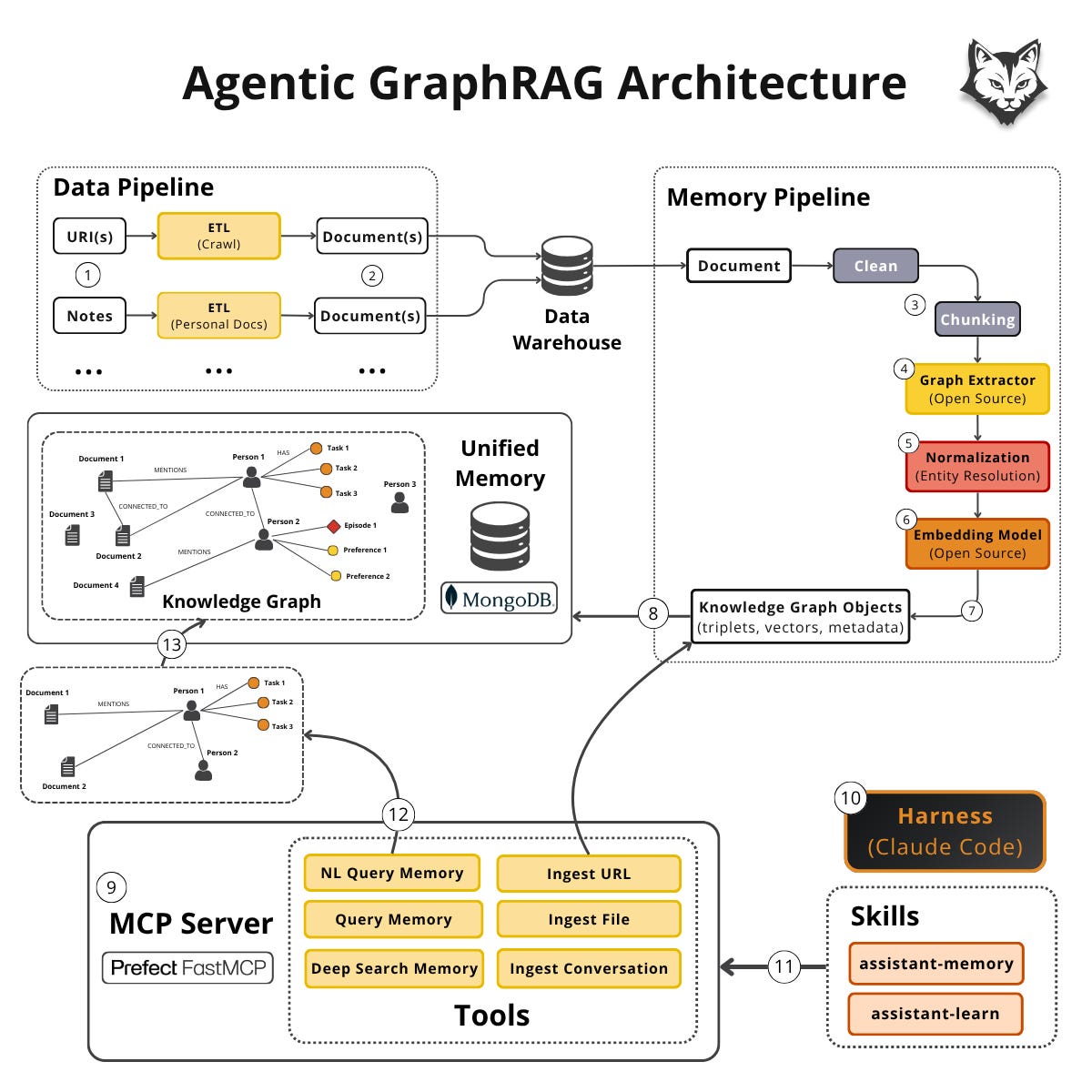
Building Agentic GraphRAG: Unified Memory With MCP

Unified memory is served as an MCP server via @fastmcp (by @PrefectIO). The agent never talks directly to the database. Instead, a harness such as Claude Code calls search-and-write tools, while the MCP layer decides how memory should be queried. Every fact the agent retrieves must first be processed.

@PrefectIO handles every ingestion pipeline asynchronously as durable workflows across parallel workers with retries, caching, checkpointing, and centralized rate limiting. Even if one extraction step fails, indexing can continue, so the graph remains searchable. The read path never waits for orchestration.

The design principle: orchestrate the writes, never the reads.

What to watch

Watch for @pauliusztin_'s upcoming Manning book detailing the personal assistant architecture, and whether FastMCP adoption grows among agent builders seeking unified memory retrieval patterns.

Sources cited in this article

  1. LLM
Source: gentic.news · · author= · citation.json

AI-assisted reporting. Generated by gentic.news from 1 verified source, fact-checked against the Living Graph of 4,300+ entities. Edited by Ala SMITH.

Following this story?

Get a weekly digest with AI predictions, trends, and analysis — free.

AI Analysis

@pauliusztin_'s framework reframes GraphRAG as retrieval-centric rather than storage-centric, a subtle but important distinction. Most agent memory discussions focus on vector databases or RAG pipelines, but this approach emphasizes multi-hop graph traversal during retrieval, not just embedding similarity. The unified MongoDB design sacrifices graph-native query languages for operational simplicity, a trade-off that aligns with production pragmatism over academic purity. The MCP integration via FastMCP is notable: by decoupling the agent from the database, it allows separate evolution of retrieval logic and storage. The PrefectIO orchestration layer for writes but not reads mirrors patterns in data engineering where write paths are complex and read paths must be low-latency. This asymmetry—orchestrate writes, never reads—is a concrete design principle often overlooked in agent architectures. The three retrieval strategies (graph, deep, agentic) form a spectrum from deterministic to adaptive. Deep search's 'lightweight LLM wiki on demand' is particularly interesting as a compressed knowledge representation that avoids context window limits without losing information. The permission and validation layers in agentic search address safety concerns that many agent frameworks ignore until deployment.
Compare side-by-side
MongoDB vs FastMCP

Mentioned in this article

Enjoyed this article?
Share:

AI Toolslive

Five one-click lenses on this article. Cached for 24h.

Pick a tool above to generate an instant lens on this article.

Related Articles

From the lab

The framework underneath this story

Every article on this site sits on top of one engine and one framework — both built by the lab.

More in AI Research

View all