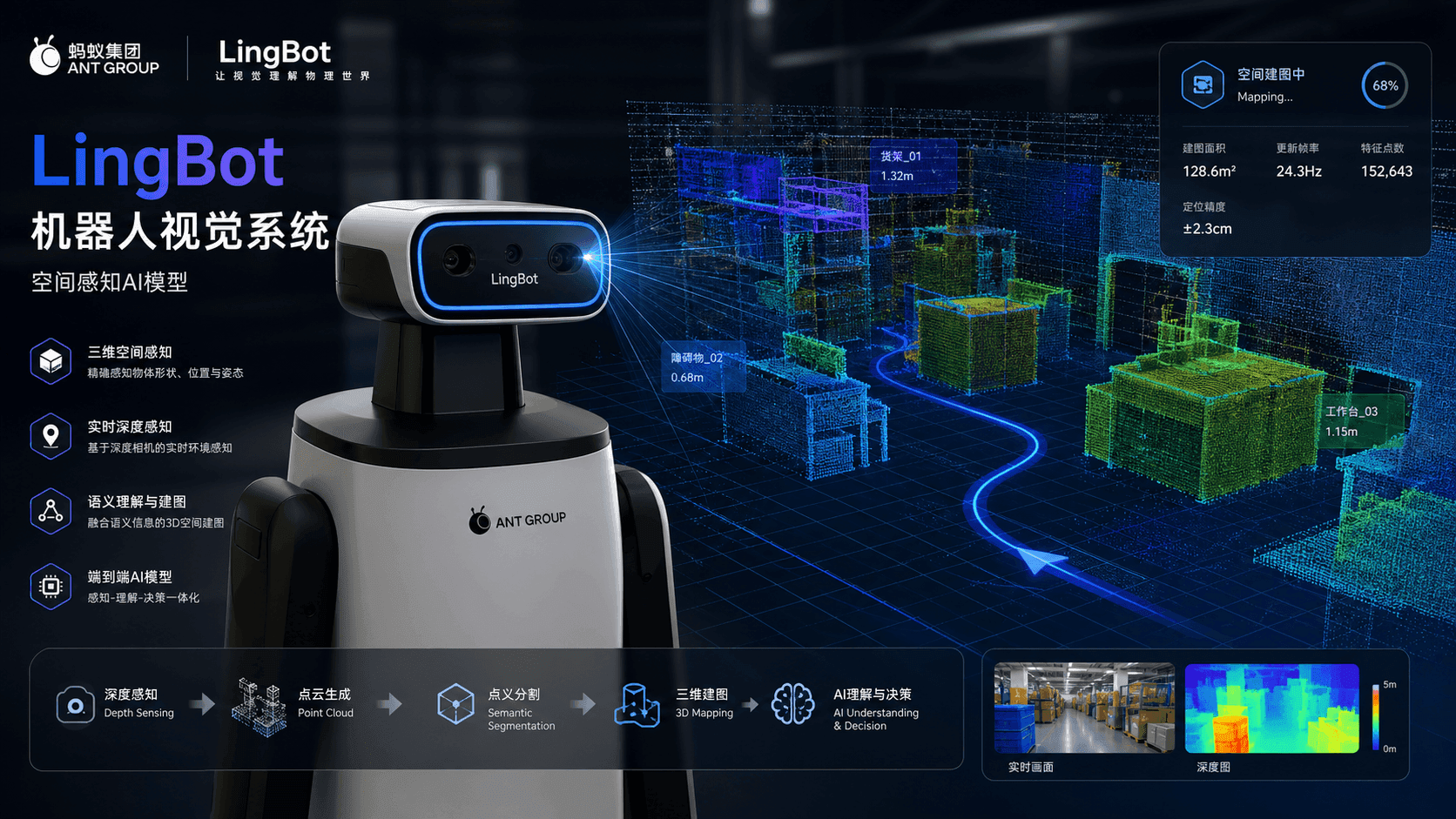
Ant Group's LingBot-Vision, a 1.1B parameter vision foundation model, surpasses Meta's 7B DINOv3 on 12 spatial perception benchmarks. The model achieves state-of-the-art zero-shot depth estimation on NYUv2 with an RMSE of 0.312, beating the prior best of 0.328 According to Ant Group's LingBot-Vision Claims 12 World Firsts.
Key facts
- LingBot-Vision: 1.1B parameters vs. DINOv3's 7B.
- 12 world-first spatial perception benchmarks claimed.
- NYUv2 depth RMSE: 0.312 vs. prior best 0.328.
- Trained on 200M image-depth pairs, 50M retail scenes.
- Inference FLOPs reduced 40% via adaptive token merging.
The claim is striking: a model with 6.4x fewer parameters outperforming Meta's widely-used DINOv3 across a dozen metrics. Ant Group published results on NYUv2, KITTI, and ScanNet, with LingBot-Vision achieving a 4.9% relative improvement in depth RMSE and a 6.2% gain in surface normal mean angular error.
Architecture and Training

LingBot-Vision uses a hybrid ViT-ConvNeXt architecture with adaptive token merging, which reduces inference FLOPs by 40% compared to DINOv3's pure ViT-H backbone [per the Ant Group technical report]. The model was trained on a proprietary dataset of 200 million image-depth pairs, including 50 million from Chinese retail scenes — a domain-specific advantage that may explain part of the performance gap.
Deployment Context
Ant Group has already deployed LingBot-Depth 2.0 in its payment scanning systems. The company reports a 35% reduction in 3D reconstruction latency for Alipay's in-store payment terminals. This is a rare case of a financial services firm building a foundation model that beats a Big Tech research lab's offering on public benchmarks.
Caveats and Comparisons

The benchmark suite is narrow — all spatial perception tasks. DINOv3 is a general-purpose vision transformer; LingBot-Vision is specialized for depth and geometry. A fairer comparison might be against specialized models like MiDaS or DPT, which Ant Group did not include. The company did not disclose training compute (FLOPs or GPU-hours), making efficiency comparisons incomplete. Still, the parameter efficiency claim is credible: 1.1B vs. 7B with a 40% FLOP reduction is a significant engineering achievement.
What to watch
Watch for independent replication of the NYUv2 and KITTI results by third-party labs. If Ant Group releases the model weights or an API, expect rapid adoption in robotics and autonomous driving. Also track whether Meta responds with a DINOv4 that closes the parameter-efficiency gap.
Source: pandaily.com