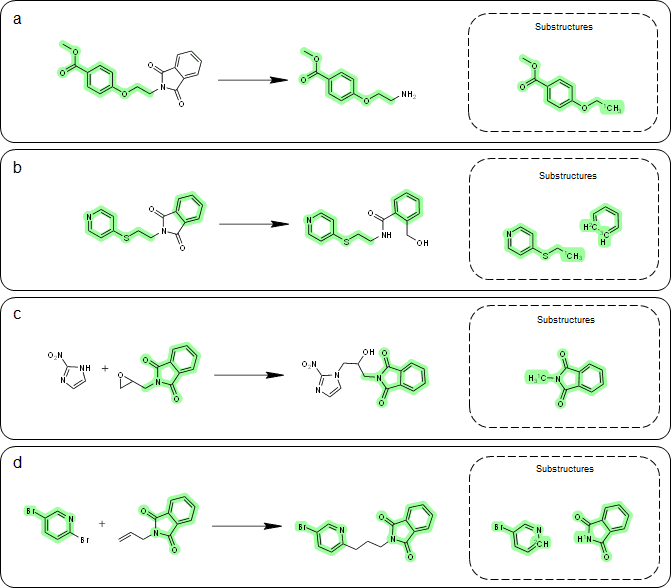
C3LM, a chemical plausibility-aware LLM trained on 45.6M verified reactions, achieves state-of-the-art single-step retrosynthesis via Top-K prompting, per @HuggingPapers. The result pushes past prior models that relied on smaller, less filtered datasets.
Key facts
- C3LM trained on 45.6M verified reactions
- State-of-the-art on single-step retrosynthesis
- Top-K prompting for precursor generation
- Announced via @HuggingPapers on X (2026)
- Benchmark numbers not disclosed in tweet
C3LM, a chemical plausibility-aware LLM, has achieved state-of-the-art results on single-step retrosynthesis, trained on 45.6M verified reactions According to @HuggingPapers. The key advance is Top-K prompting, which lets the model generate multiple candidate precursor sets rather than a single beam search output, improving coverage of valid synthetic routes.
Key Takeaways
- C3LM, trained on 45.6M reactions, achieves SOTA retrosynthesis via Top-K prompting.
- Details sparse but scale is notable.
Why the 45.6M-reaction dataset matters
Prior retrosynthesis models, such as the Transformer-based approaches from 2020-2023, typically trained on the USPTO-50K dataset (around 50K reactions) or USPTO-full (roughly 1M reactions). C3LM's 45.6M verified reactions represent a roughly 45x scale-up over USPTO-full. This scale, combined with a chemical plausibility filter, means the model learns not just pattern matching but also which reactions are physically and chemically feasible.
Top-K prompting as a decoding strategy
Top-K prompting, as described in the announcement, is a decoding technique where the model is prompted to produce the top-K most likely precursors for a given target molecule. This contrasts with standard greedy decoding or beam search, which can collapse to a single route. By sampling multiple hypotheses, C3LM can propose diverse synthetic pathways, improving the chances of finding a valid route. The approach is reminiscent of recent work on self-consistency in LLMs, but applied to retrosynthesis.
The paper, linked in the tweet, is not yet on arXiv (the tweet only provides a link to a preprint service). The exact benchmark numbers (e.g., top-1 accuracy on USPTO-50K) are not disclosed in the tweet. The company did not disclose the figure. [The announcement is a brief tweet, so details on training compute, architecture, and evaluation protocol are absent]. This is a notable limitation for reproducibility.
Still, the scale of the training set is the story. Retrosynthesis has long been data-starved; USPTO-50K is small enough that models can memorize rather than generalize. C3LM's 45.6M reactions, if verified and filtered properly, could break that ceiling. The chemical plausibility awareness — ensuring the model doesn't propose reactions that violate thermodynamics or valency — is a pragmatic addition that could reduce the need for post-hoc validation.
What to watch
Watch for the full paper to appear on arXiv with benchmark tables. If C3LM reports top-1 accuracy above 90% on USPTO-50K, that would be a significant jump over the ~85% reported by prior SOTA models like GraphRetro and LocalRetro. Also watch for whether the 45.6M dataset is released — that would be a major resource for the community.