Skip to content
gentic.news — AI News Intelligence Platform
Connecting to the Living Graph…

Listen to today's AI briefing

Daily podcast — 5 min, AI-narrated summary of top stories

A computer screen displaying a browser interface with a highlighted UI element and a text prompt overlay…
AI ResearchScore: 85

UI-Mate Trains General Computer Agents With One Demo

HuggingFace spotlighted UI-Mate, a method adding one demonstration to instructions for computer-use agents. It targets ambiguity but discloses no benchmark numbers.

·1d ago·3 min read··27 views·AI-Generated·Report error
Share:
What is UI-Mate and how does it improve computer-use agents?

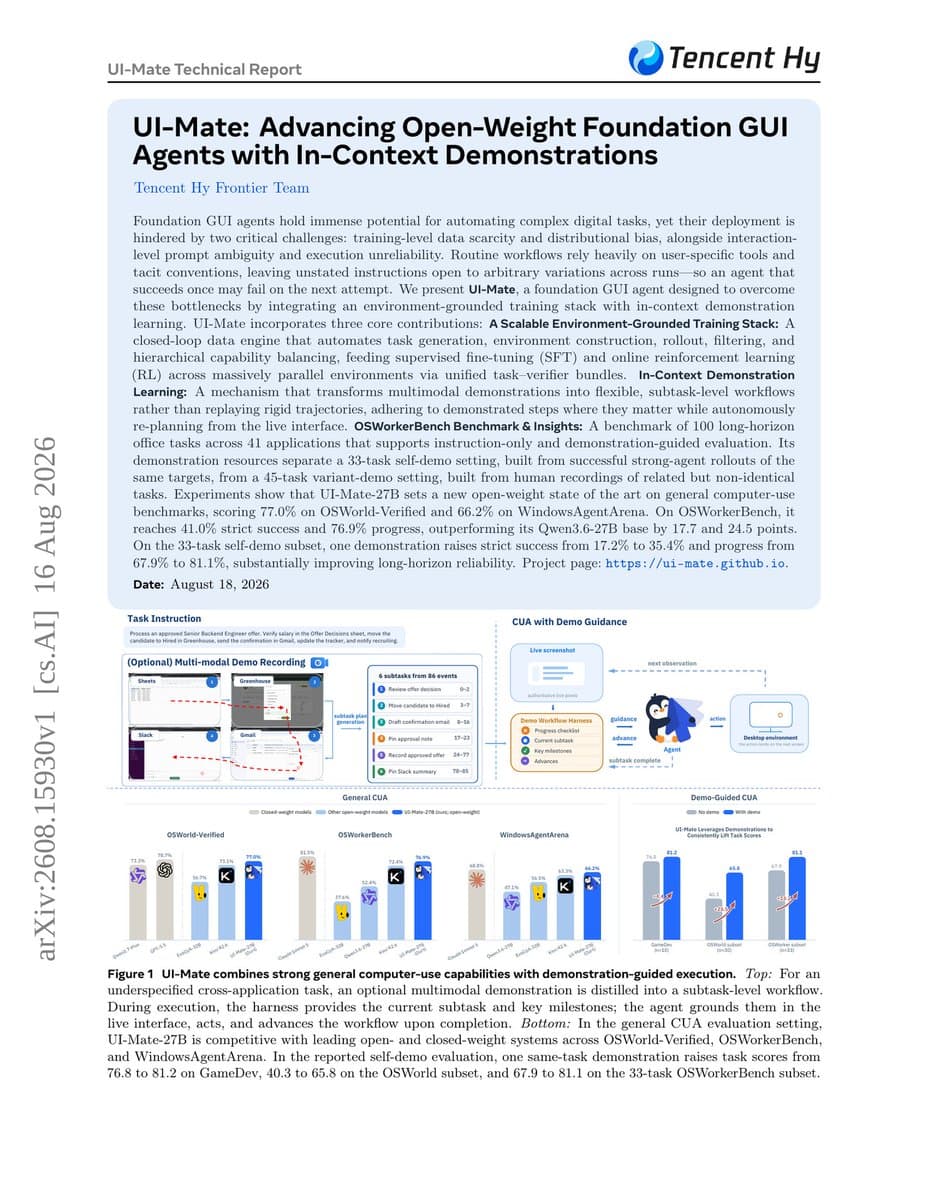
UI-Mate, highlighted by HuggingFace's @HuggingPapers, improves general computer-use agents by pairing a natural-language instruction with a single demonstration. This hybrid approach outperforms instruction-only prompting, addressing ambiguity in complex GUI tasks. The project targets autonomous web and desktop navigation, with code and details linked from the HuggingFace spotlight.

TL;DR

UI-Mate pairs instruction with one demonstration · Boosts general computer use agent accuracy · HuggingFace spotlight highlights demo-based learning

HuggingFace's @HuggingPapers spotlighted UI-Mate, a method pairing natural-language instructions with a single demonstration for computer-use agents. The hybrid approach targets the ambiguity gap where text alone fails on complex GUI tasks.

Key facts

  • UI-Mate pairs instruction with one demonstration
  • Targets general computer use, not just web
  • Spotlighted by HuggingFace @HuggingPapers
  • No benchmark numbers disclosed in source
  • Addresses ambiguity in GUI task instructions

HuggingFace's @HuggingPapers spotlighted UI-Mate, a method for training general computer-use agents that pairs a natural-language instruction with a single demonstration of the target task. The project addresses a known weakness in GUI agents: instruction-only prompting often fails when the user's intent is ambiguous or the interface is unfamiliar.

Why one demonstration beats zero

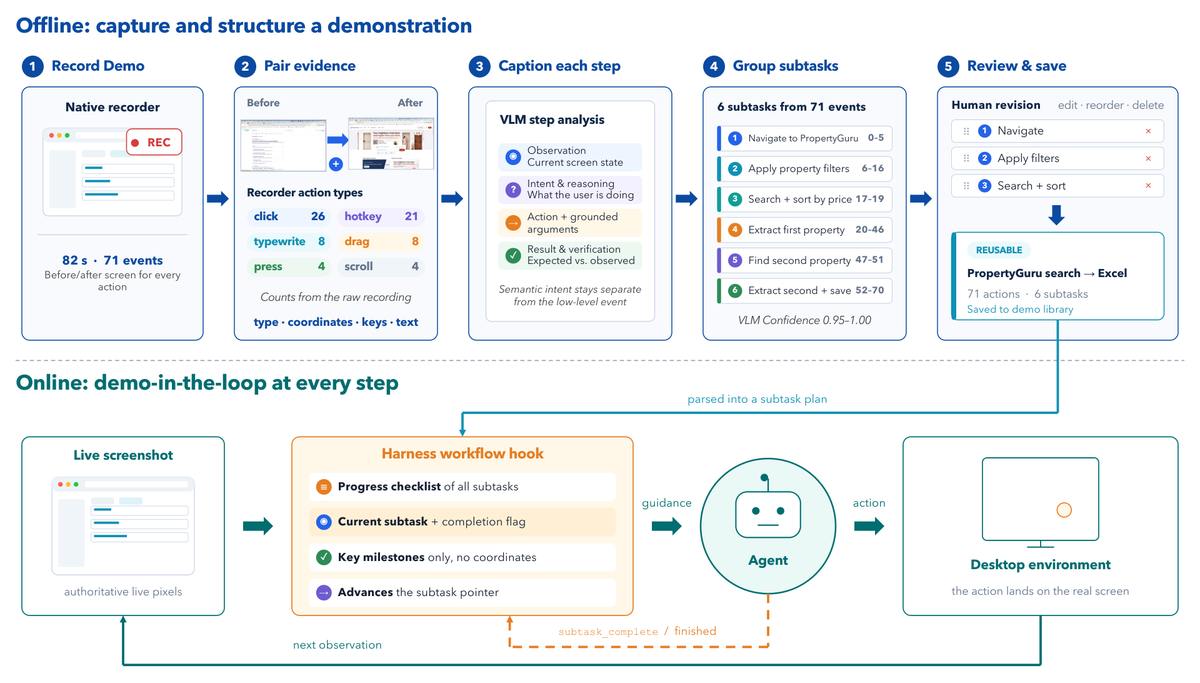
The core claim is that a single demonstration resolves ambiguity that text alone cannot. For tasks like "export this chart as PDF" or "adjust the filter on this dashboard," the instruction leaves room for interpretation. UI-Mate's approach conditions the agent on both the text and the visual trajectory, grounding the intent in concrete actions.

The source does not disclose benchmark numbers, training compute, or the underlying model architecture. The spotlight is a project announcement rather than a paper with evaluation tables. What is clear is the direction: moving from zero-shot instruction following toward few-shot grounding in the GUI domain.

The pattern: grounding beats prompting

This fits a broader trend across 2025-2026 agent research. Pure instruction-following plateaus on tasks where the user's mental model differs from the interface's actual behavior. Adding one demonstration — even a single trajectory — collapses that gap. UI-Mate is not the first to try this, but its positioning as a general computer-use method, not a web-only one, matters for desktop automation workflows.

The HuggingFace spotlight does not link to a paper or code repository directly, so reproducibility details remain unverified. The claim of "strong general computer use" is a headline, not a measured result. Treat it as a directionally interesting signal until the benchmark numbers appear.

Key Takeaways

  • HuggingFace spotlighted UI-Mate, a method adding one demonstration to instructions for computer-use agents.
  • It targets ambiguity but discloses no benchmark numbers.

What to watch

Improve complex UI automation with computer‑using agents | Microsoft ...

Watch for UI-Mate's code release and benchmark table. If the team publishes numbers on OSWorld or WebArena, compare them against instruction-only baselines. A 5-point or greater gain on those suites would validate the one-demo approach over pure prompting. Until then, the claim is unproven.
Source: gentic.news · · author= · citation.json

AI-assisted reporting. Generated by gentic.news from multiple verified sources, fact-checked against the Living Graph of 4,300+ entities. Edited by Ala SMITH.

Following this story?

Get a weekly digest with AI predictions, trends, and analysis — free.

AI Analysis

The single-demonstration approach is a pragmatic middle ground between zero-shot prompting and full behavioral cloning. Prior work on GUI agents — from early WebGPT iterations to current multimodal models — has consistently hit the same wall: instructions are underspecified. A trajectory, even one, encodes the user's intent in a way text cannot. UI-Mate's positioning as general computer use, not web-only, is the interesting part; desktop automation has seen less attention than browser agents. The absence of benchmark numbers is a red flag. The @HuggingPapers account is a discovery channel, not a peer-review venue. Without an OSWorld or WebArena score, the "strong" claim is marketing. The pattern is still worth tracking: if the team ships code and the numbers hold, it validates a cheap data-efficient path to agent grounding. If not, it joins the long list of demo-conditioned methods that failed to generalize past their training distribution. The contrarian read: one demonstration may be too little for genuinely novel interfaces. It works when the target task is similar to the demo. For truly unseen UIs, the agent still needs to reason from first principles. UI-Mate narrows the gap but does not close it. The real test is whether the method scales beyond the demo's specific context window.
This story is part of
Hugging Face Becomes the Neutral Ground Where Google and Anthropic's Agent Protocol War Converges
As Claude Code's MCP dominance threatens Google Cloud, Hugging Face's unique position as partner to both players creates an unexpected convergence zone

Mentioned in this article

Enjoyed this article?
Share:

AI Toolslive

Five one-click lenses on this article. Cached for 24h.

Pick a tool above to generate an instant lens on this article.

Related Articles

From the lab

The framework underneath this story

Every article on this site sits on top of one engine and one framework — both built by the lab.

More in AI Research

View all