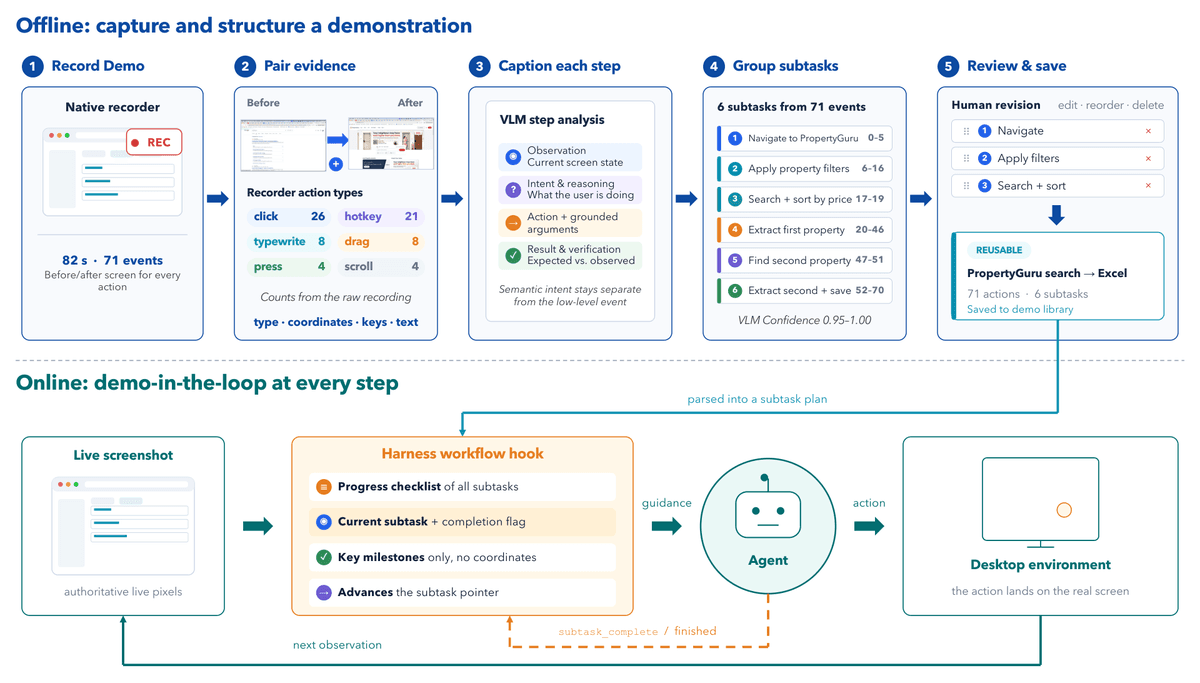
Tencent released UI-Mate on Hugging Face, an open-weight GUI agent that learns procedures from a single demonstration. The agent re-plans from the live screen, targeting UI automation without task-specific training data.
Key facts
- Released on Hugging Face by Tencent
- Learns procedures from a single demonstration
- Re-plans from live screen during execution
- Open-weight, allowing self-hosting and fine-tuning
- No model size or benchmark data disclosed
Tencent has released UI-Mate on Hugging Face, an open-weight GUI agent that learns procedures from a single demonstration and re-plans from the live screen According to the Hugging Papers tweet. The model is designed to automate UI workflows by observing one example and then executing the task while adapting to real-time screen changes.
The single-demonstration learning approach reduces the need for large annotated datasets, which have been a bottleneck in GUI automation. Unlike earlier agents that follow fixed action sequences, UI-Mate's re-planning mechanism allows it to handle unexpected UI states, making it more robust in dynamic environments. The open-weight release lets developers fine-tune and deploy UI-Mate on their own infrastructure, a departure from proprietary agents that require API access.
This release comes as GUI agents gain traction in enterprise automation, where adaptability to changing interfaces is critical. Tencent's move to open weights could accelerate adoption and community contributions, though the company has not disclosed model size, training data, or benchmark results. The tweet provides no technical details beyond the agent's capabilities, so performance comparisons against existing agents like OpenAI's Operator or Anthropic's computer-use remain unverified.
What's missing
The source is a brief announcement, so specifics on architecture, parameter count, and evaluation metrics are absent. Without benchmark numbers, it's unclear how UI-Mate compares to state-of-the-art GUI agents. The claim of learning from a single demonstration is notable but unproven in this announcement.
Why it matters
The open-weight strategy is significant. If UI-Mate matches or exceeds proprietary agents, it could democratize GUI automation, especially for organizations with privacy constraints. The live re-planning feature is a practical differentiator, as many agents fail when UI layouts shift mid-task. Tencent's release signals a growing trend of major labs open-sourcing agentic models, challenging the closed-model paradigm.
What to watch

Watch for benchmark results or a technical paper from Tencent detailing UI-Mate's architecture and performance. If the model gains traction on Hugging Face, community evaluations against proprietary agents will reveal whether single-demonstration learning holds up in real-world tasks. Also monitor for enterprise adoption announcements that could signal commercial viability.