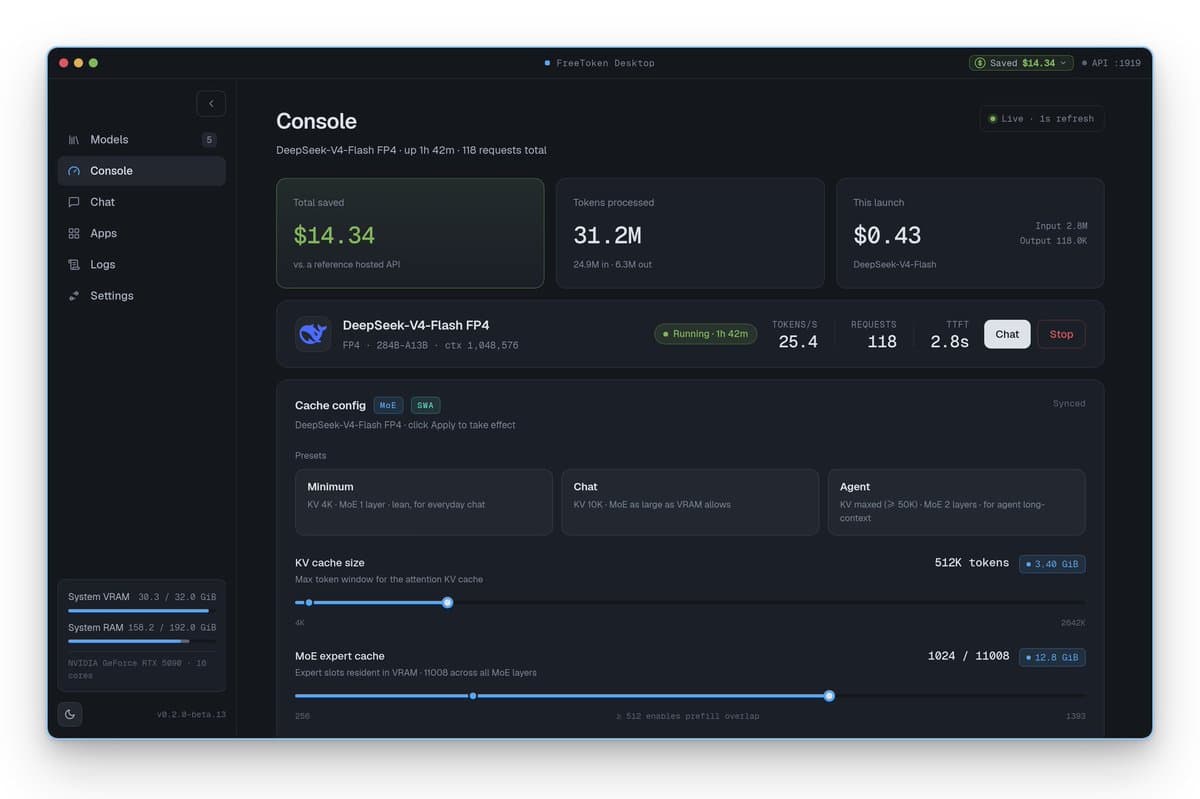
FreeToken, an edge-native MoE serving framework, claims to run a 284B-parameter model locally on a gaming desktop. It treats the entire PC as a unified inference platform, spanning 20+ MoE models from 35B on a laptop up to that 284B desktop ceiling.
Key facts
- FreeToken claims 284B MoE on gaming desktop
- 35B on laptop, 20+ MoE models supported
- No benchmark numbers or hardware specs disclosed
- MoE sparsity makes 284B plausible but unverified
- Competes with llama.cpp, Ollama, vLLM for edge
- Source: @HuggingPapers tweet, no paper link
- 284B at 4-bit needs ~140GB, forcing offload
- No tokens-per-second or latency figures provided
FreeToken, an edge-native MoE serving framework, claims to turn a consumer PC into a unified inference platform, serving 20+ MoE models from 35B on a laptop to 284B on a gaming desktop According to @HuggingPapers. The claim, posted on X, is thin on architecture details — no paper, no benchmark numbers, no GitHub link in the thread. But the headline numbers are worth scrutiny because they sit at the edge of what consumer hardware can plausibly do.
Key Takeaways
- FreeToken claims 284B MoE serving on a gaming desktop via unified PC inference.
- No benchmarks disclosed; feasibility depends on MoE sparsity and offload strategy.
What 284B on a desktop actually implies
The 284B figure on a gaming desktop suggests aggressive offloading and expert-level scheduling, not brute-force GPU memory. A typical gaming desktop has 16-24GB VRAM and 32-64GB system RAM. A 284B MoE model, even at 4-bit quantization, needs roughly 140GB just for weights. That forces the framework to keep most experts in system RAM or on NVMe, moving only active experts to GPU at each token step. This is the same trick used by llama.cpp's offloading and by the MoE inference work in DeepSpeed, but FreeToken's pitch is that the PC itself becomes a distributed inference node, with the model spread across all available resources.
The 35B-on-a-laptop claim is more believable — a 35B MoE model at 4-bit is around 17GB, which fits in a high-end laptop's unified memory. But the 284B claim implies either extreme quantization (2-bit) or a very sparse activation pattern where only a fraction of experts load per token. MoE models like Mixtral 8x7B activate only 2 of 8 experts per token, so effective memory bandwidth per token is far lower than the full parameter count suggests.
The gap between claim and evidence
The source provides no measured latency, no tokens-per-second figures, no hardware specs beyond "gaming desktop," and no comparison to existing local inference tools. The tweet links to a paper or project page (the URL is truncated in the post), but the source text doesn't name the authors or institution. [The source] doesn't disclose whether the 284B model is a known open-weight model (e.g., DeepSeek-V3 or Qwen2.5-Max) or a custom MoE, which matters because architecture determines feasibility.
If the 284B model is DeepSeek-V3 (671B total, 37B active), then 284B is a distilled or pruned variant — not the full model. If it's a sparse MoE with 10% active parameters, then per-token compute is roughly equivalent to a 28B dense model, which is plausible on a desktop. The claim is not impossible, but it's underspecified. [The source] gives no token-generation speed, no time-to-first-token, and no memory footprint numbers.
Why this matters beyond the hype
Edge MoE serving is a real trend. The economics are obvious: local inference eliminates per-token cloud costs, cuts latency for interactive use, and keeps data on-device for privacy. [According to the tweet], FreeToken's "unified inference platform" framing suggests it treats CPU, GPU, and memory as a single pool, which is the right approach for MoE where expert sparsity means memory bandwidth matters more than raw FLOPs.
But the 284B number could be a marketing ceiling, not a practical serving rate. Running a 284B model at 1 token per second is technically "serving" but useless for chat. The real test is whether FreeToken sustains interactive speeds — 10+ tokens per second — on that hardware. The source doesn't provide that. [The source] also doesn't say whether the framework supports quantization, speculative decoding, or expert prefetching, all of which are standard in production MoE serving.
The competitive landscape
FreeToken enters a field with established players: llama.cpp, Ollama, and vLLM on the open-source side, plus proprietary edge runtimes. llama.cpp already runs MoE models with CPU offloading, but it doesn't claim 284B on a desktop. [The source] doesn't compare FreeToken to these tools, which is a red flag — if the framework were genuinely faster, the tweet would likely cite a benchmark. The absence of numbers suggests the project is early, and the 284B claim may be aspirational.
Still, the direction is correct. MoE models are the standard for frontier AI, and running them locally is the only way to get private, low-latency inference without a data center. If FreeToken delivers even 50% of its claim, it's a meaningful step. But until there's a reproducible benchmark, treat 284B as a headline, not a specification.
What to watch
Watch for FreeToken's official release: a paper or GitHub repo with benchmark tables. Specifically, look for tokens-per-second on a named GPU (e.g., RTX 4090) and whether the 284B model is a known open-weight MoE or a custom architecture. If no benchmark appears within 90 days, treat the claim as vaporware.