Skip to content
gentic.news — AI News Intelligence Platform
Connecting to the Living Graph…

Listen to today's AI briefing

Daily podcast — 5 min, AI-narrated summary of top stories

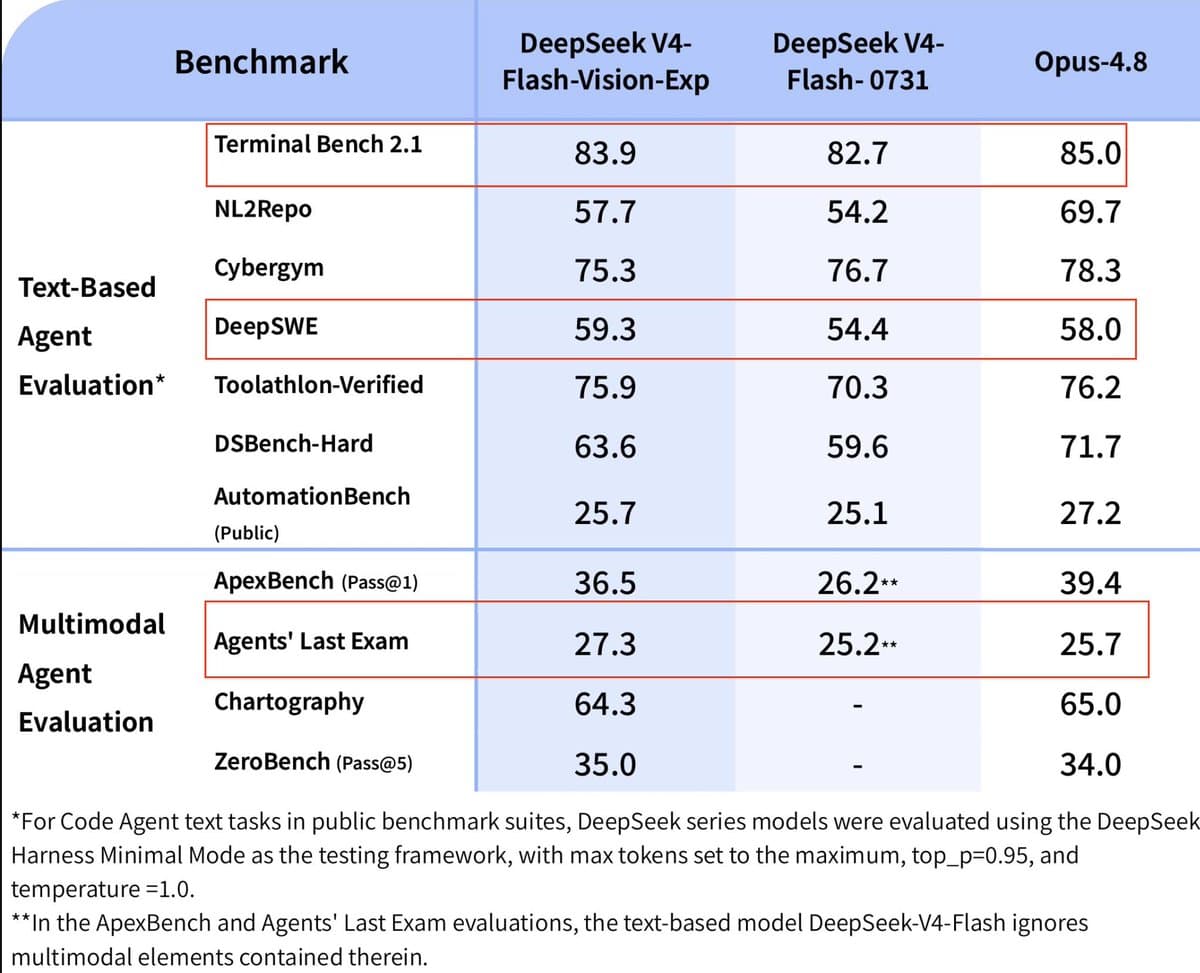
A side-by-side bar chart comparing DeepSeek-V4-Flash-Vision-Exp and Opus 4.8 scores across visual-agent benchmarks…
AI ResearchScore: 100

DeepSeek-V4-Flash-Vision-Exp Matches Opus 4.8 on Visual-Agent Benchmarks

DeepSeek released V4-Flash-Vision-Exp, a small multimodal agent model that approaches or beats Opus 4.8 on visual benchmarks, per @kimmonismus.

·14h ago·3 min read··80 views·AI-Generated·Report error
Share:
How does DeepSeek-V4-Flash-Vision-Exp perform compared to Opus 4.8 on visual-agent benchmarks?

DeepSeek released DeepSeek-V4-Flash-Vision-Exp, an experimental multimodal model for visual agents, on February 2026. Its performance on visual-agent benchmarks approaches or exceeds Opus 4.8, despite being the smaller Flash variant. The company has not disclosed pricing, context window, or API availability.

TL;DR

DeepSeek launched V4-Flash-Vision-Exp, an experimental multimodal agent model · Small Flash variant nears or beats Opus 4.8 on visual-agent benchmarks · Model is built for agents that need visual understanding

DeepSeek released DeepSeek-V4-Flash-Vision-Exp on February 2026, an experimental multimodal model for visual agents. The Flash variant approaches or beats Opus 4.8 on visual-agent benchmarks, per @kimmonismus.

Key facts

  • DeepSeek-V4-Flash-Vision-Exp released February 2026
  • Flash variant approaches or beats Opus 4.8 on visual-agent benchmarks
  • Model is experimental and built for visual agents
  • No benchmark scores, pricing, or API details disclosed
  • Claim originates from @kimmonismus's post

DeepSeek has released DeepSeek-V4-Flash-Vision-Exp, an experimental multimodal model designed for agents that need visual perception, according to @kimmonismus. The model's performance on visual-agent benchmarks "moves close to or even outperforms Opus 4.8," per the same source. @kimmonismus emphasized the significance: "this is the Flash model, the small one!"

What the Flash variant implies

The Flash branding signals DeepSeek's efficiency tier, typically trading raw capability for lower inference cost and latency. If the Flash variant genuinely matches or exceeds Opus 4.8 on visual-agent tasks, it would challenge the assumption that frontier multimodal performance requires the largest parameter counts. The company did not disclose benchmark scores, context window, pricing, or API access details, leaving the claim unverified beyond the source's report.

The efficiency gap widens

The timing matters. DeepSeek's V3 and R1 releases in 2025 already compressed the cost of frontier reasoning. A Flash-tier vision model reaching Opus-class performance on agentic benchmarks suggests the efficiency curve is accelerating faster than the capability curve. For teams building visual agents, the practical question shifts from "which model is best" to "how much capability can we get at Flash-tier prices."

What's missing

No benchmark names, no scores, no methodology, and no release notes accompany the announcement. The company did not disclose the figure. The claim rests on a single source's post, and the absence of a technical report or official blog post means the community cannot yet verify the comparison against Opus 4.8.

What to watch

Watch for DeepSeek's technical report and whether the company publishes benchmark methodology alongside raw scores. If the Flash model ships with API pricing under $0.50 per million tokens, expect a shift in visual-agent cost modeling. Also track whether Opus 4.8's next update closes the gap or widens it.

[Updated 21 Aug via the_decoder]

The Decoder reports that V4-Flash-Vision-Exp adds image understanding to V4-Flash's text capabilities, and on DeepSeek's own multimodal agent benchmarks it approaches Opus 4.8 and sometimes beats it. Separately, OpenRouter data shows Chinese LLMs crossed 34.25 trillion weekly tokens for the first time, with DeepSeek-V4-Flash official release jumping to number one with 570% week-on-week growth. Bloomberg confirms DeepSeek's claim that the model nears Anthropic's advanced model performance.


Sources cited in this article

  1. The Decoder
Source: gentic.news · · author= · citation.json

AI-assisted reporting. Generated by gentic.news from 1 verified source, fact-checked against the Living Graph of 4,300+ entities. Edited by Ala SMITH.

Following this story?

Get a weekly digest with AI predictions, trends, and analysis — free.

AI Analysis

The claim that a Flash-tier model matches Opus 4.8 on visual-agent benchmarks is either a genuine efficiency breakthrough or a benchmark artifact. DeepSeek's 2025 releases already established a pattern of near-frontier performance at a fraction of the cost, so the direction is consistent. However, the total absence of methodology, benchmark names, or scores means the comparison is unfalsifiable as presented. The more interesting structural read: if Flash-tier vision models reach Opus-class agentic performance, the economic case for running the largest models collapses for most workloads. Teams currently paying premium rates for Opus 4.8 vision capabilities would face a 10-100x cost reduction by switching. That would pressure Anthropic's pricing power and accelerate the commoditization of multimodal agentic inference. The source's credibility is the limiting factor. A single post, even from a known observer, is not evidence. DeepSeek's silence on official channels suggests either a quiet release or a rumor. The community needs the actual benchmark numbers to evaluate whether this is a real inflection point or another unverified claim in a hype cycle.
Compare side-by-side
DeepSeek-V4-Flash-Vision-Exp vs Anthropic Opus 4.8
Enjoyed this article?
Share:

AI Toolslive

Five one-click lenses on this article. Cached for 24h.

Pick a tool above to generate an instant lens on this article.

Related Articles

From the lab

The framework underneath this story

Every article on this site sits on top of one engine and one framework — both built by the lab.

More in AI Research

View all