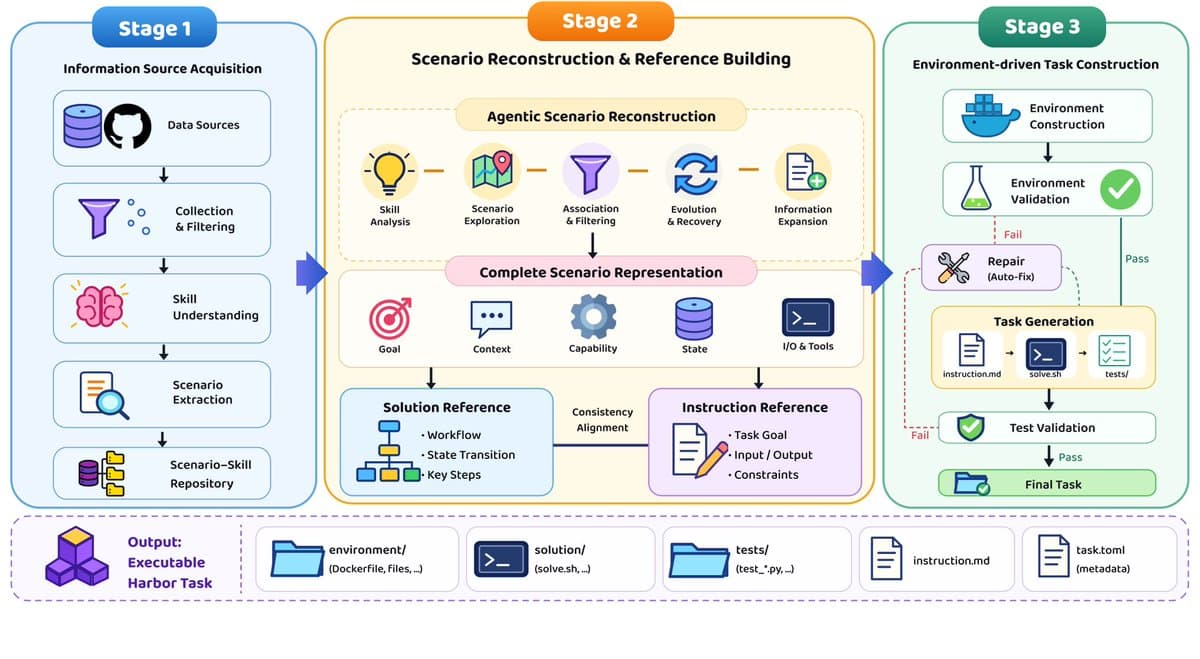
FACET introduces 6,078 executable terminal tasks, reconstructing scenarios by building the environment first. The dataset, shared via @HuggingPapers, aligns instruction, solution, and verifier to that state, improving Terminal-Bench 2.1 with 1.2K trajectories.
Key facts
- 6,078 validated terminal tasks with dense checks
- Fine-tuning with 1.2K trajectories improves Terminal-Bench 2.1
- Environment-first reconstruction aligns instruction, solution, verifier
- Source via @HuggingPapers on X
- Exact benchmark delta not disclosed
The FACET dataset addresses a persistent problem in agent training: terminal tasks that preserve intent and state. Instead of generating instructions in isolation, FACET reconstructs scenarios by building the environment first, then aligns the instruction, solution, and verifier to that reconstructed state. According to @HuggingPapers, this approach produces 6,078 validated tasks with dense checks, ensuring the evaluation is grounded in the actual terminal state rather than abstract expectations.
Why environment-first matters
The core innovation is the ordering of operations. Most synthetic task generators write an instruction and then attempt to verify a solution against a hypothetical state. FACET inverts this: it builds the environment first, then derives the instruction and solution from that concrete state. This avoids the common failure mode where a verifier checks for a solution that doesn't match the actual terminal output, a mismatch that inflates benchmark scores without improving real agent performance.
The practical payoff is measurable. Fine-tuning with just 1.2K trajectories from FACET improves performance on Terminal-Bench 2.1, a benchmark for terminal-based agents. The source does not disclose the exact score delta or the base model used, so the magnitude of the improvement remains unspecified. [The company did not disclose the figure.]
Dense checks and validation
FACET's 6,078 tasks each come with dense checks, meaning the verifier validates intermediate states, not just the final output. This is a stricter evaluation than typical end-state verification, catching agents that stumble through the wrong path but land on the correct final result. The dense checks also support more granular feedback during fine-tuning, which likely explains why a relatively small 1.2K trajectory set yields a benchmark improvement.
The approach is notable for its data efficiency. Most synthetic data efforts require tens of thousands of trajectories to move a benchmark needle. FACET's 1.2K figure suggests the quality of the reconstruction — preserving intent and state — matters more than raw volume. This is a contrarian data point in a field where scale is often treated as the primary lever.
Limitations
The source is a brief announcement, not a paper. It does not specify the agent skills used to generate the tasks, the base model for fine-tuning, or the exact Terminal-Bench 2.1 score. Whether the improvement generalizes to other benchmarks or production terminal agents is unverified. The dataset's release venue — via @HuggingPapers — suggests a formal paper and dataset are forthcoming, but the details remain pending.
What to watch
Watch for the full FACET paper and dataset release, which should disclose the base model, the skill taxonomy, and the exact Terminal-Bench 2.1 delta. The key question is whether the 1.2K trajectory efficiency holds across other agent benchmarks like SWE-Bench or WebArena, which would validate the environment-first reconstruction approach as a general training method rather than a one-off benchmark artifact.
Key Takeaways
- FACET builds 6,078 terminal tasks environment-first, aligning instruction, solution, verifier.
- Fine-tuning with 1.2K trajectories improves Terminal-Bench 2.1.