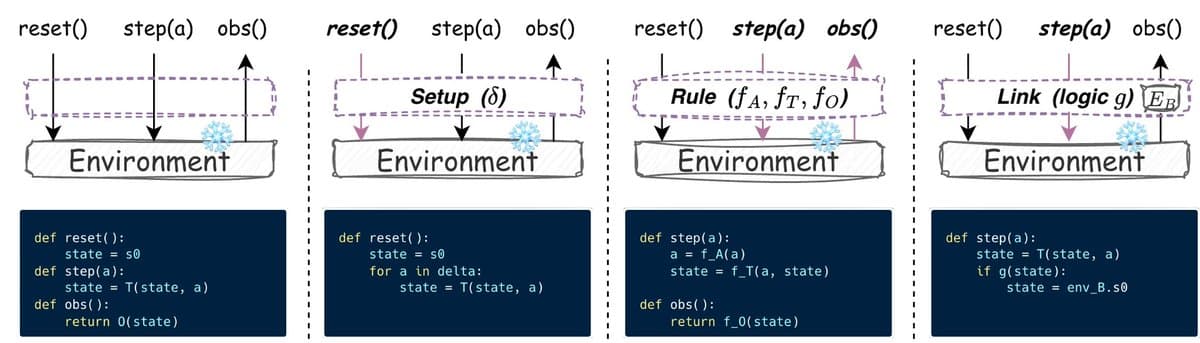
Google released EnvHarness, a programmable layer that turns static agent environments into adaptive ones, per @HuggingPapers. The system adds plug-in components (Setup, Rule, Link) without modifying original code, reporting up to +9 points on held-out tasks.
Key facts
- EnvHarness adds Setup, Rule, Link plug-in components
- Up to +9 points on held-out agent tasks
- No code modifications to original environment required
- Announced via @HuggingPapers on X
- No benchmark names or baselines disclosed
Google's EnvHarness, flagged by @HuggingPapers on X, introduces a programmable layer that converts static agent environments into adaptive ones. The design allows researchers to attach plug-in components—Setup, Rule, Link—without touching the underlying environment code. This addresses a structural weakness in current agent evaluation: static benchmarks reward memorization of fixed trajectories, not the adaptive behavior required for real-world deployment.
How the plug-in architecture changes evaluation
EnvHarness's core claim is that you can retrofit adaptivity onto existing environments. The Setup component initializes dynamic conditions, Rule injects constraints or changing objectives mid-trajectory, and Link connects across environment states or episodes. This is a meaningful departure from the standard practice of re-running agents on frozen Gym or BabyAI-style tasks. The reported gain of up to +9 points on held-out tasks suggests that agents trained or tuned with EnvHarness generalize better when the test distribution shifts. The source does not disclose which specific benchmarks or agent architectures were used, nor the compute cost of the tuning process.
The gap between benchmark scores and deployed agents
This release lands amid a broader critique of static evaluation. Recent lab findings have shown that agents overfit to the exact reward structure of their training environments, and that small perturbations to state transitions can collapse performance. EnvHarness's plug-in approach is a direct counter-move: by making the environment itself a variable, it forces the agent to learn policies robust to procedural changes. Whether the +9 point delta holds across diverse task families (navigation, tool use, multi-step reasoning) is unverified—the announcement provides no per-task breakdown, no baseline comparison, and no ablations of the three components in isolation. The company did not disclose the figure for the control condition, only the headline delta.
Why this matters more than the press release suggests
The structural significance is that EnvHarness treats the environment as a first-class programmable object, not a fixed test fixture. This aligns with a pattern across the past 90 days: several labs have moved from static suites (e.g., SWE-Bench, AgentBench) toward adversarial or self-generating evaluation. If EnvHarness gains traction, it could standardize how adaptive evaluation is conducted—but the lack of open-source code or a paper in the announcement leaves the reproducibility question open. The source is a single social post; no benchmark harness, no repository link, and no baseline numbers beyond the +9 delta are provided.
What to watch
Watch for the official Google release with code and a paper. If published, check whether the +9 delta replicates on SWE-Bench or AgentBench, and whether the Setup/Rule/Link components are independently ablated. A repository with a working harness would be the first concrete signal of real adoption.