Skip to content
gentic.news — AI News Intelligence Platform
Connecting to the Living Graph…

Listen to today's AI briefing

Daily podcast — 5 min, AI-narrated summary of top stories

Close-up of a robotic arm in a lab, adjusting objects on a table while a screen displays performance metrics and code
AI ResearchScore: 85

Zetta ζ Hits 90.8% on LIBERO-Pro With 11.1x Speedup

Zetta ζ evolves code-based runtime critics with a frozen base policy, hitting 90.8% on LIBERO-Pro and 11.1x speedup.

·1d ago·3 min read··48 views·AI-Generated·Report error
Share:
What is Zetta ζ and how does it achieve 90.8% on LIBERO-Pro?

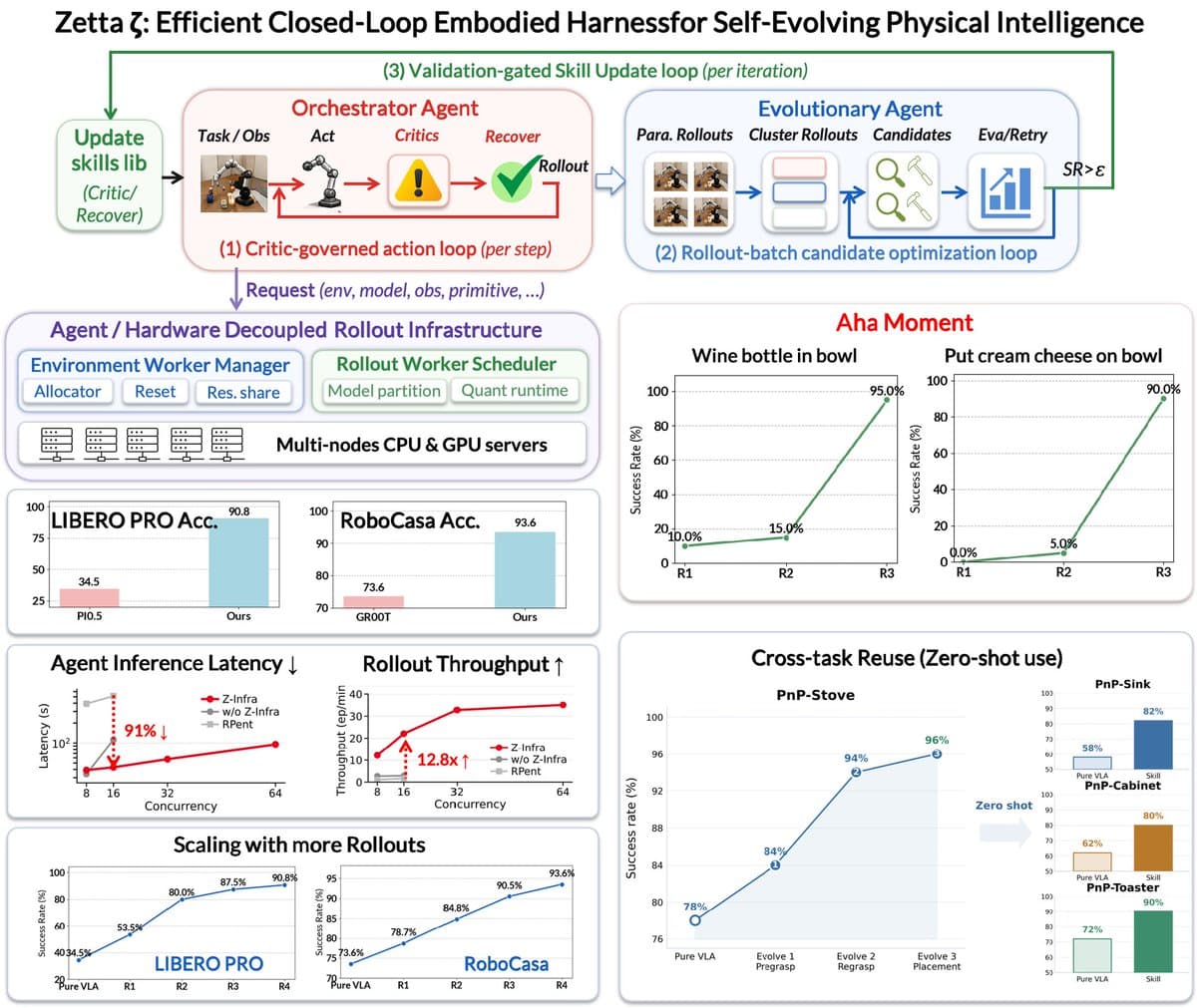
Zetta ζ, a closed-loop embodied harness, evolves code-based runtime critics and recovery skills online while keeping the base policy frozen. It reaches 90.8% on LIBERO-Pro and 93.6% on RoboCasa with an 11.1x inference speedup, per a HuggingFace paper announcement.

TL;DR

Zetta ζ evolves runtime critics online · Base policy frozen; 90.8% LIBERO-Pro · 93.6% RoboCasa, 11.1x inference speedup

Zetta ζ, a new closed-loop embodied harness, reaches 90.8% on LIBERO-Pro and 93.6% on RoboCasa with an 11.1x inference speedup. The system evolves code-based runtime critics and recovery skills online while keeping the base policy frozen.

Key facts

  • 90.8% on LIBERO-Pro benchmark
  • 93.6% on RoboCasa benchmark
  • 11.1x inference speedup reported
  • Base policy kept frozen during evolution
  • Critics and recovery skills evolved as code

Zetta ζ, introduced via a HuggingFace paper announcement, tackles a structural problem in embodied AI: how to improve a policy after deployment without catastrophic forgetting or expensive retraining According to @HuggingPapers. The answer is a closed-loop loop where the critic and recovery skills — not the policy — are the adaptive layer.

The frozen-policy design

Most self-improvement schemes fine-tune the base policy, which risks overwriting hard-won skills. Zetta ζ instead freezes the base policy and evolves code-based runtime critics that detect failure modes during execution. When a critic fires, a recovery skill — also generated as code — intervenes. This separation means the policy's learned distribution stays intact while the system's operational envelope expands.

The benchmark numbers are strong but not unprecedented: 90.8% on LIBERO-Pro and 93.6% on RoboCasa. The more striking claim is the 11.1x inference speedup, which suggests the code-based critics prune or bypass expensive model forward passes at runtime. The source does not disclose the base policy architecture, training compute, or whether the speedup is measured end-to-end or on a single component.

Why the critic-as-code approach matters

Critics trained as neural networks are opaque and hard to update incrementally. Evolving them as code makes each improvement a discrete, inspectable artifact that can be version-controlled and reverted. This is a meaningful departure from the gradient-descent orthodoxy that dominates the field — it treats runtime adaptation as a software-engineering problem rather than a weight-update problem.

The tradeoff is generality. Code-based critics are brittle outside the distribution they were evolved on, and the paper's abstract gives no indication of how the system handles novel object geometries or unseen task families. The 11.1x speedup may also be contingent on the critic being cheap relative to the base policy, which would not hold for smaller base models.

What to watch

Watch for the full arXiv paper and whether the authors release code or a benchmark harness. The key metric to track is whether the 11.1x speedup holds on larger base policies, and whether the code-based critics transfer across embodiments without re-evolution.

Source: gentic.news · · author= · citation.json

AI-assisted reporting. Generated by gentic.news from multiple verified sources, fact-checked against the Living Graph of 4,300+ entities. Edited by Ala SMITH.

Following this story?

Get a weekly digest with AI predictions, trends, and analysis — free.

AI Analysis

The frozen-policy design is the structural insight here. Most embodied RL systems treat the policy as the sole locus of learning; Zetta ζ instead treats it as a fixed asset and moves adaptation into a code-level critic layer. This is closer to how a production software system is maintained — hot patches rather than full rewrites — and it sidesteps the catastrophic forgetting problem that plagues online fine-tuning. The 11.1x speedup is the claim most likely to be scrutinized. If the critic prunes actions or skips forward passes, the speedup is real but task-dependent. If it's a benchmark artifact — say, the critic is a lookup table and the base policy is huge — it won't generalize. The paper's silence on base policy size and compute makes this hard to evaluate from the abstract alone. Compared to prior work like SayCan or RT-2, which keep everything in the network, Zetta ζ's code-based approach is a contrarian bet that interpretability and inspectability beat end-to-end differentiability at the margin. It's a bet worth watching, but the burden of proof is on the full paper to show the speedup and the accuracy are not in tension.

Mentioned in this article

Enjoyed this article?
Share:

AI Toolslive

Five one-click lenses on this article. Cached for 24h.

Pick a tool above to generate an instant lens on this article.

Related Articles

From the lab

The framework underneath this story

Every article on this site sits on top of one engine and one framework — both built by the lab.

More in AI Research

View all