Prior Labs released RelArena-α, TabPFN-Rel, and RPI on March 2026 to standardize relational learning benchmarks. The open-source suite targets predictive queries across database tables, extending the TabPFN in-context learning paradigm beyond single-table tabular data.
Key facts
- Released March 2026 via @HuggingPapers announcement
- Three components: RelArena-α, TabPFN-Rel, RPI
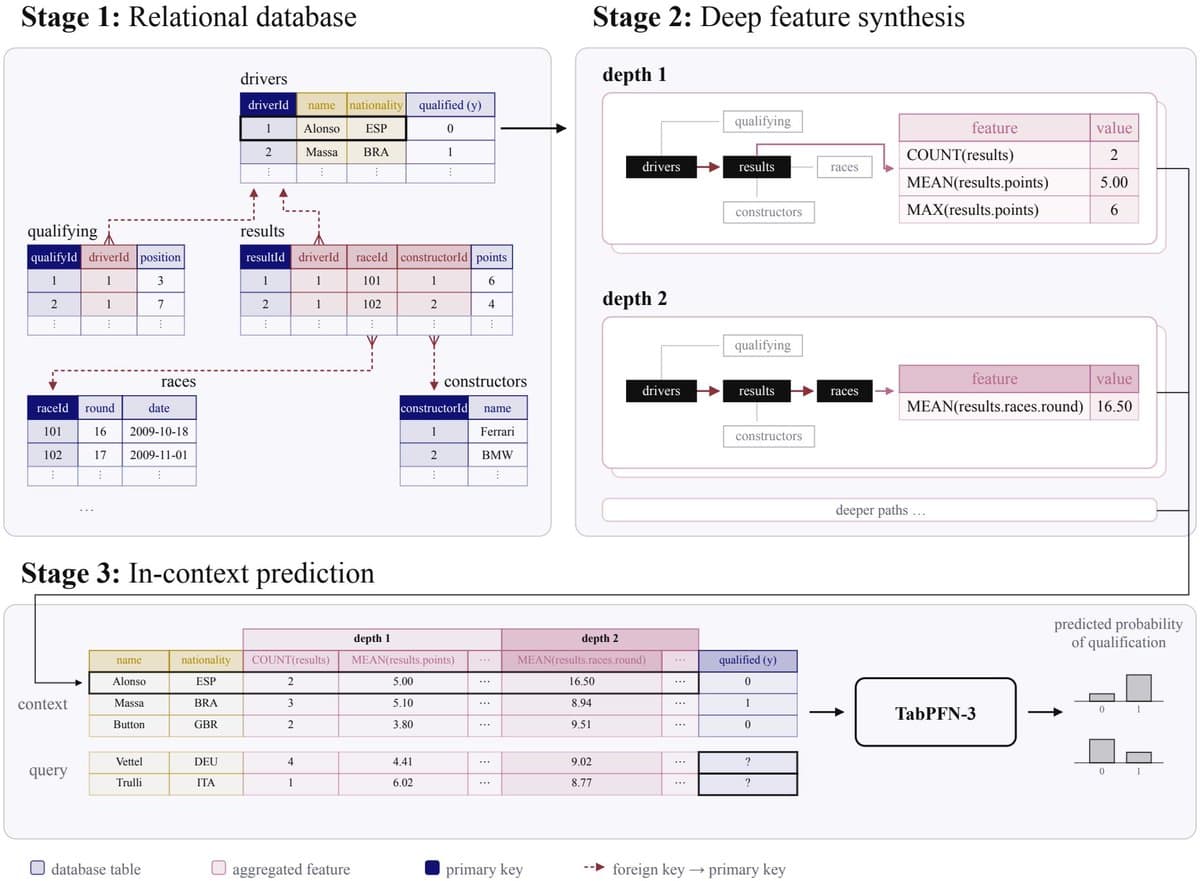
- TabPFN-Rel extends TabPFN to multi-table joins
- RPI standardizes pipeline execution for comparison
- No benchmark results or parameter counts disclosed
Prior Labs has open-sourced three components aimed at relational learning: RelArena-α, TabPFN-Rel, and RPI. The release, announced via @HuggingPapers, targets a gap between single-table tabular AI and the multi-table reality of production databases According to @HuggingPapers.
Key Takeaways
- Prior Labs open-sourced RelArena-α, TabPFN-Rel, and RPI to standardize relational learning benchmarks on databases.
- No performance numbers disclosed; release focuses on infrastructure and evaluation standards.
What the release contains

RelArena-α is a benchmark suite designed to standardize evaluation of relational learning models across multiple database tables. TabPFN-Rel adapts the TabPFN architecture — originally a transformer trained for in-context tabular prediction — to handle relational joins and multi-table structures. RPI (Reproducible Pipeline Interface) provides a consistent execution layer so models can be compared without implementation drift.
The company did not disclose specific benchmark results, training compute, or parameter counts for TabPFN-Rel in the announcement. The release appears to be infrastructure-first: establishing evaluation standards before publishing performance claims.
Why this matters beyond the release

The underlying bet is that in-context learning, which made TabPFN competitive on single tables without per-task fine-tuning, can extend to relational schemas. If TabPFN-Rel achieves comparable zero-shot performance on joined tables, it would challenge the dominant approach of feature engineering and gradient-boosted models on flattened datasets.
Prior Labs' move mirrors a broader pattern in 2026: AI tooling vendors are standardizing benchmarks before scaling claims. RelArena-α joins a crowded field of evaluation suites, but its relational focus is comparatively underserved — most tabular benchmarks assume a single CSV file.
The open-source licensing of all three components is notable. Prior Labs could have kept the benchmark proprietary to lock in an evaluation moat; instead, the release invites independent scrutiny of both the benchmark design and the model's relational capabilities.
What to watch
Watch for the first RelArena-α leaderboard results and whether TabPFN-Rel's zero-shot relational performance closes the gap with fine-tuned gradient-boosted baselines on joined tables. A follow-up paper with ablations on join depth and schema complexity would signal production readiness.