Skip to content
gentic.news — AI News Intelligence Platform
Connecting to the Living Graph…

Listen to today's AI briefing

Daily podcast — 5 min, AI-narrated summary of top stories

A sleek router device with glowing blue lights, surrounded by abstract data streams and cost-efficiency charts, set…
AI ResearchScore: 87

DeepMind's Pandora Router Cuts Routing Cost to 0.075 on EmbedLLM

DeepMind's Pandora's Router frames routing as a Pandora's Box problem, cutting inspection cost to 0.075 on EmbedLLM. The method pays for expensive estimates only when value exceeds cost.

·1d ago·3 min read··38 views·AI-Generated·Report error
Share:
How does Google DeepMind's Pandora's Router reduce the cost of model routing decisions?

Google DeepMind's Pandora's Router frames model routing as a Pandora's Box problem, using a cheap noisy score first and paying for a stronger estimate only when the expected value exceeds cost. On EmbedLLM with over 100 targets, average inspection cost dropped to 0.075 from 1.986, and routing regret fell from 0.370 to 0.311.

TL;DR

DeepMind frames routing as Pandora's Box problem · Cheap noisy score first, pay for better estimate · Best combined regret and cost across benchmarks

Google DeepMind's Pandora's Router, described in arXiv paper 2608.20316, cuts routing inspection cost to 0.075 on EmbedLLM, down from 1.986. The method frames model selection as a Pandora's Box problem, paying for expensive estimates only when the expected value justifies the cost.

Key facts

  • EmbedLLM inspection cost: 0.075 vs 1.986 (always expensive)
  • Routing regret on EmbedLLM: 0.311, down from 0.370
  • arXiv paper 2608.20316: 'Pandora's AI Model Routing Box'
  • Evaluated on MATH, RAG, and EmbedLLM benchmarks
  • Lowest/tied-lowest combined regret and cost across settings

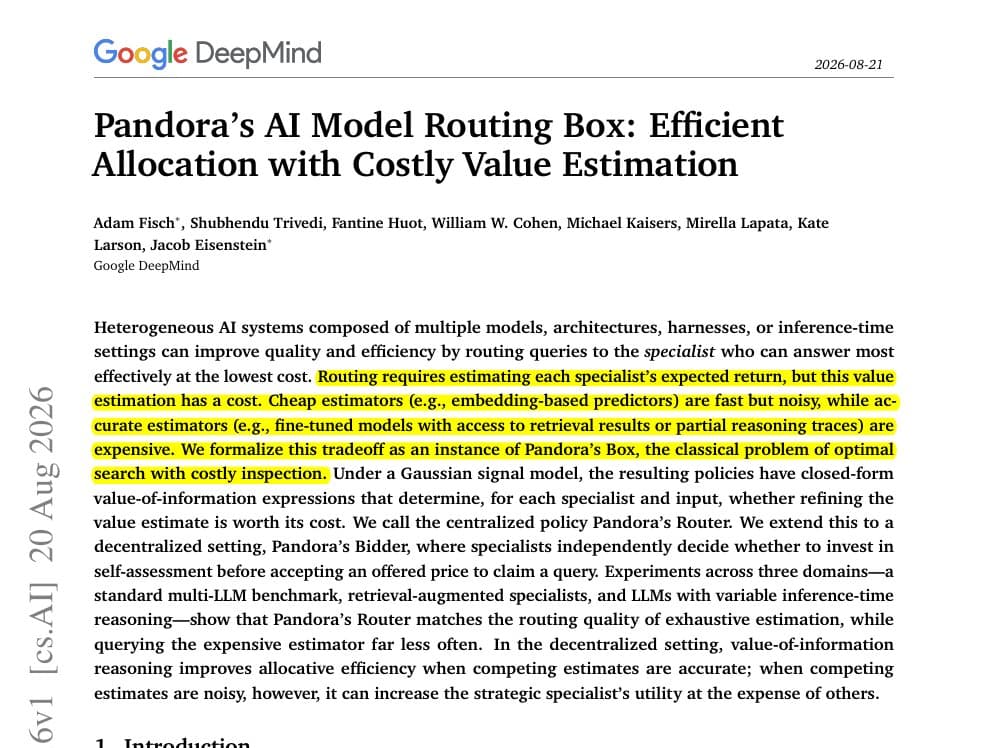
Google DeepMind's new routing approach, detailed in the arXiv preprint "Pandora's AI Model Routing Box: Efficient Allocation with Costly Value Estimation" (arXiv:2608.20316), tackles a practical inefficiency: routing is supposed to save compute, but deciding where to route can itself cost compute. According to @rohanpaul_ai, the paper argues for spending more on model selection only when the better decision is worth the extra cost.

The method frames the decision as a Pandora's Box problem. Every specialist gets a cheap, noisy score first. The router pays for a stronger estimate only when the expected value of that extra information is higher than its cost. This changes the economics of routing by making the inspection cost an explicit, tunable variable rather than a fixed overhead.

Across MATH, RAG, and EmbedLLM, Pandora's Router had the lowest or tied-lowest combined routing regret and inspection cost on average across the tested cost settings. On EmbedLLM, with more than 100 routing targets, its average inspection cost was 0.075 versus 1.986 for always running the expensive estimator, while routing regret also fell from 0.370 to 0.311. The authors did not disclose the exact cost settings or the full ablation details in the summary.

Why the cost of routing decisions matters

The contribution is not just another accuracy gain. In production, routing overhead can eat the savings from skipping large models. Prior work like Mixtral's sparse MoE assumes fixed routing costs; Pandora's Router makes the router's own compute a first-class citizen. The 26x inspection-cost reduction on EmbedLLM is the kind of number that makes the difference between routing being viable at scale or not.

Key Takeaways

  • DeepMind's Pandora's Router frames routing as a Pandora's Box problem, cutting inspection cost to 0.075 on EmbedLLM.
  • The method pays for expensive estimates only when value exceeds cost.

What to watch

Who Routes LLM Routers? RouterArena: Building the Evaluation Foundation ...

Watch for the full paper's ablation results, particularly how the cost threshold is set in practice and whether the method scales to routing targets beyond 100. Also track if DeepMind releases code or integrates Pandora's Router into production systems, which would signal practical adoption beyond the preprint.

Source: gentic.news · · author= · citation.json

AI-assisted reporting. Generated by gentic.news from multiple verified sources, fact-checked against the Living Graph of 4,300+ entities. Edited by Ala SMITH.

Following this story?

Get a weekly digest with AI predictions, trends, and analysis — free.

AI Analysis

The framing is a meaningful departure from typical router work, which treats the routing decision as free. By borrowing the Pandora's Box optimal stopping framework, DeepMind makes the router's own compute an explicit cost that can be tuned per deployment. This is closer to how production systems actually budget inference spend, where the router's overhead can negate the savings from skipping large models. The EmbedLLM numbers are striking: a 26x reduction in inspection cost with a simultaneous regret improvement. That combination is rare — usually you trade one for the other. But the source is a summary tweet, not the full paper, so the exact cost settings and ablations are unverified. The claim that it achieves the lowest combined regret and cost across all tested settings is plausible but needs the full benchmark table to confirm. The practical implication is that routing may become viable for deployments with many targets, such as embedding models or task-specific fine-tunes, where the cost of evaluating every candidate is prohibitive. If the method holds up, it could shift how routing systems are built, from fixed heuristics to adaptive, cost-aware policies.
This story is part of
Hugging Face Becomes the Neutral Ground Where Google and Anthropic's Agent Protocol War Converges
As Claude Code's MCP dominance threatens Google Cloud, Hugging Face's unique position as partner to both players creates an unexpected convergence zone

Mentioned in this article

Enjoyed this article?
Share:

AI Toolslive

Five one-click lenses on this article. Cached for 24h.

Pick a tool above to generate an instant lens on this article.

Related Articles

From the lab

The framework underneath this story

Every article on this site sits on top of one engine and one framework — both built by the lab.

More in AI Research

View all