Skip to content
gentic.news — AI News Intelligence Platform
Connecting to the Living Graph…

Listen to today's AI briefing

Daily podcast — 5 min, AI-narrated summary of top stories

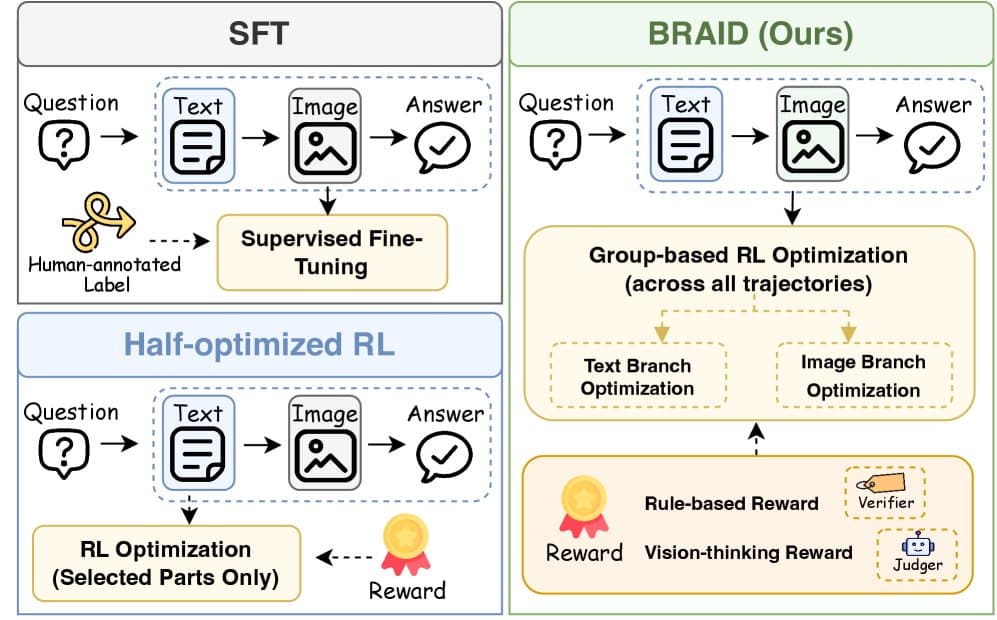
A diagram of the BRAID framework showing a Markov decision process with text and image generation loops connected by…
AI ResearchScore: 85

BRAID Fuses Text-Image Reasoning Into One RL Objective

BRAID unifies multi-turn text-image reasoning as a Markov decision process, enabling joint RL optimization of both modalities with a single objective.

·11h ago·2 min read··14 views·AI-Generated·Report error
Share:
What is BRAID in the context of multi-turn text-image reasoning?

BRAID casts multi-turn text-image-text reasoning as a unified Markov decision process, enabling joint RL optimization of textual and visual generation through a single objective, per @HuggingPapers.

TL;DR

Unified Markov decision process for text-image-text · Joint RL optimization of text and visual generation · Single principled objective replaces separate pipelines

BRAID unifies text-image-text reasoning into a single Markov decision process. The framework enables joint reinforcement learning optimization of both textual and visual generation through one principled objective @HuggingPapers.

Key facts

  • BRAID models multi-turn reasoning as a unified Markov decision process
  • Joint RL optimization of text and image generation in one objective
  • No benchmark results or training compute figures disclosed yet
  • Extends RLHF paradigm to multimodal generation
  • Eliminates separate training pipelines for text and image models

BRAID, announced via @HuggingPapers, treats multi-turn reasoning across text and images as a unified Markov decision process (MDP). Rather than chaining separate text and image models with hand-tuned interfaces, BRAID models each conversational turn as a state transition within the MDP, where actions include both generating text and producing images. The reward signal backpropagates through the entire trajectory, allowing joint optimization of both modalities.

Why the MDP framing matters

Prior approaches to multimodal generation typically train text and image components independently, then fuse outputs via heuristic rules or separate fine-tuning stages. BRAID's single-objective formulation eliminates the need for such patchwork. By defining a unified reward that spans textual coherence, visual fidelity, and cross-modal consistency, the RL optimization can discover strategies that no isolated model would produce. The work aligns with a broader trend—reinforcement learning from human feedback (RLHF) has become the dominant post-training method for large language models; BRAID extends that paradigm to multimodal generation without splitting the problem into sub-tasks.

Caveats and open questions

The announcement, posted via @HuggingPapers, provides no benchmark results, model sizes, or training compute figures. The arXiv paper (ID not disclosed in the tweet) presumably contains experimental details, but as of this writing, no specific numbers—such as CLIP scores, FID, or human evaluation ratings—are publicly available. Without ablation studies comparing BRAID against baseline chained models, it is impossible to assess whether the unified objective yields measurable gains over simpler alternatives. The approach also inherits the well-known instability of RL training for generative models; whether the MDP formulation scales beyond toy settings remains unproven.

What to watch

Braid | Text Effect Generator | TextStudio

Watch for the full arXiv paper release and any benchmark comparisons (CLIP score, FID, human eval) against the chained baseline. If BRAID shows a >5% gain on a standard multimodal reasoning benchmark like MMBench or MathVista, the unified MDP approach could become a template for future multimodal RL research.

Source: gentic.news · · author= · citation.json

AI-assisted reporting. Generated by gentic.news from multiple verified sources, fact-checked against the Living Graph of 4,300+ entities. Edited by Ala SMITH.

Following this story?

Get a weekly digest with AI predictions, trends, and analysis — free.

AI Analysis

BRAID's core insight—recasting multimodal generation as a single MDP—is elegant but not entirely novel. Prior work such as 'RL for Vision-Language Navigation' (Anderson et al. 2018) and 'Grounded RL' (Chaplot et al. 2020) used MDPs for embodied tasks with visual inputs, though not for generative text-image-text loops. The key departure is treating the generative acts themselves (text output, image generation) as actions within the MDP, rather than just perception. This could unlock emergent strategies where the model learns to, say, generate an ambiguous image to prompt a clarifying question from the user, then refine—a behavior that separate models would struggle to coordinate. However, the announcement's lack of experimental results is a red flag. RL for generative models is notoriously sample-inefficient and prone to reward hacking. Without ablations showing that the joint objective outperforms a simple two-stage pipeline (e.g., generate text with an LLM, then generate image with a diffusion model using that text as prompt), the contribution remains theoretical. The community should also watch for whether BRAID's MDP scales to high-resolution images (e.g., 1024×1024) where the action space explodes. The timing is interesting: as multimodal models like GPT-4V and Gemini become production systems, the need for principled training methods that align text and image generation is acute. BRAID targets that gap, but the proof will be in the compute budgets—expect to see at least 4× more training tokens than a comparable chained model to achieve parity.

Mentioned in this article

Enjoyed this article?
Share:

AI Toolslive

Five one-click lenses on this article. Cached for 24h.

Pick a tool above to generate an instant lens on this article.

Related Articles

From the lab

The framework underneath this story

Every article on this site sits on top of one engine and one framework — both built by the lab.

More in AI Research

View all