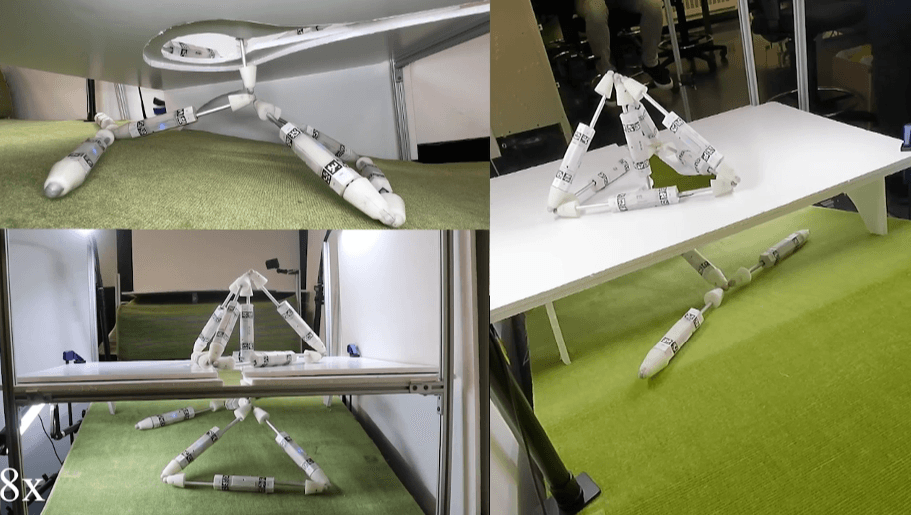
Researchers at Columbia University have demonstrated a novel robotic system called "Truss Links" capable of autonomous self-assembly and, strikingly, the disassembly of other robots to harvest their components for repair or growth. The work, highlighted in a social media post by AI observer Rohan Pandey, shows mobile units using magnetic connectors to form larger structures, then selectively decoupling to literally consume other robots for parts.
What the System Does
The Truss Links system consists of individual robotic modules that can move independently and connect to one another via magnetic interfaces. Once connected, they can form stable, larger structures—essentially self-assembling into a collective robot. The key advancement is the system's ability to then selectively disconnect these magnetic bonds, allowing it to disassemble other robotic structures or non-functional units and incorporate their components into itself.
This process enables two primary functions:
- Zero-waste repair: A damaged robot can harvest functional parts from a non-operational peer to restore its own functionality.
- Physical growth: A robot can increase its size and structural complexity by assimilating parts from other units, adapting its form to new tasks or environments.
Key Result: 66.5% Mobility Gain
The research quantified a core benefit of this approach. Through the process of cannibalizing parts for repair and optimized reassembly, the system demonstrated a 66.5% gain in mobility compared to its baseline, pre-adaptation state. This metric likely refers to the ability of a repaired or augmented robot to traverse terrain or overcome obstacles more effectively than a damaged or simpler counterpart.
How It Works: Magnetic Connectors + Selective Decoupling
The technical enabler is a combination of reversible magnetic connectors and a control system that manages "selective decoupling."
- Magnetic Connectors: Provide a strong, reliable physical bond between modules without complex mechanical latches, allowing for rapid connection and release.
- Selective Decoupling: The robot's software decides which bonds to break and when, enabling it to dismantle a target structure in a controlled manner to extract specific components. This turns other robots into a source of spare parts or building materials.
This creates a form of physical metabolism for robots—ingesting material from the environment (other robots) to sustain and enhance itself.
Potential Applications: Thriving Where Humans Can't
The researchers position this as a blueprint for robots designed for extreme environments where human intervention for repair or retrieval is impossible or prohibitively expensive. Potential domains include:
- Deep-sea exploration: Robotic collectives could repair themselves on the ocean floor.
- Space missions: Swarms of robots on distant planets or moons could repurpose damaged units to extend mission lifespans.
- Disaster zones: Search-and-rescue robots in collapsed structures could adapt their form by scavenging from irreparably damaged teammates.
The concept moves beyond traditional modular robotics—where modules are designed to be interchangeable—into a realm of competitive or sacrificial resource gathering within a robotic population.
gentic.news Analysis
This work from Columbia sits at a compelling intersection of several accelerating trends in robotics research: modular self-assembly, swarm intelligence, and resource-aware autonomy. The reported 66.5% mobility gain is a significant quantitative justification for a behavior that seems almost biological in its ruthlessness.
Technically, the shift from cooperative assembly to selective disassembly for part harvesting is a notable step. Most modular robotic systems, like those from the University of Pennsylvania's MODLAB or earlier MIT M-Blocks, focus on collaboration and reconfiguration within a single collective. Columbia's Truss Links introduce an intra-swarm resource competition layer, creating a ecosystem-like dynamic. This aligns with a broader research direction towards creating more resilient and persistent autonomous systems, a theme we've seen in DARPA's ANTS program concepts and in work on robotic "survival" in unstructured environments.
For practitioners, the immediate implication is in control and ethics architecture. Deploying systems capable of cannibalizing peers requires robust fault identification and rules of engagement to prevent destructive cascades. The long-term vision, however, is profound: truly long-lived robotic systems that can maintain themselves in the field indefinitely by treating their surroundings—including other robots—as a renewable parts depot. This moves us closer to the sci-fi concept of self-sustaining machines, though substantial challenges in energy autonomy and component degradation remain.
Frequently Asked Questions
What are Truss Links robots?
Truss Links are a modular robotic system developed at Columbia University where individual units can connect via magnetic interfaces to form larger structures. Their defining feature is the ability to selectively disassemble other robots to scavenge parts for self-repair or physical growth.
How does a robot "eat" another robot for parts?
The process uses "selective decoupling" of magnetic connectors. A functional robot identifies a target (often a damaged or simpler unit), maneuvers to it, and systematically breaks the magnetic bonds holding the target together. It then extracts specific components—like structural segments or actuators—and reattaches them to itself using its own magnetic connectors.
What does a 66.5% mobility gain mean?
This metric, reported by the researchers, quantifies the improvement in a robot's ability to move after it has repaired or augmented itself using scavenged parts. A robot that has cannibalized components from others became 66.5% more effective at locomotion (likely measured by speed, obstacle negotiation, or terrain traversal) compared to its original or damaged state.
Where would self-cannibalizing robots be used?
The primary application is in extreme, inaccessible environments where human repair is impossible. This includes deep-space missions (e.g., on Mars), deep-sea infrastructure maintenance, nuclear decommissioning sites, or disaster zones like collapsed mines or buildings, where robots must be fully self-sufficient for long durations.