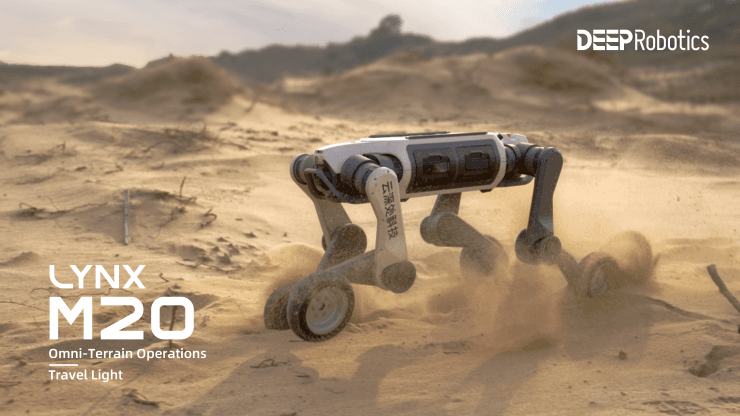
Chinese robotics company DEEP Robotics has deployed its Lynx M20 wheeled-legged quadruped robot in a pilot application with e-commerce and logistics giant JD Logistics. According to a social media post by AI researcher Rohan Paul, the robot is being used as a "Cyber Tea Farmer," suggesting a mobile platform application likely involving transport or monitoring tasks.
The Lynx M20 is a hybrid robot that combines quadrupedal legs with wheels at the ends of its limbs. This design aims to provide the stability and rough-terrain capability of legged locomotion with the efficiency and speed of wheeled movement on flat surfaces.
What Happened
DEEP Robotics has deployed at least one Lynx M20 unit with JD Logistics in what appears to be a field test or pilot program. The "Cyber Tea Farmer" designation suggests the robot is being used in an agricultural or goods transport context, possibly within JD's extensive logistics network that handles agricultural products.
The social media post indicates the deployment is underway but provides limited technical details about the specific tasks, duration, or performance metrics of the pilot.
Technical Context: The Lynx M20 Platform
The Lynx M20 represents DEEP Robotics' approach to hybrid locomotion. Key technical features include:
- Hybrid Locomotion: Four limbs ending in wheels that can function as both legs for stepping over obstacles and wheels for efficient rolling movement
- Payload Capacity: The platform is designed to carry significant payloads, making it suitable for logistics applications
- Autonomous Operation: Like most modern quadruped platforms, the Lynx M20 is designed for autonomous or semi-autonomous operation
- All-Terrain Capability: The combination of legs and wheels theoretically allows operation across varied surfaces from indoor floors to outdoor rough terrain
Market and Application Context
This deployment represents a practical field test of wheeled-legged robotics technology in a commercial logistics setting. JD Logistics operates one of China's most extensive supply chain networks, making it an ideal testing ground for robotic systems that could eventually automate portions of warehouse operations, inventory management, or intra-facility transport.
The "tea farmer" application suggests the robot might be tested in agricultural product handling or monitoring, which aligns with JD's business in fresh food logistics and agricultural supply chains.
Limitations and Unknowns
The announcement lacks critical details that would allow for proper technical assessment:
- No performance metrics or reliability data from the deployment
- No information on autonomy level or specific tasks performed
- No comparison to alternative solutions (traditional AGVs, legged robots without wheels, or human workers)
- No scale information (single unit test or larger deployment)
- No duration or success criteria for the pilot
gentic.news Analysis
This deployment represents another data point in the ongoing commercialization of legged robotics beyond research labs and controlled demonstrations. The partnership between DEEP Robotics and JD Logistics follows a pattern we've observed throughout 2025-2026, where Chinese robotics companies are aggressively pursuing real-world deployments with major commercial partners.
What's particularly interesting here is the choice of a wheeled-legged hybrid design rather than a pure quadruped. This suggests DEEP Robotics is prioritizing practical efficiency over biological fidelity—the Lynx M20 appears optimized for environments where it will spend most of its time on flat surfaces but needs occasional legged capability for curbs, stairs, or uneven sections. This is a pragmatic engineering choice that contrasts with Boston Dynamics' more biologically-inspired approaches.
The JD Logistics partnership is significant given JD's scale and technological ambition. As we covered in our February 2026 analysis of warehouse automation trends, JD has been testing various robotic solutions across its fulfillment network. This Lynx M20 deployment appears to be testing whether hybrid locomotion offers advantages over traditional automated guided vehicles (AGVs) or human-operated equipment in specific niche applications.
However, without performance data, it's impossible to assess whether this represents a meaningful advancement or simply another field test in the crowded legged robotics space. The true test will be whether this pilot leads to scaled deployment or remains a one-off demonstration.
Frequently Asked Questions
What is the Lynx M20 robot?
The Lynx M20 is a wheeled-legged quadruped robot developed by Chinese company DEEP Robotics. It features four limbs that end in wheels, allowing it to switch between walking like a quadruped and rolling like a wheeled vehicle depending on the terrain and task requirements.
What does 'Cyber Tea Farmer' mean in this context?
The "Cyber Tea Farmer" designation appears to be a project name or application concept for how JD Logistics is testing the Lynx M20 robot. It likely refers to using the robot as a mobile platform for tasks related to tea agriculture or tea product logistics, such as transport, monitoring, or inventory management within JD's supply chain.
How does wheeled-legged hybrid locomotion work?
Wheeled-legged hybrids like the Lynx M20 have wheels attached to the ends of their limbs. On flat surfaces, they can roll on these wheels for efficient, fast movement. When encountering obstacles, stairs, or rough terrain, they can lift their limbs and walk like traditional quadrupeds. This aims to combine the efficiency of wheels with the adaptability of legs.
Is this a commercial deployment or just a test?
Based on available information, this appears to be a pilot program or field test rather than a full commercial deployment. Such tests allow companies like JD Logistics to evaluate new robotic technologies in real-world conditions before making larger investment decisions.