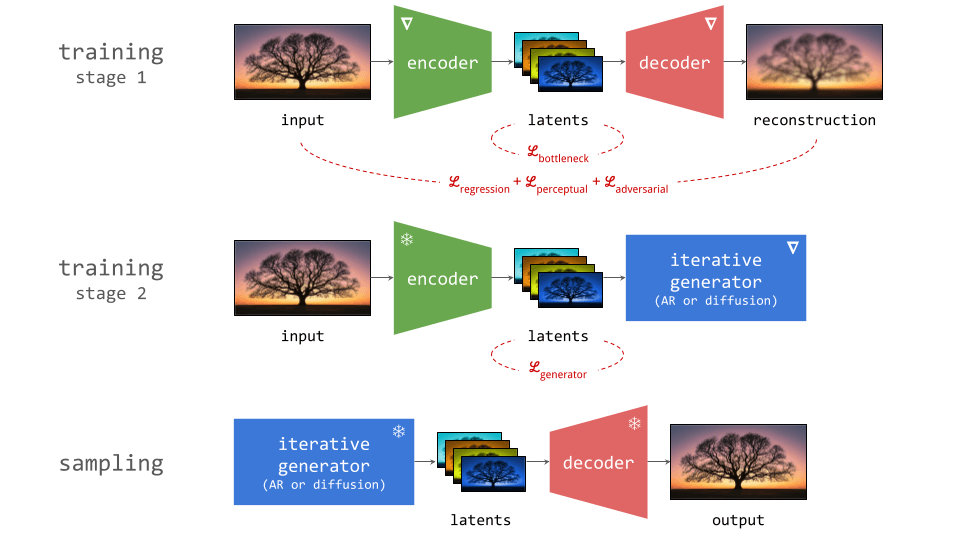
Google DeepMind has unveiled significant research advancements in the training methodology for diffusion models, the powerful class of generative AI systems behind tools like DALL-E, Stable Diffusion, and Midjourney. While the full paper details remain to be published, early indications suggest the research focuses on optimizing how these models learn and utilize latent representations—the compressed, meaningful versions of data that serve as the foundation for AI generation processes.
Understanding Diffusion Models and Their Limitations
Diffusion models have revolutionized generative AI by progressively adding noise to data (the forward process) and then learning to reverse this process to generate new samples from pure noise. This approach has produced stunning results in image generation, audio synthesis, and even molecular design. However, these models face significant challenges: they're computationally expensive to train, often requiring massive datasets and substantial processing power, and their quality can be inconsistent depending on how they learn to represent data in their latent spaces.
The latent space—where data is represented in compressed, meaningful form—is crucial to diffusion model performance. How models organize and navigate this space determines everything from generation quality to the ability to perform controlled edits. Current approaches often result in suboptimal latent representations that limit efficiency and quality.
DeepMind's Training Innovations
While specific architectural details await the full paper release, DeepMind's research appears to address core training challenges through novel approaches to latent representation learning. The work likely explores:
Improved Latent Initialization: How diffusion models begin their training process significantly impacts final performance. Better initialization strategies could lead to faster convergence and more stable training.
Optimized Noise Schedules: The pattern of noise addition during training affects how well models learn to reverse the diffusion process. More intelligent scheduling could improve generation quality.
Enhanced Representation Learning: Techniques that help diffusion models learn more meaningful, disentangled latent representations—where different dimensions correspond to interpretable features like object shape, color, or texture.
Training Efficiency Methods: Approaches that reduce the computational burden of training diffusion models without sacrificing quality, potentially through better utilization of latent spaces.
Implications for AI Development
This research has far-reaching implications across multiple domains:
Creative Industries: More efficient diffusion models could lower the barrier to high-quality AI generation, enabling smaller studios and individual creators to leverage cutting-edge tools. Improved latent representations might also enable finer control over generated content, allowing for more precise artistic direction.
Scientific Research: In fields like drug discovery and materials science, where diffusion models are used to generate molecular structures, better latent representations could lead to more accurate and diverse candidate generation, accelerating research timelines.
Media Production: Enhanced diffusion models could improve video generation, special effects, and audio synthesis, potentially reducing production costs while increasing creative possibilities.
Model Accessibility: More efficient training could make state-of-the-art diffusion models accessible to researchers and developers with limited computational resources, democratizing AI development.
The Competitive Landscape
DeepMind's entry into diffusion model optimization represents a significant move in the competitive AI research landscape. While companies like OpenAI, Stability AI, and Anthropic have driven recent diffusion model advancements, DeepMind brings substantial expertise in reinforcement learning and optimization techniques that could yield unique approaches to improving these systems.
This research direction aligns with DeepMind's broader strategy of advancing fundamental AI capabilities while improving efficiency—a pattern seen in their work on AlphaFold for protein folding and their contributions to reinforcement learning.
Future Directions and Open Questions
As the full research becomes available, several questions will be important to address:
- How do these improvements scale across different data modalities (images, audio, video, 3D)?
- What are the trade-offs between training efficiency and generation quality?
- Can these techniques be combined with other recent advances like latent consistency models or flow matching?
- How do improved latent representations affect controllability and interpretability of generated content?
Conclusion
Google DeepMind's work on training better latents for diffusion models represents an important step toward more efficient, capable, and accessible generative AI systems. By addressing fundamental challenges in how these models learn representations, the research could unlock new capabilities while reducing computational costs—a crucial consideration as AI systems grow increasingly sophisticated.
As the AI community awaits the full paper, this development signals continued rapid advancement in generative AI, with implications spanning creative arts, scientific research, and technological innovation. The focus on improving foundational training processes rather than simply scaling model size reflects a maturing approach to AI development that prioritizes both capability and efficiency.
Source: Twitter discussion by Omar Sar (@omarsar0) referencing upcoming Google DeepMind research.