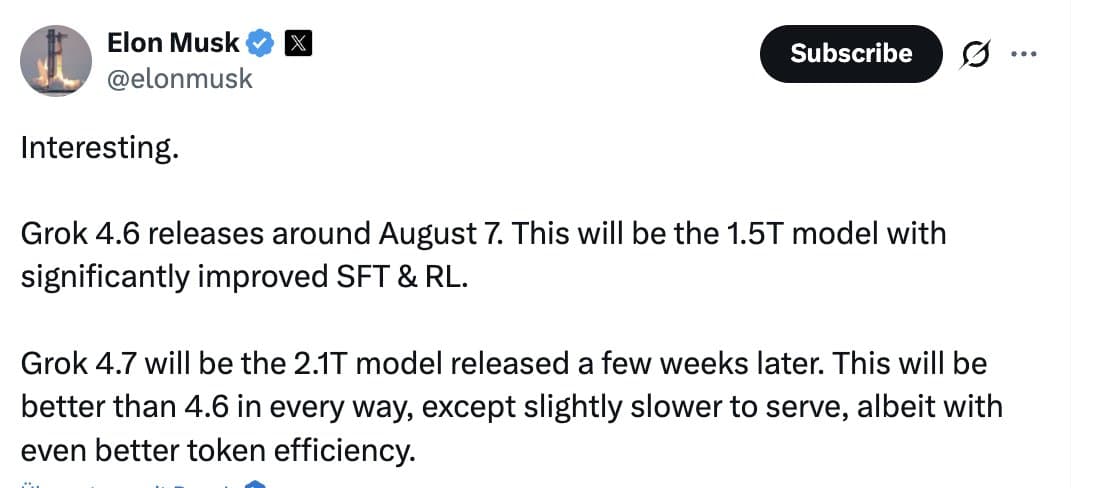
Elon Musk has reiterated a core argument for large-scale battery deployment, stating that energy storage could allow the United States to extract twice as much energy from its existing grid infrastructure. The claim centers on utilizing batteries to bridge the gap between peak and average power demand.
What Musk Said
In a recent post, Musk provided the underlying numbers: the peak power output of the US grid is approximately 1.1 Terawatts (TW), while the average power consumption is about 0.5 TW. This creates a significant utilization gap. His proposed solution is straightforward: charge grid-scale batteries during off-peak hours (like at night) when demand and wholesale electricity prices are low, and discharge them during peak daytime hours when demand strains the system.
“So charge the batteries at night, and discharge during day,” Musk summarized.
This is not a new concept—it's the fundamental value proposition of arbitrage for grid-scale storage. However, Musk's prominence and Tesla's direct involvement in the battery and utility space through its Megapack product give the statement practical weight. The assertion implies that widespread storage deployment could effectively raise the average power delivered by the grid closer to its peak capacity, dramatically improving asset utilization without building new power plants or transmission lines.
The Technical and Economic Rationale
The logic is rooted in load balancing. Electrical grids must be built to handle the absolute highest predicted demand (peak load), but that maximum capacity sits idle for much of the day. This is inefficient and expensive. Batteries act as a buffer:
- Smoothing the Duck Curve: In grids with high solar penetration, net demand plummets during midday (when solar produces) and then spikes sharply in the evening as the sun sets and people return home—a pattern called the "duck curve." Batteries can store excess solar generation from the afternoon and release it during the evening ramp, flattening the curve.
- Deferring Grid Upgrades: By providing localized power during peak times, batteries can postpone or eliminate the need for costly upgrades to transformers and distribution lines.
- Integrating Renewables: Solar and wind are intermittent. Large-scale storage is widely seen as essential for making them reliable primary power sources, capturing energy when it's generated and delivering it when it's needed.
Musk's 2x figure is a high-level illustration of the potential. In practice, the achievable increase depends on battery cost, cycle life, local grid constraints, and market structures. The core message is that storage transforms the grid from a just-in-time delivery system into a time-shifted one, unlocking latent capacity.
gentic.news Analysis
Musk's comment is a succinct public-facing summary of the business case Tesla Energy has been making for years. It directly aligns with Tesla's strategy to scale its Megapack utility-scale battery business. This isn't just theoretical; Tesla's Megapack deployments, like the 360 MWh project in Hawaii or the massive 730 MWh system in California, are physical implementations of this exact thesis—storing renewable energy to replace fossil-fuel "peaker" plants.
The statement also intersects with a major trend we've been tracking: the convergence of AI and energy infrastructure. As we covered in [Article on AI-Optimized Grid Management], advanced forecasting algorithms and AI-driven control systems are becoming critical for optimizing the charge/discharge cycles of these vast battery fleets, maximizing their economic value and grid stability benefits. Musk's simple "charge at night, discharge by day" rule is the baseline; the next layer of value is using AI to make millisecond-by-millisecond decisions based on price signals, weather forecasts, and grid health.
Furthermore, this vision faces competition. While Tesla is a leader in integrated battery systems, other players like Fluence (a Siemens & AES joint venture), CATL, and LG Energy Solution are aggressively pursuing the same global grid storage market. The key differentiator may increasingly be software—the AI and grid service algorithms—that sits on top of the battery hardware, a space where Tesla aims to maintain an edge.
Ultimately, Musk is reframing the energy debate. The challenge isn't just generating enough clean energy; it's building the "shock absorbers" for the grid to use it efficiently. His 2x claim highlights that the potential efficiency gain from storage is so large it fundamentally changes the economics of the energy transition.
Frequently Asked Questions
How would batteries double grid output?
They wouldn't double the instantaneous peak power output (still ~1.1 TW). Instead, they would allow the grid to deliver a higher average power over time by storing energy during low-demand periods and releasing it during high-demand periods. This more fully utilizes the existing wires and generation capacity, effectively delivering more total energy (TWh) from the same infrastructure.
Is Tesla the only company working on this?
No. Tesla is a major player through its Megapack, but the grid-scale battery storage market includes strong competitors like Fluence, CATL, LG Energy Solution, and others. The underlying technology (lithium-ion batteries) is commoditizing, making the system integration, software, and financing capabilities key competitive factors.
What are the main barriers to this happening?
The primary barriers are cost and supply chain. While battery prices have fallen dramatically, multi-gigawatt-hour projects still require billions in capital. Supply chains for lithium, cobalt, and other materials need to scale. Additionally, regulatory and market rules in many regions have not fully evolved to compensate storage for all the grid services (energy arbitrage, frequency regulation, capacity) it can provide.
Does this apply to homes with Powerwalls?
The same principle applies at a smaller scale. Homeowners can charge their Powerwalls from solar or off-peak grid power and use that energy during expensive peak hours, reducing their bill and taking pressure off the local grid. However, Musk's 2x comment is specifically about the macro-scale effect of massive, utility-owned battery installations on the entire national grid's efficiency.