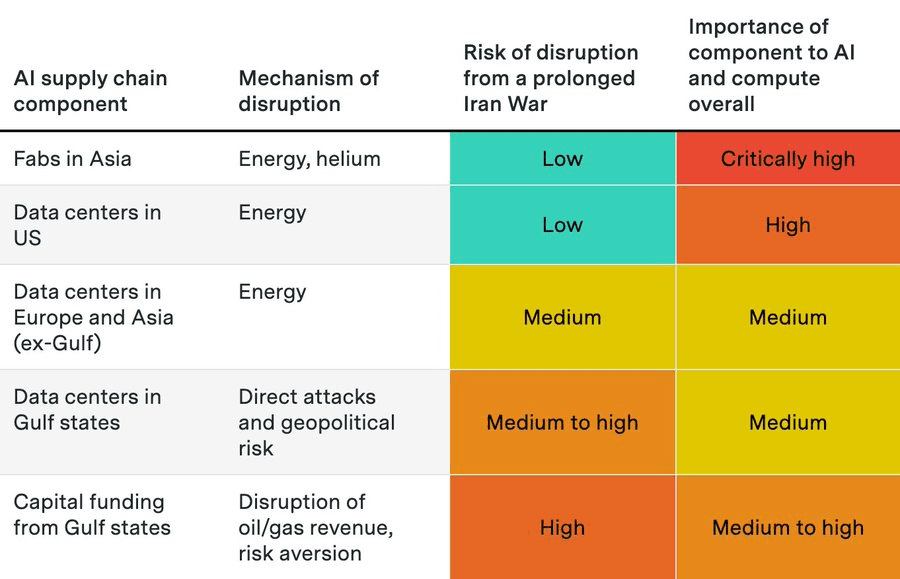
A new analysis from Epoch AI Research, highlighted by AI researcher @kimmonismus, examines the potential impact of the Iran conflict on global AI development. The core finding is counterintuitive: while the conflict has disrupted key energy supplies, the immediate, direct impact on AI compute and data centers may be limited. The more significant, longer-term risk lies in the geopolitical chilling of the massive Gulf investment flows that have become a primary fuel for AI infrastructure expansion.
The Immediate Shock: Energy & Materials
The analysis notes that a shutdown of the Strait of Hormuz—a critical global chokepoint—would affect approximately 20% of global liquefied natural gas (LNG) supplies and about one-third of the global helium supply. Both are critical industrial inputs; helium is essential for cooling in advanced semiconductor fabrication.
However, the report argues that the extraordinarily high profit margins in leading-edge chip manufacturing (fabs) allow these facilities to absorb even massive spikes in energy and material costs. The analysis further states that US data centers are "insulated from the energy shock entirely," likely due to domestic energy sources and long-term contracts.
The Real Risk: Gulf Capital Flight
The more profound threat identified is not physical supply chains but financial ones. The analysis points to two converging risks:
- Dropping Oil Revenue: Conflict and instability can suppress oil prices or disrupt exports, reducing the sovereign wealth fund capital available for overseas investment.
- Rising Geopolitical Risk: Gulf investors may become more risk-averse, pulling back from large, long-term, high-profile foreign technology projects perceived as exposed to geopolitical volatility.
This directly threatens the funding model for next-generation AI infrastructure. A prime example cited is "Stargate UAE," a rumored multi-billion-dollar, U.S.-UAE joint venture AI supercluster project. Such megaprojects rely heavily on patient capital from Gulf sovereign wealth funds like Mubadala (UAE) and the Public Investment Fund (Saudi Arabia).
Bottom Line: Marginal Slowdown vs. Existential Derailment
The report's conclusion is that a prolonged but contained conflict in the region would likely "slow the buildout at the margins but won't derail it." Existing projects and operational infrastructure have sufficient buffers. The existential danger to the AI buildout would come from a dramatic escalation of the war, which could trigger a full-scale retreat of Gulf capital and severe physical disruption to global trade routes.
gentic.news Analysis
This Epoch AI analysis provides a crucial, capital-centric lens on AI geopolitics that often focuses solely on compute or talent. It validates a trend we've been tracking: the deepening financial symbiosis between Silicon Valley's AI ambitions and Gulf sovereign wealth. Our previous coverage of Microsoft's $1.5 billion investment in G42, with its intricate U.S. oversight requirements, highlighted the delicate political balancing act already in play. The Hormuz conflict injects a massive new variable into this equation.
The report's focus on "Stargate UAE" as a bellwether is astute. While never officially confirmed, persistent reports from The Information and others describe a $100 billion-scale project between Microsoft and OpenAI, potentially funded by UAE capital. If this project is real, its fate would be the clearest signal of whether Gulf investment remains "patient" or is becoming "panicked." This analysis from Epoch AI—a research organization known for its work on AI compute trends—shifts the risk conversation from FLOPs and watts to dollars and sovereign risk, a necessary evolution for the industry.
Frequently Asked Questions
How could a war in the Middle East affect AI development in the US?
The primary effect would be indirect, through financial channels rather than immediate hardware shortages. A significant portion of capital funding massive AI data center builds and startup scaling comes from Gulf sovereign wealth funds (e.g., Saudi Arabia's PIF, UAE's Mubadala). Regional conflict threatens oil revenues and increases perceived risk, potentially causing this capital to dry up or retreat, slowing down the pace of new AI infrastructure investment in the US and elsewhere.
Why are chipmakers able to absorb huge energy cost spikes?
Leading-edge semiconductor fabrication is one of the most capital-intensive and profitable industrial processes globally. The profit margins on advanced chips (e.g., for AI accelerators) are exceptionally high. This provides a large financial buffer that allows companies like TSMC, Samsung, or Intel to pay significantly more for critical inputs like energy and specialty gases (e.g., helium) without threatening the viability of production, at least in the short to medium term.
What is "Stargate UAE" and why is it mentioned?
"Stargate UAE" is the rumored codename for a hypothesized, next-generation AI supercluster project. Reports suggest it could be a $100 billion joint venture involving Microsoft, OpenAI, and UAE-based investors. It is cited in the analysis as a canonical example of the type of ultra-large-scale, Gulf-funded AI infrastructure project that would be most vulnerable to a pullback in investment due to geopolitical risk stemming from regional conflict.
Are US AI data centers really immune to global energy price shocks?
According to the Epoch AI analysis, US data centers are largely insulated. This is likely due to a combination of factors: a diversified domestic energy grid (natural gas, renewables, nuclear), long-term fixed-price power purchase agreements (PPAs) with utilities, and geographic location away from the immediate supply disruption. They are not completely immune, but their exposure is mitigated compared to industries reliant on just-in-time global LNG shipments.