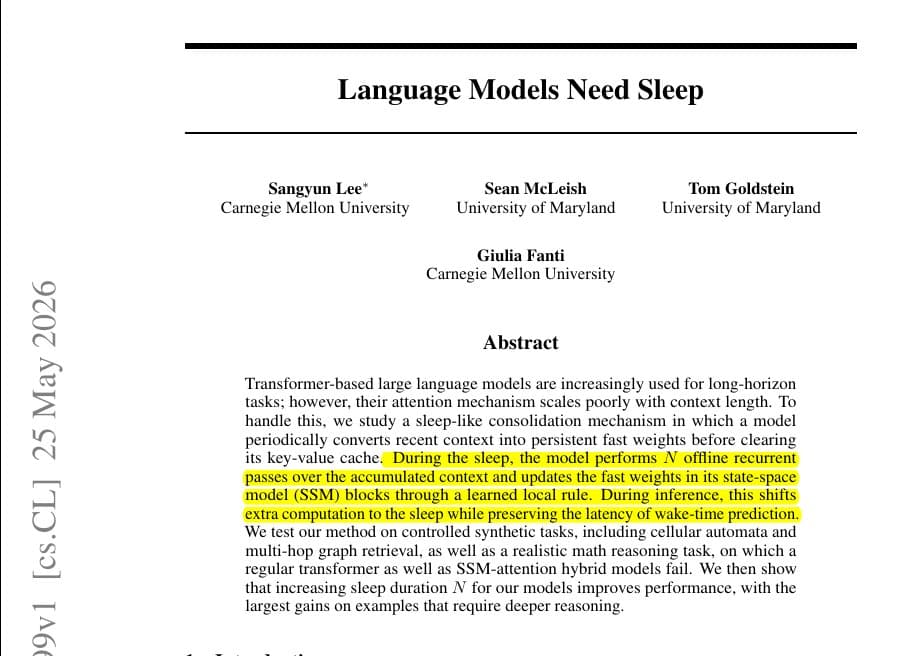
A new arXiv paper proposes adding a sleep phase to language models. The technique pauses inference, consolidates recent context into fixed-size memory layers, and clears the attention cache, reducing quadratic cost.
Key facts
- Paper title: 'Language Models Need Sleep' (arXiv 2605.26099).
- Tested on cellular automata, graph lookup, GSM-Infinite.
- Sleep runs offline passes over recent context.
- Writes results into fast weights in state-space blocks.
- Longer sleep improves performance on hard reasoning tasks.
The problem with today's transformer agents is well-known: as context grows, attention's O(n²) complexity makes inference slower and more expensive. The usual fix — keeping more tokens nearby — turns every next-token prediction into a larger search through the past [According to @rohanpaul_ai].
Now a paper titled "Language Models Need Sleep" (arXiv 2605.26099) proposes a sharper idea: memory is not only storage. Sometimes the hard part is converting a messy stretch of experience into a state that can actually be used later. So the paper's idea is to add a sleep phase, where the model pauses, rereads recent context several times, writes the useful information into fixed-size memory layers, and then clears the short-term attention cache.
During sleep, the model runs several offline passes over recent context, writes the result into fast weights inside its state-space blocks, then clears the attention cache. This means the model pays extra compute while sleeping, not while answering, so normal prediction can still happen with 1 forward pass.
The authors test this on cellular automata, graph lookup, and GSM-Infinite math problems, where the model must use old information that is no longer sitting in its attention cache. The main result is that longer sleep improves performance, especially on harder cases that need deeper reasoning rather than just remembering a fact.
The big deal is that long-horizon agents may not need to carry bigger and bigger raw context forever, because they can consolidate the important parts and safely forget the raw tokens. This directly challenges the current trend of scaling context windows to millions of tokens — a strategy that carries steep inference costs.
The unique take: The paper reframes the long-context problem from a capacity issue to a consolidation issue. Instead of expanding context windows (the GPT-4-128K approach), the sleep phase compresses experience into a fixed-size latent state, analogous to how biological brains consolidate short-term memories into long-term storage during sleep.
What to watch

Watch for follow-up work testing the sleep phase on real-world agent benchmarks like SWE-Bench or WebArena, and whether any inference provider (Anthropic, OpenAI, Google) adopts a similar consolidation step in their long-context products.