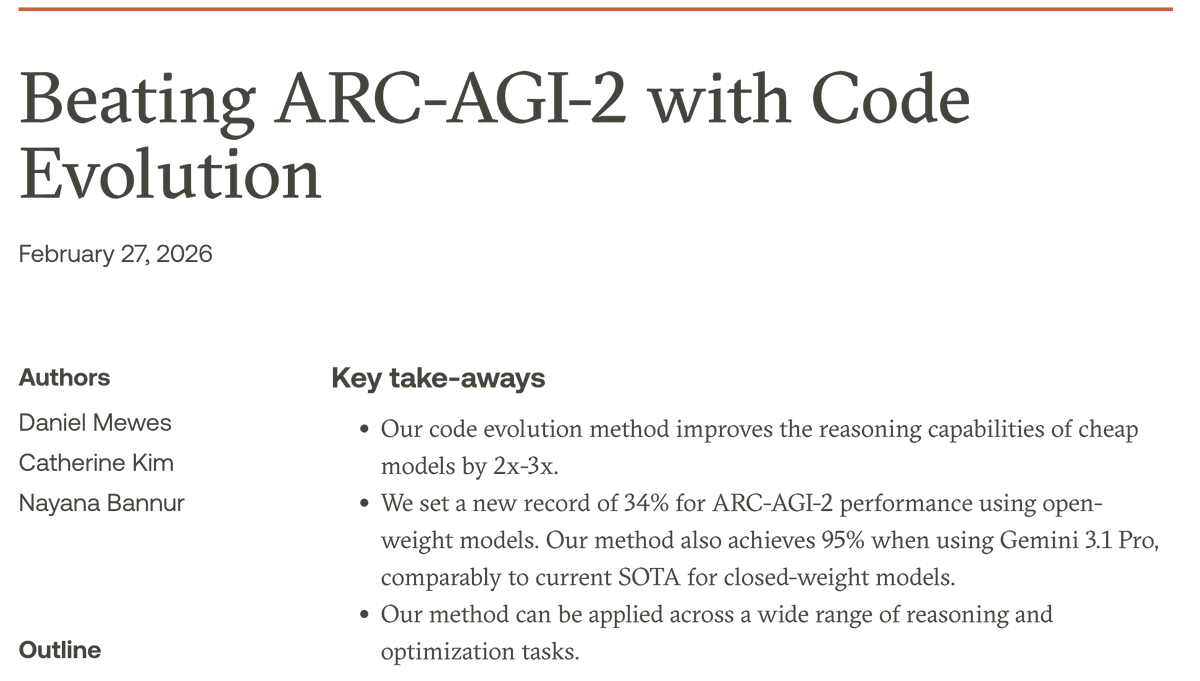
In a significant development for artificial intelligence optimization, AI research company Imbue has open-sourced Evolver—a tool that applies evolutionary algorithms powered by large language models to automatically improve code and prompts. The system has demonstrated remarkable capabilities, achieving 95% accuracy on the challenging ARC-AGI-2 benchmark, a performance level that researchers compare to what might be expected from a hypothetical GPT-5.2 model.
How Evolutionary AI Works
Evolver operates on principles inspired by biological evolution but enhanced with artificial intelligence. The system requires three components: starting code or a prompt, a scoring mechanism to evaluate results, and an LLM capable of suggesting improvements. Unlike traditional evolutionary algorithms that rely on random mutations, Evolver employs LLMs to propose targeted fixes based on observed failures.
"Evolver works like natural selection for code," explains the announcement from Imbue. "You give it three things: starting code or prompt, a way to score results, and an LLM that suggests improvements. Then it runs in a loop. It picks high-scoring solutions, mutates them, tests the mutations, and keeps what works."
The key innovation lies in how the system learns from failure. When a solution fails on specific inputs, the LLM analyzes those failures and suggests modifications to address them. While most suggestions prove ineffective, the occasional successful mutation becomes the foundation for subsequent generations of improvements.
Technical Innovations and Efficiency Gains
Evolver incorporates several sophisticated optimizations that distinguish it from simpler evolutionary approaches:
Batch mutations allow the system to address multiple failures simultaneously rather than iterating through problems one at a time. Learning logs enable discoveries made in one evolutionary branch to inform improvements in others, creating a form of cross-pollination between solution paths. Perhaps most significantly, post-mutation filters screen out unpromising mutations before they undergo costly scoring processes.
"The verification step alone cuts costs 10x," notes the announcement, highlighting the economic advantage of this approach over brute-force testing of every mutation.
Applications Beyond Traditional Optimization
The versatility of Evolver stems from its minimal requirements: any problem where LLMs can comprehend the code and where outputs can be scored becomes a candidate for optimization. This opens up numerous applications:
- Agentic workflows: Complex multi-step processes involving multiple AI agents can be systematically improved
- Prompt templates: The perennial challenge of prompt engineering becomes automated through evolutionary refinement
- Code performance: Existing codebases can be optimized for speed, memory usage, or other metrics
- Reasoning chains: Logical sequences and decision-making processes can be refined for accuracy and efficiency
Perhaps most remarkably, this optimization occurs without traditional machine learning techniques. "No gradient descent needed. No differentiable functions required," emphasizes the announcement, highlighting how Evolver bypasses some of the most computationally expensive aspects of conventional AI improvement.
Benchmark Performance and Implications
The 95% score on ARC-AGI-2 (Abstraction and Reasoning Corpus for AGI) represents a breakthrough in automated reasoning. This benchmark, designed to test abstract reasoning capabilities similar to human intelligence, has proven challenging for even advanced AI systems. Achieving near-perfect performance through evolutionary optimization rather than massive model training suggests new pathways toward artificial general intelligence.
This performance level, described as "GPT-5.2-level" by researchers, indicates that sophisticated optimization of existing models may yield capabilities previously thought to require next-generation architectures. The implication is profound: we may be able to extract significantly more capability from current AI models than previously realized through intelligent optimization techniques.
The Future of AI Development
Evolver's open-source release democratizes access to advanced AI optimization techniques that were previously confined to well-resourced research organizations. By making this technology publicly available, Imbue enables broader experimentation with evolutionary approaches to AI improvement.
The system represents a shift toward what might be called "meta-optimization"—using AI to improve AI systems themselves. This recursive improvement loop, where each generation of AI helps create better versions of itself, accelerates progress while potentially reducing computational costs compared to training ever-larger models from scratch.
As AI systems become increasingly complex, tools like Evolver that can automatically refine and optimize these systems will become essential components of the AI development toolkit. The combination of evolutionary algorithms with large language models creates a powerful synergy that may define the next phase of artificial intelligence advancement.
Source: Imbue announcement via @LiorOnAI on X