In the rapidly evolving landscape of artificial intelligence, one of the most persistent challenges has been designing effective agent skills. As AI researcher Omar Sar noted in his recent analysis, "Most agent skills I see today are hand-crafted or poorly designed by an agent." This manual approach to skill development has created a bottleneck in AI advancement—until now.
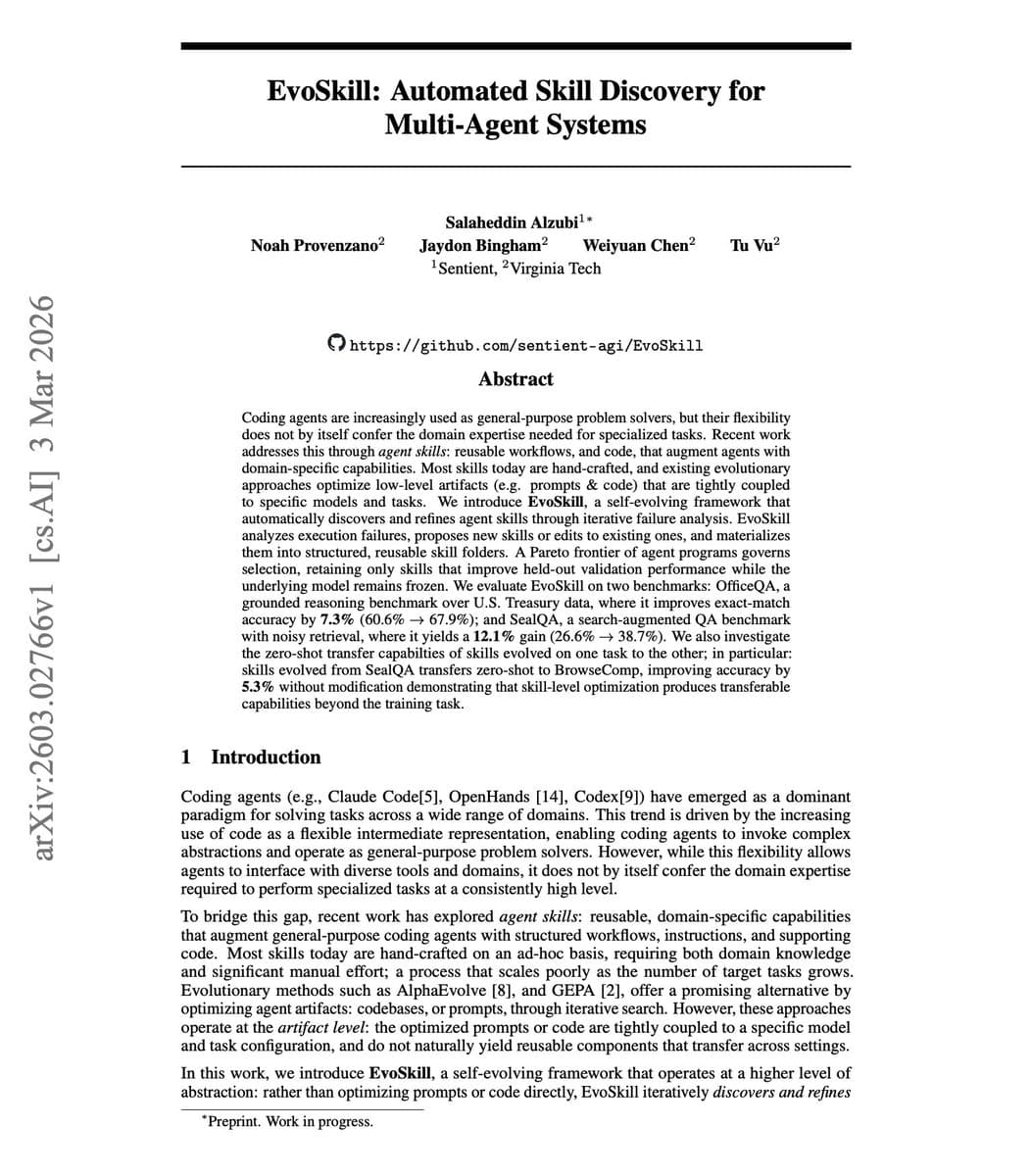
A groundbreaking paper introduces EvoSkill, a self-evolving framework that represents a paradigm shift in how AI agents develop capabilities. Rather than relying on human engineers to meticulously craft each skill, EvoSkill enables agents to automatically discover and refine their own skills through an intelligent process of iterative failure analysis.
How EvoSkill Works: A Three-Agent Collaboration
At the heart of EvoSkill lies a sophisticated multi-agent system where three specialized AI agents collaborate to drive the entire skill evolution process:
The Executor runs tasks and identifies where failures occur during execution. This agent serves as the frontline tester, attempting to complete assigned tasks and documenting exactly where and how they fall short.
The Proposer analyzes these execution failures and diagnoses the root causes. Based on this analysis, it proposes either entirely new skills or specific edits to existing ones that would address the identified shortcomings.
The Skill-Builder takes these proposals and materializes them into structured, reusable skill folders. These aren't just theoretical improvements—they become concrete, implementable capabilities that the agent can immediately deploy.
What makes this system particularly elegant is its governance mechanism. A Pareto frontier approach governs skill selection, ensuring that only skills that demonstrably improve performance on held-out validation tasks are retained. Crucially, this improvement happens while keeping the underlying model frozen—meaning the gains come from better skill architecture, not from simply scaling up the model itself.
Measurable Performance Improvements
The effectiveness of EvoSkill isn't merely theoretical. In rigorous testing, the framework has delivered substantial performance gains across multiple challenging benchmarks:
On OfficeQA, a complex question-answering dataset, EvoSkill improved Claude Code with Opus 4.5 from 60.6% to 67.9% exact-match accuracy—a significant 7.3 percentage point improvement.
On SealQA, the gains were even more impressive, with EvoSkill yielding a 12.1% improvement in accuracy. Perhaps most remarkably, skills evolved specifically on SealQA demonstrated zero-shot transfer capability to BrowseComp, improving accuracy by 5.3% without any modification or additional training.
This transfer learning capability suggests that EvoSkill isn't just creating narrow, task-specific skills, but rather developing fundamental capabilities that generalize across domains—a holy grail in AI research.
The Significance of Self-Evolving Systems
EvoSkill represents more than just another incremental improvement in agent performance. It points toward a future where AI systems can continuously improve themselves without constant human intervention. As Sar notes, "I will continue to track this line of research closely. I think it's really important."
The framework addresses several critical limitations in current AI development:
- Scalability: Hand-crafting skills doesn't scale as AI systems tackle increasingly complex domains.
- Adaptability: Static skill sets struggle in dynamic environments where requirements constantly evolve.
- Generalization: Skills developed in isolation often fail to transfer to related but distinct tasks.
By creating a closed-loop system where agents learn from their own failures, EvoSkill mimics a fundamental aspect of biological learning while operating at digital speeds.
Implications for AI Development
The emergence of self-evolving frameworks like EvoSkill has profound implications for how we build and deploy AI systems:
Reduced Development Costs: Automating skill discovery could dramatically reduce the engineering hours required to develop capable AI agents.
Continuous Improvement: Deployed systems could continue to refine their capabilities based on real-world performance rather than remaining static after release.
Democratization: Smaller teams with limited resources could potentially develop sophisticated AI systems by leveraging self-evolving frameworks rather than needing extensive manual engineering.
Safety Considerations: While promising, self-evolving systems also raise important questions about oversight and control. How do we ensure that autonomously developed skills align with human values and safety requirements?
The Road Ahead
As multi-agent systems for building skills continue to show promise, frameworks like EvoSkill are likely to become increasingly sophisticated. Future iterations might incorporate more sophisticated failure analysis, better skill composition mechanisms, and more efficient validation processes.
The research community is already exploring how similar principles might apply beyond discrete skill development to broader capability acquisition, potentially leading to AI systems that can fundamentally redesign their own architectures based on performance feedback.
For now, EvoSkill stands as a compelling proof concept: AI agents don't need to wait for humans to teach them everything. Given the right framework, they can start teaching themselves.
Source: Research paper on EvoSkill framework as analyzed by Omar Sar (@omarsar0)