Key Takeaways
- Excalidraw, a free, open-source collaborative whiteboard, is used by Google Cloud and Meta.
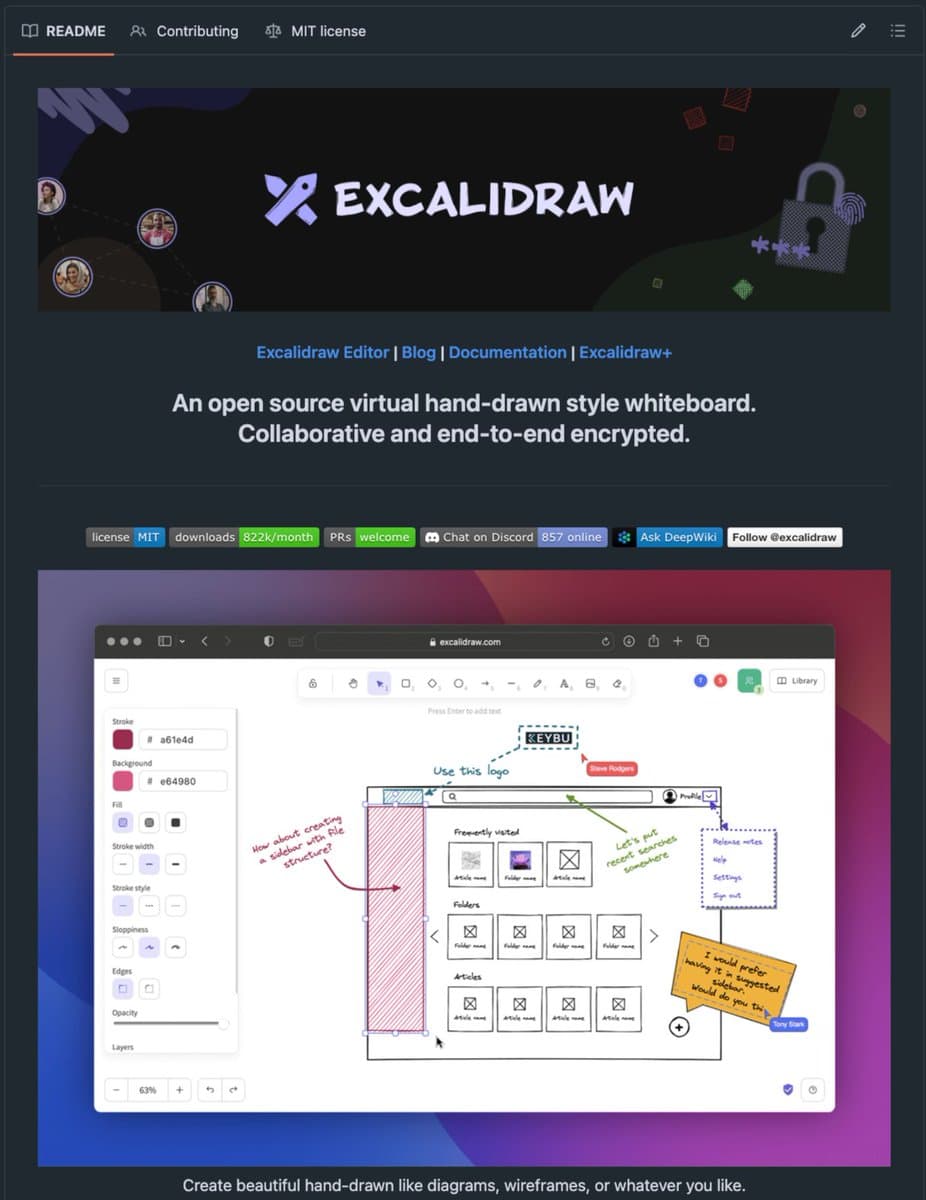
- It offers real-time collaboration, end-to-end encryption, and an infinite canvas with no account required.
What Happened

A viral post by developer Nav Toor highlights Excalidraw, a free, open-source collaborative whiteboard tool, as a direct alternative to paid platforms like Miro, Lucidchart, and Microsoft Visio. The tool has amassed over 110,000 stars on GitHub and is reportedly used internally by major tech companies including Google Cloud, Meta, Notion, Obsidian, HackerRank, Replit, and CodeSandbox.
The core argument is that Excalidraw eliminates the friction of enterprise whiteboard software: no accounts, no sign-ups, no downloads, and no board limits. Meetings can start instantly by sharing a single link.
What Excalidraw Does
Excalidraw is a web-based, local-first drawing application. Its key features, as outlined in the source, are:
- Zero-Friction Access: Works entirely in the browser. No user account is required to create or join a board.
- Hand-Drawn Aesthetic: All elements have a sketch-like, "human" appearance, intended to make complex diagrams feel approachable.
- Real-Time Collaboration: Multiple users can draw on the same infinite canvas simultaneously.
- Privacy-First & Offline: Drawings are end-to-end encrypted and are saved locally to your browser by default. It functions as a Progressive Web App (PWA) with full offline support.
- Open Source & Free: The project is under the MIT license with 346 contributors. There are no paid tiers, watermarks, or feature locks.
- Export & Embed: Can export to PNG or SVG and is embeddable as a React component.
The Cost Comparison
The post provides a stark cost comparison for a 20-person team:
Miro Business $16 $3,840 Lucidchart Team $9 $2,160 Microsoft Visio Plan 2 $15 $3,600 Excalidraw $0 $0The adoption by large tech companies suggests the tool is sufficiently robust for professional diagramming, wireframing, and system architecture design, despite being free.
Context

Excalidraw represents the "local-first" software movement, where applications prioritize user privacy and data ownership by storing information on the user's device rather than a central server. Its success challenges the prevailing SaaS model where collaboration features are typically gated behind user accounts and paid subscriptions. The fact that companies like Notion have chosen to embed Excalidraw directly into their product rather than build a proprietary tool or license a commercial one is a significant endorsement of its quality and viability.
gentic.news Analysis
This is less a story about a new AI development and more a case study in open-source tooling disrupting established SaaS markets, which has profound implications for how AI-powered features might be integrated and monetized in the future. Excalidraw's adoption by tech giants validates a growing trend: enterprises are increasingly willing to build core product features on top of mature, community-driven open-source projects rather than expensive enterprise licenses. This mirrors the pattern in AI/ML, where frameworks like PyTorch and Transformers have become foundational.
The local-first, end-to-end encrypted architecture of Excalidraw is particularly relevant for AI. As AI assistants move toward on-device inference for privacy and latency reasons, the principles behind Excalidraw's design—functioning fully offline with local data—are the same principles guiding the next generation of private AI copilots. If a collaborative whiteboard can be built this way, so too can AI-augmented design and diagramming tools.
Furthermore, this highlights a competitive pressure point for AI-native startups. If a free, open-source tool can capture the diagramming use case inside companies like Google and Meta, it raises the bar for what a paid AI diagramming tool must deliver. The value add must be substantial, moving beyond basic collaboration to genuine AI-augmented creation, analysis, or code generation from diagrams. The benchmark for a "good enough" free tool is now remarkably high.
Frequently Asked Questions
Is Excalidraw really free for commercial use?
Yes. Excalidraw is released under the permissive MIT license, which allows for unrestricted use, modification, and distribution, including for commercial purposes. There are no hidden fees or required enterprise agreements.
How does Excalidraw make money if it's free?
Excalidraw does not appear to have a direct monetization strategy. It is a community-driven open-source project. Its value to large adopters like Google and Meta may be indirect, such as reducing software licensing costs or serving as a component they can embed and customize. The project likely benefits from contributions from these large companies' developers.
How do you save and share drawings in Excalidraw?
By default, drawings are saved automatically to your browser's local storage. To share a drawing, you export it as a PNG/SVG file or, for real-time collaboration, generate a shareable link. The link creates a peer-to-peer or server-assisted session; the drawing data itself is encrypted.
What are the main limitations compared to Miro or Lucidchart?
The primary limitations are likely in enterprise-grade features: formal user management, advanced admin controls, detailed audit logs, dedicated enterprise support, and deep integrations with specific corporate identity and project management systems. Excalidraw excels at the core task of drawing and collaborating but may lack the bureaucratic layers large organizations sometimes require.