March 2026 — Enterprise adoption of AI agents faces a critical reliability gap: a March 2026 industry report revealed 86% of AI agent pilots fail to reach production due to hallucination, domain drift, and compliance failures. A new research paper, published on arXiv on April 1, 2026, proposes a concrete architectural solution—ontology-constrained neural reasoning—that demonstrates statistically significant improvements across key enterprise metrics.
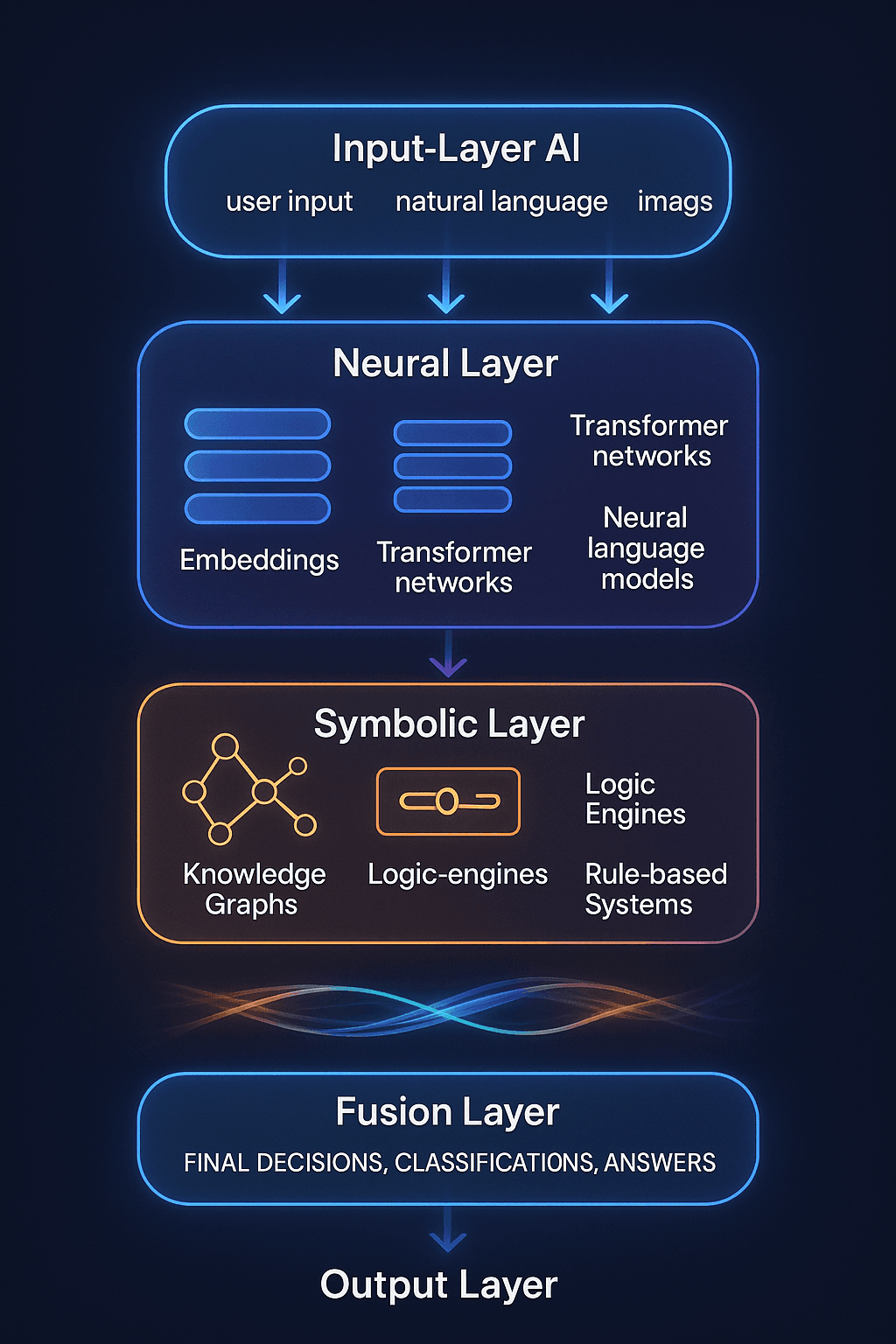
Implemented within the Foundation AgenticOS (FAOS) platform, this neurosymbolic architecture introduces formal symbolic constraints to ground the neural reasoning of large language models (LLMs). In a controlled experiment spanning 600 runs across five industries, ontology-coupled agents outperformed ungrounded baselines with effect sizes (W) of .460 for Metric Accuracy, .318 for Regulatory Compliance, and .614 for Role Consistency.
What the Researchers Built: A Three-Layer Ontological Framework
The core innovation is a three-layer ontological framework that provides semantic grounding for enterprise agents:
- Role Ontology: Defines the agent's purpose, permissions, and responsibilities (e.g., "Insurance Claims Adjuster").
- Domain Ontology: Encodes industry-specific knowledge, entities, and relationships (e.g., insurance policy types, coverage limits, regulatory clauses).
- Interaction Ontology: Governs the permissible patterns of communication and tool usage within a business process.
This framework enables asymmetric neurosymbolic coupling, where symbolic knowledge actively constrains the agent's inputs. During context assembly, the ontology filters retrieved documents to only those semantically relevant to the agent's role and domain. For tool discovery, the system uses a novel SQL-pushdown scoring method to match API tools to ontological concepts before the LLM selects them, drastically reducing hallucinated tool calls.
Key Results: Measurable Improvements Where LLMs Are Weakest
The team conducted a rigorous evaluation across FinTech, Insurance, Healthcare, Vietnamese Banking, and Vietnamese Insurance domains. The results show ontology grounding provides the most value where an LLM's parametric knowledge is weakest.

The paper identifies an inverse parametric knowledge effect: the value of ontological grounding is inversely proportional to the LLM's training data coverage of a domain. Improvements were most pronounced in Vietnam-localized domains (Vietnamese Banking & Insurance), where Western LLMs have inherently less embedded knowledge. This provides a clear blueprint for deploying reliable agents in geographically or vertically specialized contexts.
How It Works: Constraining Inputs and Validating Outputs
The FAOS architecture intervenes at multiple stages of the agentic loop:

Input-Side Constraint:
- Context Assembly: A retrieval step fetches documents, which are then filtered through the Domain Ontology. Only concepts and relationships recognized by the ontology are passed to the LLM as context, preventing "domain drift."
- Tool Discovery: Instead of letting the LLM freely reason about available tools, the system pre-scores tools via SQL-pushdown to the Interaction Ontology. The LLM chooses from a shortlist of ontologically valid tools.
- Governance Thresholds: The Role Ontology sets guardrails for decision boundaries (e.g., an agent with a "Junior Analyst" role cannot approve payments above $10,000).
Output-Side Validation (Proposed):
The paper also proposes extending coupling to constrain outputs. This includes:
- Response Validation: Checking final answers against ontological "truths."
- Reasoning Verification: Using the ontology to generate verification questions about the agent's chain-of-thought.
- Compliance Checking: Automatically flagging responses that violate regulatory rules encoded in the Domain Ontology.
This moves beyond simple post-hoc fact-checking to bake compliance and accuracy into the reasoning process itself.
Why It Matters: Bridging the Production Gap for Enterprise Agents
This work addresses the central problem highlighted in recent industry analyses: most AI agents never reach production. The 86% failure rate reported in March 2026 stems from uncontrolled hallucination and an inability to enforce business rules. This architecture provides a scalable, formal method for injecting enterprise knowledge and governance into agentic systems.

The contributions are both practical and theoretical:
- A production system serving 21 industry verticals with 650+ agents, proving scalability.
- Empirical evidence for the inverse parametric knowledge effect, guiding where to invest in ontological engineering.
- A taxonomy of neurosymbolic coupling patterns (input, output, tight, loose) that gives practitioners a vocabulary to design their own systems.
For enterprises, this means agents that can be trusted with regulated tasks in finance, healthcare, and insurance—domains where error costs are high. The localization results are particularly significant for global companies needing reliable AI in markets underrepresented in LLM training corpora.
gentic.news Analysis
This research arrives at a pivotal moment for AI agents. The knowledge graph shows a trend of 19 articles on AI Agents this week alone, reflecting intense industry focus. However, the concurrent trend of high pilot failure rates (86% as of late March 2026) reveals a stark implementation gap. This paper directly tackles the core technical deficiency behind those failures: the lack of formal, verifiable grounding for LLM reasoning in specialized domains.
The proposed architecture aligns with a broader shift from purely neural approaches to hybrid neurosymbolic systems. This mirrors earlier movements in AI history but is now being re-driven by the need to control powerful, black-box LLMs. The paper's empirical demonstration that grounding value is highest where LLM knowledge is weakest (the inverse parametric knowledge effect) is a crucial insight. It provides a clear economic rationale for ontology development: the return on investment is greatest for niche, regulated, or non-Western domains.
Furthermore, this work connects to our recent coverage of agent reliability benchmarks (see "Emergence WebVoyager: A New Benchmark Exposes Inconsistencies in Web Agent Evaluation" from April 1, 2026). While that article highlighted evaluation problems, this paper offers a concrete architectural solution to improve reliability. The FAOS platform's deployment at scale (650+ agents) suggests this isn't just academic—it's a viable path to production for enterprise teams struggling with the "agent washing" problem cited in recent reports.
Frequently Asked Questions
What is neurosymbolic AI?
Neurosymbolic AI combines neural networks (which learn patterns from data) with symbolic AI (which uses explicit rules and logic). In this architecture, the "neural" component is the large language model that handles natural language reasoning, while the "symbolic" component is the ontology—a formal, structured representation of knowledge—that constrains and guides the LLM's decisions to ensure accuracy and compliance.
How is this different from Retrieval-Augmented Generation (RAG)?
Retrieval-Augmented Generation (RAG) fetches relevant text documents to provide context to an LLM, but it doesn't understand the meaning of those documents. This ontology-based system goes beyond RAG by using a formal ontology to semantically filter retrieved content and validate the LLM's reasoning. It ensures the agent uses information correctly according to predefined business rules and relationships, not just retrieves potentially relevant text.
What industries benefit most from this approach?
The research shows the greatest improvements in domains where LLMs have weak inherent knowledge, particularly localized or highly regulated verticals. Vietnamese banking and insurance showed dramatic gains. Other prime candidates include specialized healthcare (rare disease diagnostics), complex financial derivatives, regional legal systems, and any industry with strict regulatory compliance requirements where hallucination is unacceptable.
Is the FAOS platform commercially available?
The paper states the architecture is implemented within the Foundation AgenticOS (FAOS) platform and is serving 21 industry verticals with over 650 agents in production. While the arXiv paper is a research preprint, this scale of deployment suggests FAOS is likely a commercial or internal enterprise platform. The architectural blueprint, however, is openly published for others to implement.
Source: "Ontology-Constrained Neural Reasoning in Enterprise Agentic Systems: A Neurosymbolic Architecture for Domain-Grounded AI Agents" (arXiv:2604.00555v1, submitted April 1, 2026).