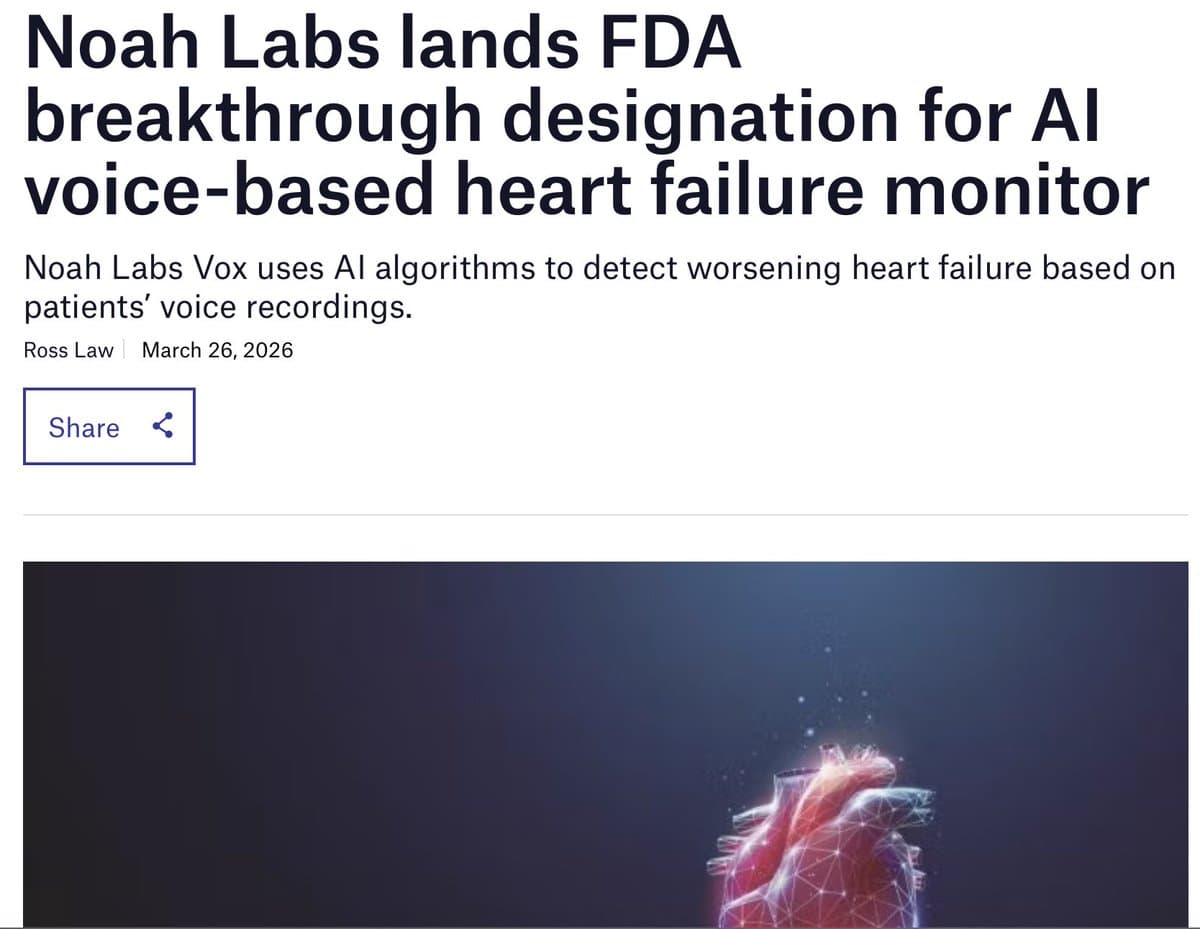
A new AI tool, designated by the U.S. Food and Drug Administration (FDA), can analyze a mere five seconds of a patient's voice to detect signs of worsening heart failure. The tool, named Vox, identifies subtle acoustic patterns linked to pulmonary congestion—fluid buildup in the lungs—that are inaudible to the human ear.
The development points toward a significant shift in remote patient monitoring, enabling cheaper, earlier detection of a chronic condition via a standard phone call. Heart failure affects an estimated 64 million people worldwide and costs the U.S. healthcare system over $30 billion annually.
What Vox Does
Vox is a voice biomarker analysis tool. Its core function is to process a short audio clip of a patient speaking. The AI has been trained to recognize specific vocal signatures correlated with increased fluid retention, a primary indicator of worsening heart failure (often termed decompensation).
Early detection of this decompensation is critical. It allows for timely medical intervention—such as medication adjustment—which can prevent costly and traumatic emergency hospitalizations. Traditionally, monitoring requires in-person check-ups, wearable devices, or patient-reported symptoms, which can be inconsistent or late.
Technical Foundation and Validation
The system's potential rests on its massive training dataset and clinical validation:
- Training Data: The model was trained on a corpus of more than 3 million voice samples. This scale is necessary to capture the vast variability in human speech across demographics, accents, and recording conditions, isolating the specific pathological signal from the noise.
- Clinical Backing: The tool's performance is supported by data from five clinical trials. FDA designation (which could be a Breakthrough Device designation or clearance) indicates the regulatory body has reviewed evidence of its safety and effectiveness for its intended use.
- The Biomarker: The technology hinges on the physiological link between fluid overload and voice production. Fluid accumulation can affect the respiratory system and vocal cord function, altering sub-acoustic features like jitter, shimmer, harmonic-to-noise ratio, and spectral tilt—features machines can quantify but humans cannot perceive.
The Practical Shift: Phone-Based Triage
The most immediate implication is the modality. If validated and deployed, this technology enables passive or active monitoring through a patient's everyday phone. A healthcare provider could implement a system where patients periodically record a short voice message, or an app could analyze voice snippets during routine telemedicine calls. The AI provides a risk score indicating the likelihood of worsening heart failure, flagging patients who need immediate follow-up.
This represents a move towards ultra-low-burden, scalable digital biomarkers. It requires no extra hardware beyond a smartphone, potentially increasing accessibility and adherence compared to wearable patches or daily weight scales (another common monitoring tool for heart failure).
Limitations and Considerations
While promising, key questions remain for real-world implementation:
- Specificity: Can the AI reliably distinguish heart failure-related vocal changes from those caused by common colds, other respiratory illnesses, or ambient noise?
- Integration: How does the Vox risk score integrate into existing clinical workflows and electronic health records?
- Access and Bias: The performance of the model across diverse populations, ages, and speech patterns must be rigorously validated to prevent diagnostic disparities.
The source tweet does not specify the company behind Vox, its exact FDA status (e.g., 510(k) clearance, De Novo grant, or Breakthrough Device designation), or published sensitivity/specificity metrics from the clinical trials.
gentic.news Analysis
This announcement fits squarely into the accelerating trend of AI-driven digital biomarkers and remote patient monitoring (RPM), a sector that has seen intense venture capital investment and regulatory activity since the early 2020s. The use of voice as a biomarker is particularly active; companies like Sonde Health (monitoring respiratory and mental health) and Kintsugi (mental health) have pioneered this space. Vox's focus on heart failure targets one of the highest-cost, highest-volume chronic conditions in healthcare, a strategically sound application for demonstrating value-based care impact.
The FDA designation is a critical differentiator. It moves Vox from a research concept to a tool with a regulated claim, enabling reimbursement and clinical adoption. This follows the broader regulatory pathway established by earlier AI/software-as-a-medical-device (SaMD) clearances in cardiology, such as the FDA-cleared EKG algorithms from Apple and AliveCor. The reported training on 3 million voice samples sets a new benchmark for scale in voice biomarker development, suggesting a potentially robust model, though peer-reviewed publication of its validation study is the next essential step for scientific scrutiny.
If the clinical trial data holds, Vox could catalyze a new standard for heart failure management bundles. Payers and accountable care organizations (ACOs) incentivized to reduce hospital readmissions would be the primary drivers for adoption. The next 12-18 months will be telling: can the team behind Vox transition from clinical trials to published results, commercial partnership, and demonstrated real-world reduction in hospitalizations? Success here would validate voice as a primary modality for chronic disease management, likely spurring similar approaches for COPD, asthma, and renal disease.
Frequently Asked Questions
What is the Vox AI tool?
Vox is an artificial intelligence software tool that has received a designation from the U.S. FDA. It is designed to analyze a five-second recording of a patient's voice to detect acoustic patterns associated with worsening heart failure, specifically fluid buildup in the lungs (pulmonary congestion).
How accurate is the Vox heart failure detector?
The source material states the tool is supported by five clinical trials and trained on over 3 million voice samples, which suggests substantial validation. However, specific accuracy metrics like sensitivity and specificity were not provided in the announcement. The FDA designation indicates the regulator has found reasonable assurance of safety and effectiveness for its intended use.
How does Vox work with just a voice clip?
The AI analyzes sub-acoustic features of the voice—tiny variations in pitch, tone, and breathiness that are imperceptible to humans. These features change when fluid accumulates in the lungs and affects the respiratory system, serving as a digital biomarker for heart failure decompensation.
What does this mean for heart failure patients?
If widely adopted, it could enable much simpler and more frequent monitoring from home using a smartphone. This could lead to earlier detection of worsening condition, allowing for timely medication adjustments and potentially preventing emergency hospitalizations, improving quality of life and reducing healthcare costs.