A large-scale, randomized field experiment involving 515 startups has delivered some of the first causal evidence quantifying the business impact of artificial intelligence. The study, highlighted by Wharton professor Ethan Mollick, found that startups whose founders were exposed to concrete case studies of successful AI use subsequently adopted AI tools more aggressively and achieved significantly better financial outcomes.
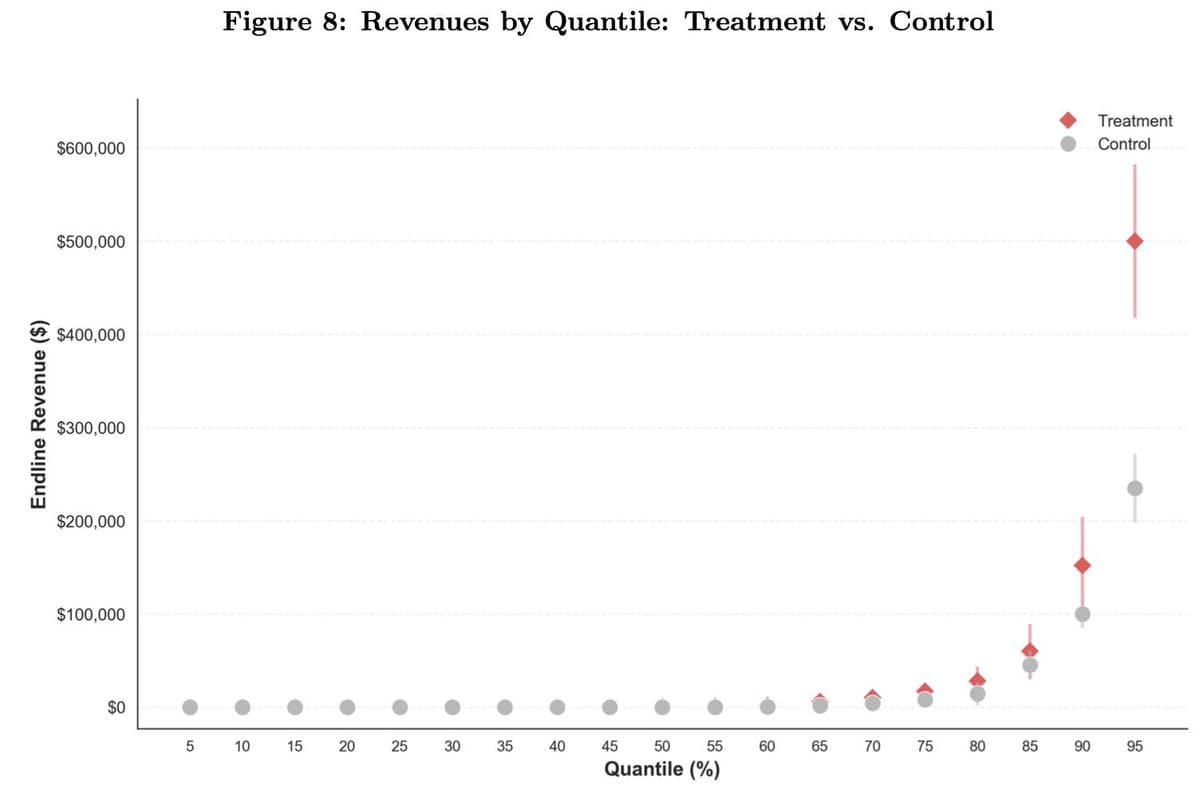
The core finding is stark: startups in the treatment group—those shown examples of how peers were using AI—used AI 44% more, generated 1.9 times higher revenue, and required 39% less capital than the control group. This moves the conversation about AI's business value beyond correlation and into the realm of measurable, causal impact.
What the Experiment Tested
The research design was a randomized controlled trial (RCT), the gold standard for establishing causality. The researchers recruited 515 early-stage startups and randomly assigned them to one of two groups:
- Treatment Group: Received educational materials featuring specific case studies of how other startups were successfully implementing AI tools to solve business problems (e.g., for marketing copy, code generation, customer support).
- Control Group: Did not receive this targeted AI case study intervention.
Both groups were then tracked over time. The intervention was not providing the AI tools themselves, but rather knowledge—a demonstration of how AI could be applied effectively in a startup context. The goal was to test whether reducing the "how-to" knowledge gap would change behavior and outcomes.
Key Results: The Performance Gap
The results, measured after a significant tracking period, showed a dramatic divergence between the two groups:
AI Adoption Rate 44% Higher Baseline +44% Revenue 1.9x Higher Baseline +90% Capital Required 39% Lower Baseline -39%This data suggests a powerful cascade effect: knowledge of practical AI applications leads to increased use, which in turn drives greater efficiency and top-line growth. The reduction in capital needed is particularly significant for the startup ecosystem, implying AI can extend runway and improve capital efficiency.
How Knowledge Drives Adoption and Performance
The study's mechanism is straightforward but profound. Many founders are aware of AI but lack a clear, credible blueprint for integrating it into their specific operations. The case studies served as a catalyst, providing:
- Proof of Concept: Evidence that similar companies were getting real results.
- Implementation Roadmaps: Concrete examples that could be adapted, lowering the trial-and-error cost.
- Legitimization: Social proof that using AI was a savvy business move, not just a tech trend.
By bridging this "know-how" gap, the intervention directly increased the treatment group's AI usage. The subsequent improvements in revenue and capital efficiency likely stem from AI's ability to automate tasks, enhance productivity, accelerate product development, and improve decision-making—allowing these startups to do more with less.
Why This Matters: From Hype to Hard Evidence
Until now, much of the discourse around AI's business value has been anecdotal or based on surveys. This study provides a controlled, quantitative foundation for two critical claims:
- AI Accelerates Businesses: The 1.9x revenue multiplier offers hard data to back the hype. For investors and founders, this makes a compelling case for prioritizing AI integration as a competitive necessity, not a speculative experiment.
- The Barrier is Knowledge, Not Technology: The key constraint for many organizations is not access to AI models (many of which are cheap or free) but a lack of understanding of how to deploy them effectively. This shifts the focus from tool-building to education, training, and knowledge dissemination.
The 39% reduction in capital needs could influence venture capital dynamics, potentially enabling more capital-efficient company building and altering expectations on burn rates.
gentic.news Analysis
This study arrives at a pivotal moment in the enterprise AI adoption curve. For the past two years, the narrative has been dominated by model capabilities (GPT-4, Claude 3, open-source frontiers) and infrastructure battles. This research pivots the focus to the last-mile problem of implementation, which is increasingly becoming the primary bottleneck. As we've covered in analyses of Microsoft's CoPilot adoption data and enterprise AI platform struggles, tool access is no longer the differentiator; operational integration is.
The findings directly support the investment theses of firms like Andreessen Horowitz and Sequoia Capital, which have heavily emphasized AI-native startups. It also validates the business models of a growing cohort of AI implementation consultancies and education platforms (e.g., Ethan Mollick's own work, Labs, AI incubators) that are emerging to fill this exact knowledge gap. The study suggests the market for "AI translation"—turning raw capability into business process—may be as large as the market for the underlying models.
Furthermore, this adds a critical data point to the ongoing debate about AI's macroeconomic impact on productivity. While aggregate productivity statistics have been slow to move, this micro-evidence from startups—typically the most agile adopters—shows the potential magnitude of the effect when adoption barriers are lowered. It implies that broad-based productivity gains may follow, but only after a significant wave of business education and process redesign.
Frequently Asked Questions
What kinds of AI were the startups likely using?
Based on the timing and context of the experiment, the case studies likely featured applications of large language models (LLMs) and generative AI tools available in 2025-2026. This would include platforms like ChatGPT, Claude, Gemini, and Github Copilot for tasks such as content creation, code generation, customer email drafting, marketing ideation, and data analysis. The focus was on accessible, cloud-based AI tools, not bespoke in-house model training.
Does this mean every startup should immediately adopt AI to double revenue?
Not automatically. The study shows a causal link between knowledge-driven adoption and improved outcomes. Simply subscribing to ChatGPT without a strategic understanding of how to apply it is unlikely to yield the same results. The key takeaway is that startups should actively seek out education, case studies, and clear implementation strategies relevant to their industry and function to replicate this effect.
How does a 39% reduction in capital needs actually work?
AI can reduce capital needs by automating roles or tasks that would otherwise require early hires (e.g., a content writer, junior marketing associate, or customer support agent), speeding up product development cycles to reach revenue faster, and improving operational efficiency across marketing, sales, and R&D. This allows the startup to achieve key milestones with less spent on payroll and extended runway before the next funding round.
Is this effect likely to be similar for large, established corporations?
The dynamics may differ. Startups are agile and can redesign processes from scratch, while large corporations face legacy systems, change management hurdles, and more complex compliance requirements. However, the core principle—that practical knowledge of use cases drives effective adoption—likely applies universally. The magnitude of the financial impact in large organizations remains an open question for further research.