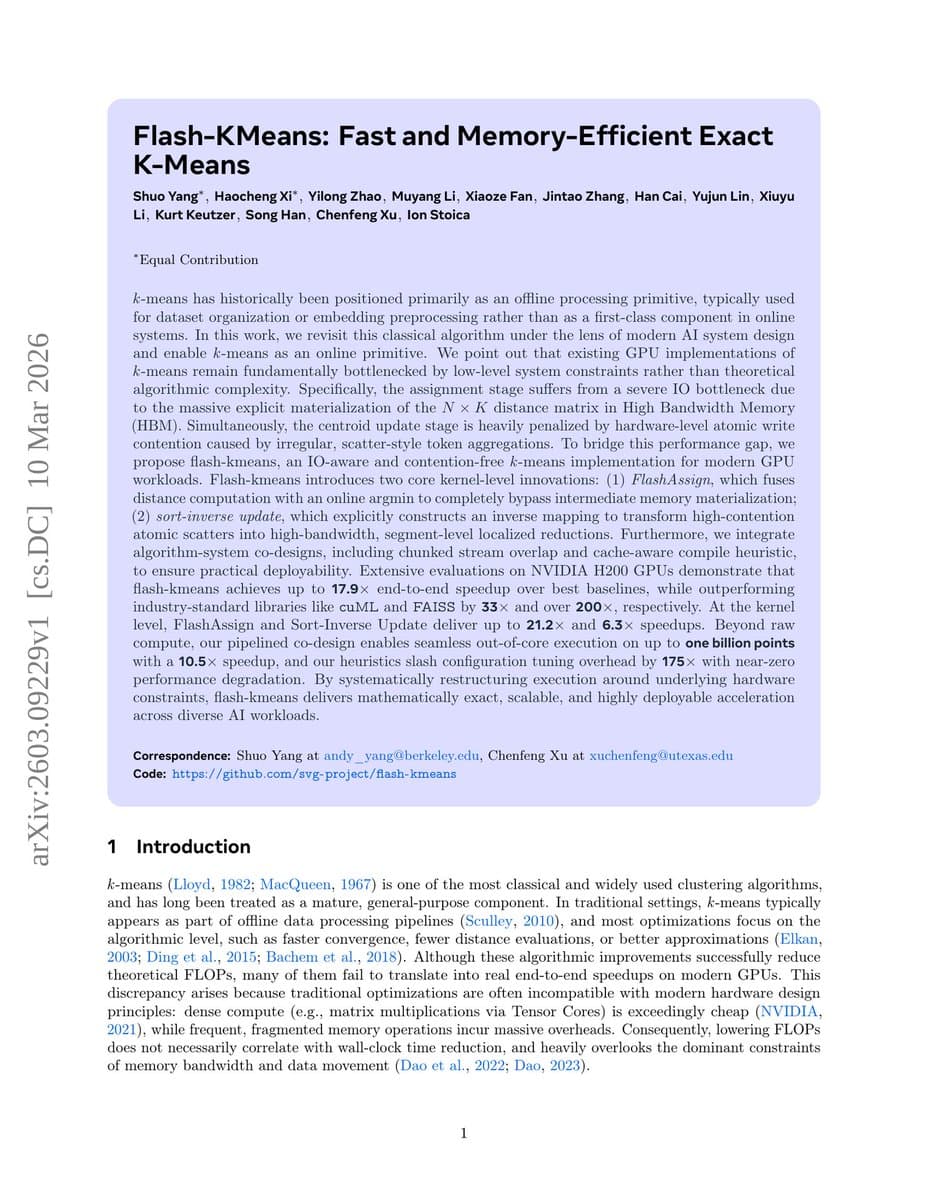
A new development in clustering algorithms has emerged with potentially transformative implications for data science and machine learning workflows. Flash-KMeans, as reported by HuggingPapers, demonstrates extraordinary performance gains over existing solutions, achieving up to 17.9x speedup over baseline implementations and a staggering 200x improvement over FAISS, Facebook's popular similarity search library.
The Technical Breakthrough: IO-Aware FlashAssign Kernels
At the heart of Flash-KMeans' performance leap are what the developers term "IO-aware FlashAssign kernels." These specialized computational units address two critical bottlenecks that have long plagued GPU-accelerated clustering algorithms: memory bottlenecks and atomic contention.
Memory bottlenecks occur when data transfer between different levels of memory hierarchy (global memory, shared memory, registers) becomes the limiting factor in computational throughput. Atomic contention happens when multiple GPU threads attempt to simultaneously update shared memory locations, causing serialization that undermines parallel efficiency.
Traditional GPU implementations of K-means clustering have struggled with these issues, particularly as dataset sizes have grown exponentially. The FlashAssign kernels appear to fundamentally rearchitect how assignment operations—the core computational step in K-means—are performed on GPU hardware.
Performance Implications for Real-World Applications
The reported speed improvements are not marginal but transformative. A 200x speedup over FAISS represents more than two orders of magnitude improvement, potentially changing what's computationally feasible in clustering applications.
Consider applications in:
- Computer vision: Clustering image features for unsupervised learning
- Natural language processing: Document clustering and topic modeling
- Bioinformatics: Gene expression clustering
- Recommendation systems: User and item clustering
For these domains, clustering operations that previously took hours could potentially be reduced to minutes, enabling more iterative experimentation and larger-scale analyses.
The FAISS Comparison Context
FAISS (Facebook AI Similarity Search) has been the gold standard for efficient similarity search and clustering on GPUs since its release in 2017. Developed by Facebook's AI Research team, FAISS optimized nearest neighbor search through quantization techniques and efficient GPU implementations. That Flash-KMeans demonstrates such dramatic improvements over this established benchmark suggests a fundamental advance in algorithmic approach rather than incremental optimization.
Potential Impact on Machine Learning Workflows
The speed improvements reported for Flash-KMeans could have cascading effects throughout machine learning pipelines:
- Faster data preprocessing: Clustering is often used in feature engineering and data preparation
- More feasible unsupervised learning: The computational cost of clustering has limited some unsupervised approaches
- Real-time clustering applications: Previously impractical use cases might now become viable
- Reduced infrastructure costs: Faster algorithms mean less GPU time required for the same tasks
Looking Forward: Implementation and Accessibility
While the initial report focuses on performance metrics, key questions remain about implementation details, compatibility with existing frameworks, and accessibility to the broader research and development community. The HuggingPapers post references a link to what appears to be a paper or technical documentation, suggesting this may soon become available to practitioners.
The integration of such advances into popular machine learning frameworks like PyTorch, TensorFlow, or scikit-learn would be crucial for widespread adoption. Given the source of the announcement (HuggingPapers, associated with Hugging Face), there's reason to expect thoughtful implementation and potentially integration with the Hugging Face ecosystem.
Conclusion: A New Era for Clustering Algorithms
Flash-KMeans represents what appears to be a breakthrough in algorithmic efficiency for GPU-based clustering. By fundamentally addressing memory bottlenecks and atomic contention through innovative kernel design, the developers have achieved performance gains that could reshape expectations for what's possible in clustering large datasets.
As with any new algorithmic advance, independent verification and benchmarking across diverse datasets and hardware configurations will be important. However, if the reported results hold under broader testing, Flash-KMeans could become a new standard for efficient clustering, with ripple effects across numerous domains of data analysis and machine learning.
Source: HuggingPapers/X post about Flash-KMeans achieving up to 17.9x speedup over baselines and 200x over FAISS via IO-aware FlashAssign kernels