What Happened
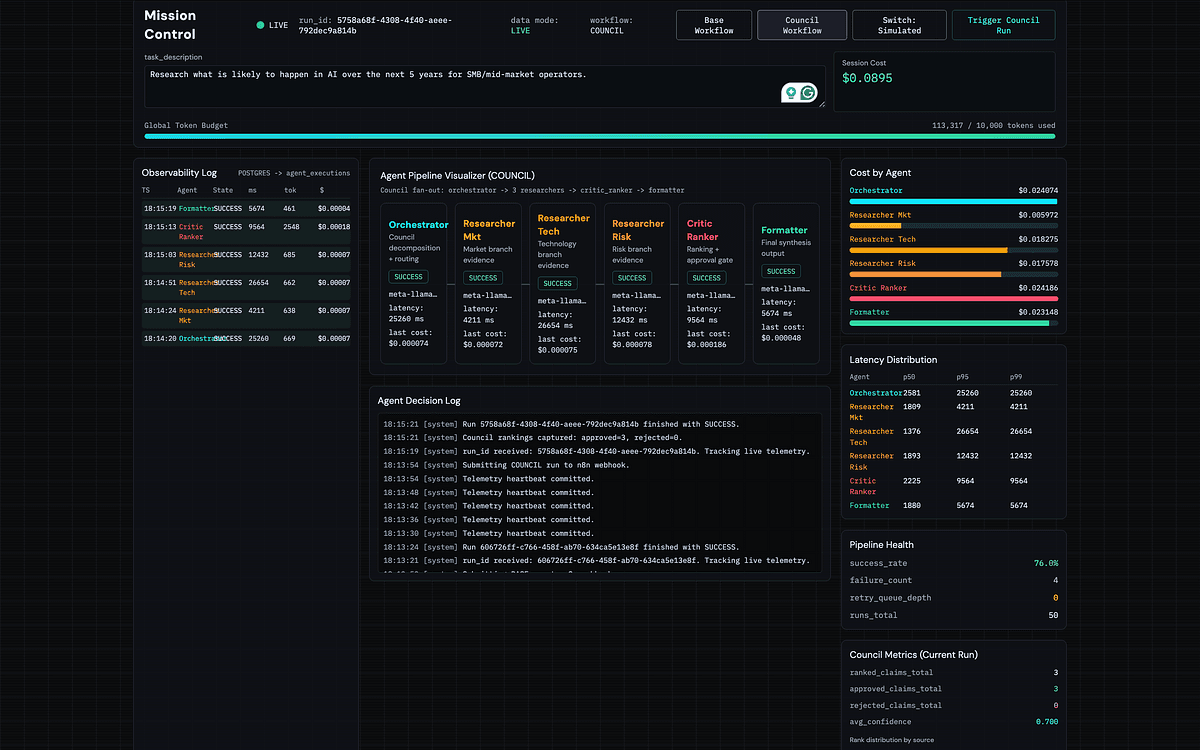
Amod Karambelkar, a technical architect, has published a detailed guide on Medium outlining a custom-built system designed to bring observability to complex, multi-agent AI applications. The core problem he addresses is the transition from simple, single-prompt interactions to sophisticated "control plane" architectures where multiple AI agents, tools, and data sources interact. In these systems, understanding what happened, why it failed, and how much it cost becomes a significant operational challenge.
The article describes a self-hosted solution that avoids reliance on proprietary, vendor-locked platforms. The architecture leverages three main components:
- n8n: An open-source workflow automation tool used as the orchestration engine. It defines and executes the multi-agent workflows, connecting various AI models (via APIs) and tools.
- PostgreSQL: A relational database that serves as the centralized audit log. Every step of an AI workflow execution—prompts sent, responses received, tool calls, errors, and metadata—is stored here for later analysis.
- OpenRouter: A unified API gateway to numerous large language models (LLMs). This provides flexibility in model choice and, crucially, a single point for tracking usage and costs across different AI providers.
The system is designed to make three key dimensions visible:
- Execution Visibility: A complete, queryable audit trail of every step in a workflow.
- Failure Analysis: Detailed error logging and tracing to pinpoint where and why a complex AI process broke down.
- Cost Attribution: The ability to trace token usage and associated costs back to specific workflow runs, agents, or even end-users.
Technical Details
The architecture represents a pragmatic, integration-focused approach to AI Operations (AIOps). Instead of building monitoring from scratch, it stitches together mature open-source tools to create a cohesive observability plane.
Workflow Orchestration with n8n: n8n provides a low-code visual interface for designing agentic workflows. Each node in a workflow can represent an LLM call (via OpenRouter), a data processing step, a conditional branch, or a call to an external API. This makes the control logic explicit and manageable.
Centralized Logging with PostgreSQL: The critical innovation is the disciplined logging of all n8n node executions to a structured database schema. This includes timestamps, input/output payloads (which can be sanitized for PII), node execution status, and correlation IDs to trace a single user request through the entire graph of AI interactions. This transforms opaque AI execution into queryable data.
Unified Model Gateway with OpenRouter: By routing all LLM calls through OpenRouter, the system abstracts away individual provider APIs (OpenAI, Anthropic, Google, etc.). More importantly, OpenRouter's API provides standardized response headers containing precise token usage, enabling fine-grained cost tracking per request, which is then logged to PostgreSQL.
The result is a dashboard-ready data layer. Teams can use SQL or connect business intelligence (BI) tools to PostgreSQL to answer questions like: "What is the average cost per successful customer service resolution?" "Which agent in the workflow has the highest failure rate?" "What was the exact chain of events for the failed order status query from user X?"
Retail & Luxury Implications
For retail and luxury brands deploying AI beyond simple chatbots, this type of observability architecture is not a luxury—it's a prerequisite for responsible and scalable operation. The implications are significant for several high-value use cases:
1. Complex Customer Service & Concierge Agents: A luxury brand's AI concierge might chain together multiple steps: a sentiment-aware LLM interprets a customer's nuanced request, a retrieval-augmented generation (RAG) agent searches internal knowledge bases for product care instructions, a tool checks inventory in real-time, and another generates a personalized email summary. Without the observability plane described, diagnosing a failure in this chain is guesswork. With it, support teams can see the exact step where the RAG failed to retrieve the correct manual or where the inventory check timed out.
2. Agentic Personal Shopping & Styling: An AI stylist that interacts over multiple sessions, maintains a customer's style profile, and calls external APIs for product discovery and outfit visualization creates a complex stateful workflow. Observability enables tracking the stylist's "reasoning" (the chain of prompts and tool calls) for each recommendation, which is crucial for quality assurance, bias auditing, and iteratively improving the system's taste and brand alignment.
3. Supply Chain & Demand Forecasting Agents: AI systems that autonomously analyze social trends, sales data, and weather patterns to adjust production or logistics involve high-stakes decisions. The ability to audit the data sources and logical steps the AI took to arrive at a forecast is essential for risk management and regulatory compliance.
4. Cost Control at Scale: As covered in our previous analysis, enterprises are rapidly adopting RAG and agentic architectures. These systems can incur unpredictable and spiraling costs if not monitored. The integrated cost-tracking aspect of this architecture allows finance and tech teams to attribute AI spend to specific business units, campaigns, or product lines, moving AI from a nebulous R&D cost to a measurable operational expense.
The gap between this self-built solution and production readiness for a global brand like LVMH or Richemont is primarily in enterprise-grade features: robust security, access controls, scalability, and integration with existing IT monitoring stacks (e.g., Datadog, Splunk). However, the architectural blueprint is directly applicable. It demonstrates that the core need—turning AI agent workflows from a "black box" into a "glass box"—is solvable with today's technology.