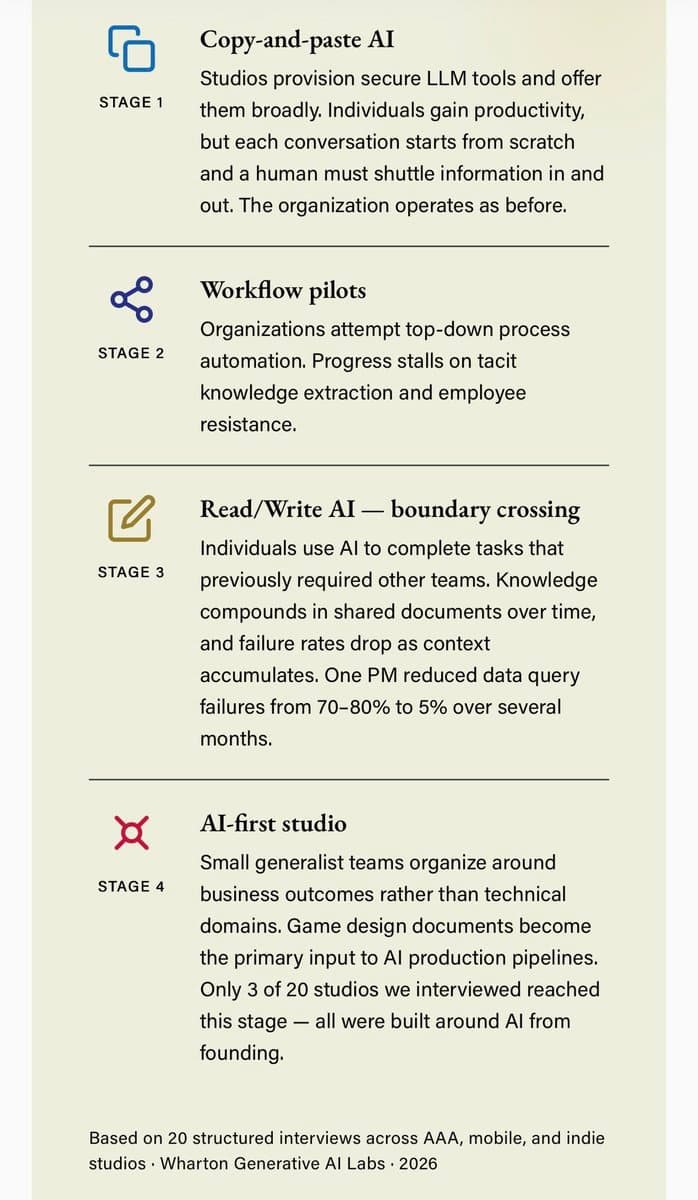
A new research report from the Wharton School at the University of Pennsylvania, authored by Zimran Ahmed, provides a ground-level view of how the video game industry is grappling with the rise of generative AI. The study, based on interviews with professionals at 20 different game development studios, reveals a landscape of stark contrasts, where organizational culture and strategic choice are creating a significant divide in adoption speed and depth.
What the Report Found
The core finding is the absence of a unified industry response. Instead, the report identifies a spectrum of approaches:
- AI-First Innovators: A subset of studios, often newer or with specific technical leadership, are aggressively integrating AI across the pipeline. This includes using tools for concept art generation, narrative brainstorming, voice synthesis, and even prototyping code. These studios view AI as a fundamental lever for productivity and creative exploration.
- Cautious Integrators: The largest group appears to be studios adopting AI tools in specific, siloed areas—such as using large language models (LLMs) for generating placeholder dialogue or texture upscaling tools—while maintaining traditional workflows for core creative tasks. The approach is experimental and incremental.
- Resistant Holdouts: A meaningful number of studios, particularly those with strong established artistic identities or unionized workforces, are actively resisting the adoption of generative AI. Concerns cited include ethical issues around training data, fear of homogenizing artistic output, potential job displacement, and contractual/IP ambiguities.
The Organizational Challenge
The report underscores that the primary barrier is not technological access but organizational adaptation. Success or failure in leveraging AI is less about buying a software license and more about:
- Leadership Mandate: Whether studio leadership has a clear, communicated strategy for AI experimentation and integration.
- Workflow Re-engineering: Adapting established, often complex, cross-disciplinary pipelines (art → design → engineering → QA) to incorporate non-deterministic AI tools.
- Skill Redeployment: Training artists, writers, and designers to become effective "AI editors" and prompt engineers, rather than being replaced by the tools.
- IP and Legal Navigation: Addressing unresolved questions about the copyright status of AI-generated assets and the provenance of training data.
The report suggests that studios failing to develop a coherent internal stance on these points are at risk of falling behind in both development efficiency and competitive innovation.
What This Means in Practice

The fragmentation means the game industry is conducting a massive, real-world A/B test. Over the next 12-18 months, the performance gap between studios that effectively harness AI for iteration and content generation and those that do not is likely to widen. This could reshape competitive dynamics, especially in content-heavy genres like open-world games, MMORPGs, and live-service titles.
gentic.news Analysis
This Wharton report provides crucial qualitative data to a trend we've been tracking quantitatively: the uneven absorption of AI into creative industries. It contextualizes the flurry of AI tool announcements from companies like Unity (Muse, Sentis), NVIDIA (Audio2Face, DLSS), and Adobe (Firefly) with the reality of studio-level implementation. The resistance noted aligns with ongoing legal and labor disputes, such as the SAG-AFTRA voice actor strike provisions around AI, which we covered in late 2024.
The identified spectrum creates a new axis of competition. Historically, studios competed on engine tech (Unreal vs. Unity), IP, and talent. Now, "AI fluency" may become a core competency. This mirrors the early cloud adoption era in enterprise software, where organizational agility determined winners. For investors and analysts, this report is a reminder to look beyond which studio is using AI and ask how they are adapting their organization, culture, and production philosophy to wield it effectively. The studios currently in the "cautious integrator" camp face the most strategic pressure: they must decide whether to accelerate investment or risk being outmaneuvered by nimbler, AI-native competitors.
Frequently Asked Questions
What are game studios using AI for most right now?
Based on the report and industry trends, the most common current uses are in pre-production and content augmentation: generating mood boards and concept art variations, creating placeholder dialogue and barks for NPCs, upscaling textures, and synthesizing temporary voice-overs. Use in core gameplay programming and final asset creation remains less common due to quality control and IP concerns.
Why are some game studios resistant to using AI?
Resistance stems from several key areas: ethical concerns about artists' work being used in training datasets without consent; fears that AI-generated content will dilute unique artistic style and lead to homogenization; unresolved legal questions about who owns the copyright to an AI-generated asset; and pressure from creative staff and unions worried about job displacement and de-skilling.
Will AI replace game developers and artists?
The report's findings suggest that, in the near term, AI is more likely to change these roles than replace them outright. The most effective studios are focusing on upskilling teams to act as creative directors and editors for AI outputs. The demand for high-level creative vision, narrative cohesion, and technical problem-solving remains, but the toolkit and workflow are evolving.
How will this adoption gap affect the games I play?
In the short term, you may not notice a drastic difference. Over time, however, studios that master AI-assisted development may be able to produce richer, more detailed worlds, offer more dynamic narrative branches, or update live-service games with new content at a faster pace. Conversely, studios that resist may lean harder into a "handcrafted" aesthetic as a market differentiator.