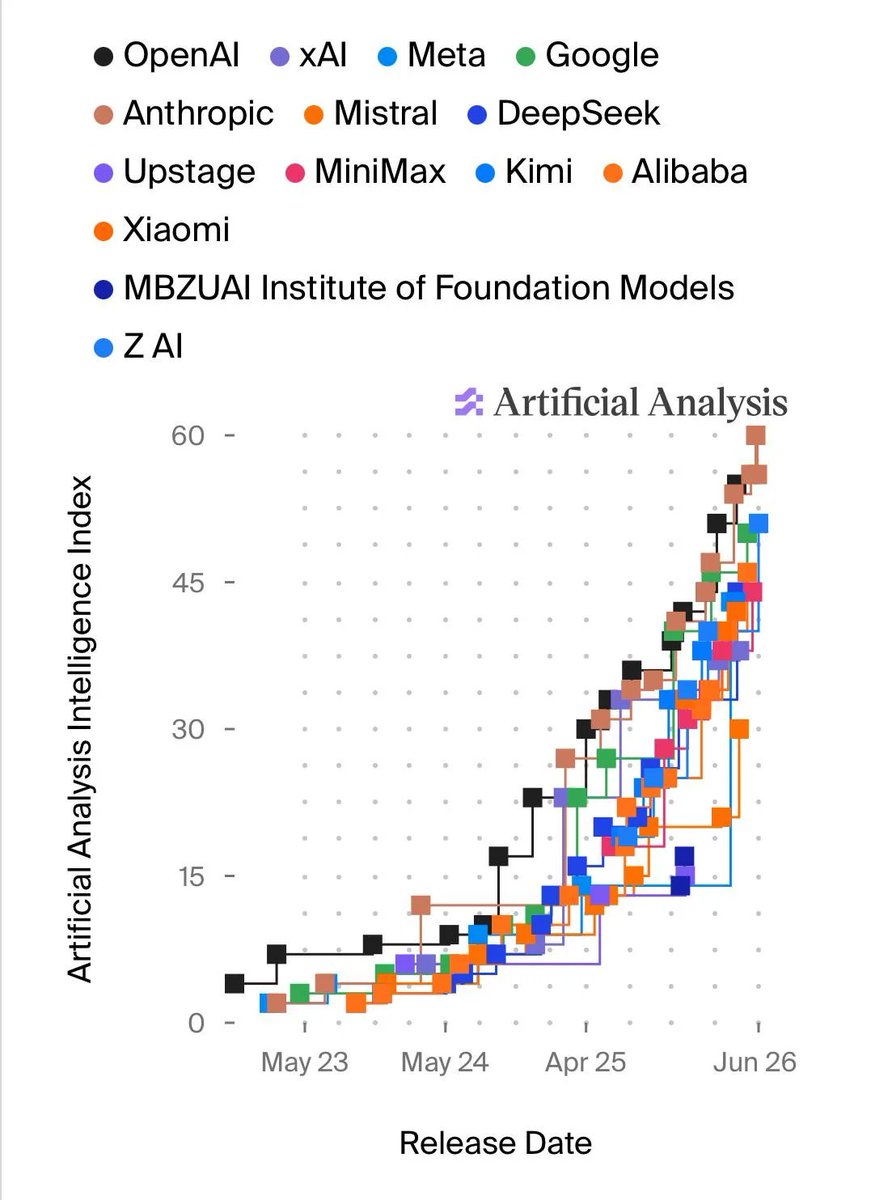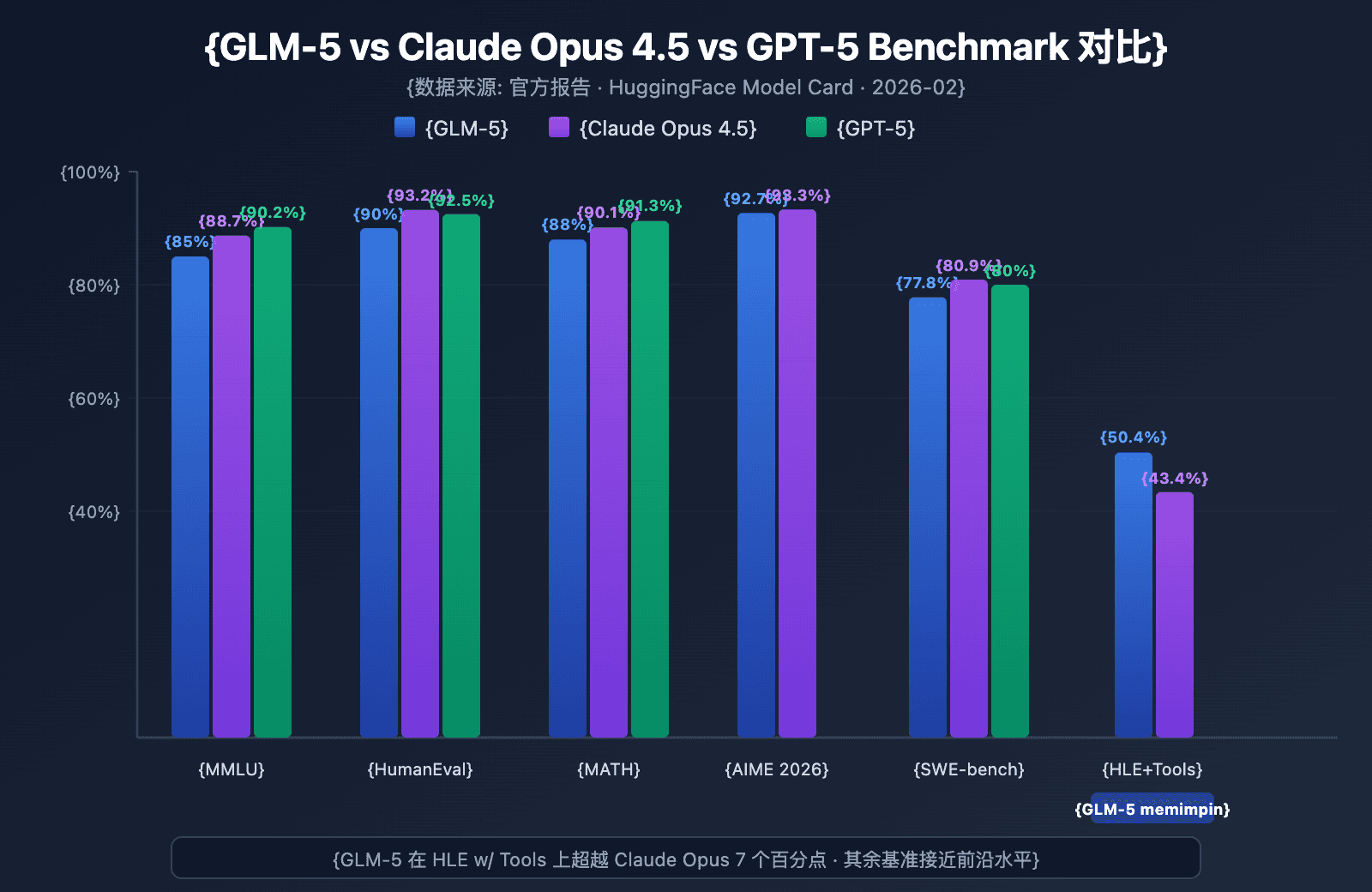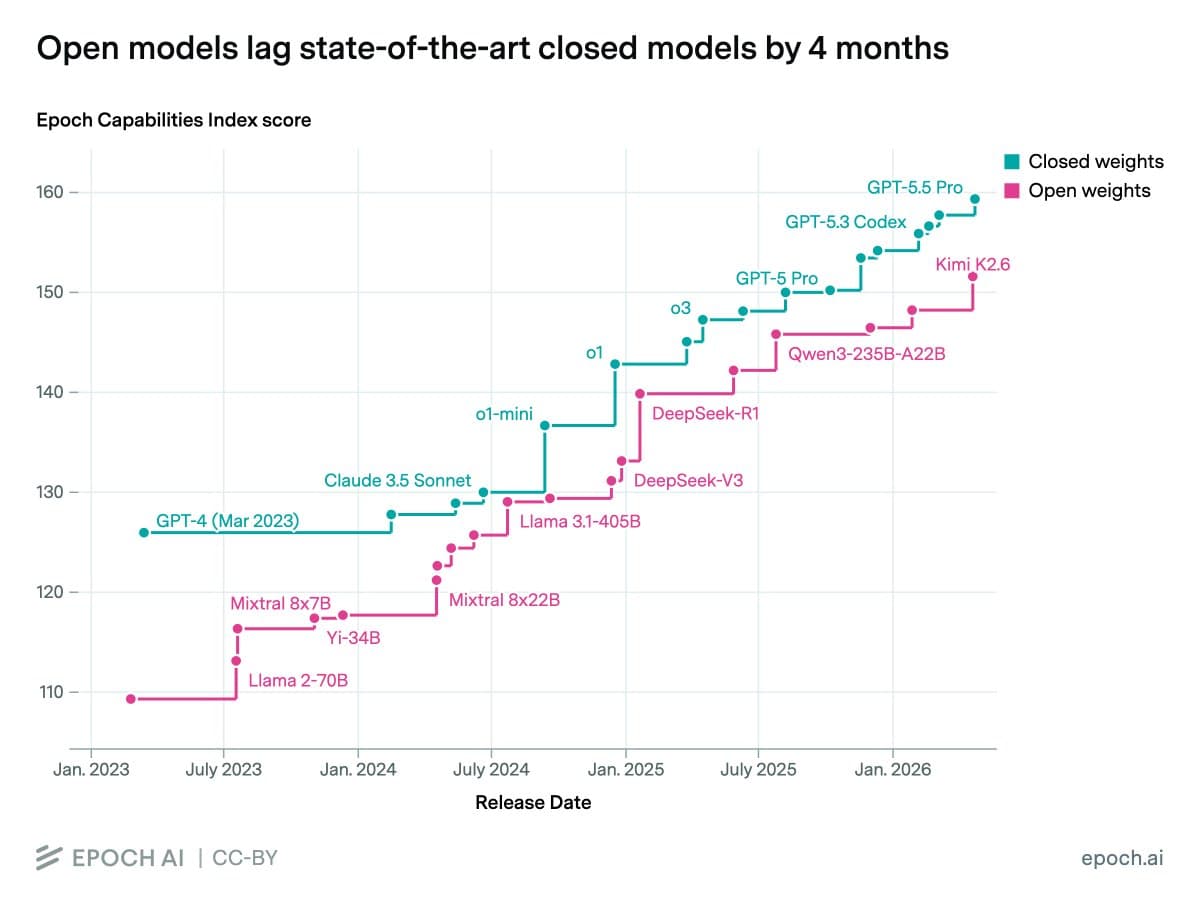
EpochAI research reveals open-weight models trail frontier closed-source models by four months. The finding, shared by @kimmonismus, underscores how quickly open models are closing the gap.
Key facts
- Open-weight models trail frontier closed-source models by 4 months.
- Finding comes from EpochAI research shared by @kimmonismus.
- Earlier estimates from 2023 pegged the gap at 6–12 months.
- Lag is measured in months, not years, showing rapid catch-up.
- Gap validates open models for many production use cases.
EpochAI research, reported by @kimmonismus, quantifies the performance lag between open-weight and frontier closed-source AI models at just four months. The analysis likely compares release dates and benchmark scores across major players like Meta (Llama series), Mistral, and OpenAI (GPT-4o, o1).
The Gap in Context
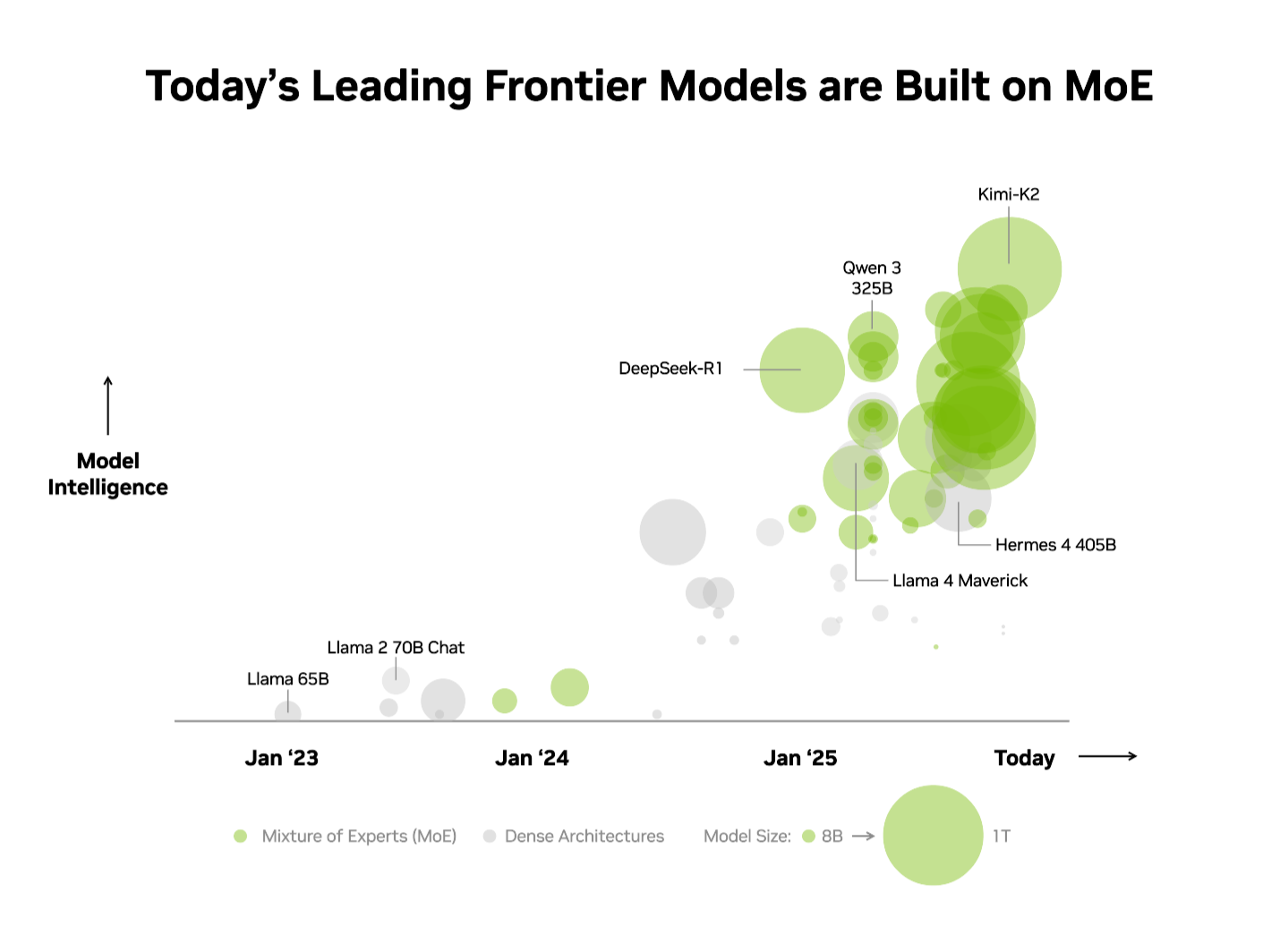
Four months is a short window in AI development cycles, where model training runs alone can take weeks. [According to @kimmonismus], the lag is 'very little' yet 'impressive,' reflecting how open-weight models have accelerated their cadence. For context, earlier estimates from 2023 pegged the gap at 6–12 months for smaller models; the compression to four months signals a structural shift in how quickly open ecosystems replicate or approximate frontier capabilities.
What This Means for the AI Landscape
The four-month lag is both a validation and a challenge for open-weight advocates. It suggests open models are viable for many production use cases — fine-tuning, on-premises deployment, research — where the bleeding edge isn't required. But it also confirms that closed models retain a lead, particularly on complex reasoning, coding benchmarks, and multimodal tasks. EpochAI's finding implies that open models are not yet substitutes for frontier systems in high-stakes applications, but they are closing the gap faster than many industry observers predicted.
Methodological Caveats
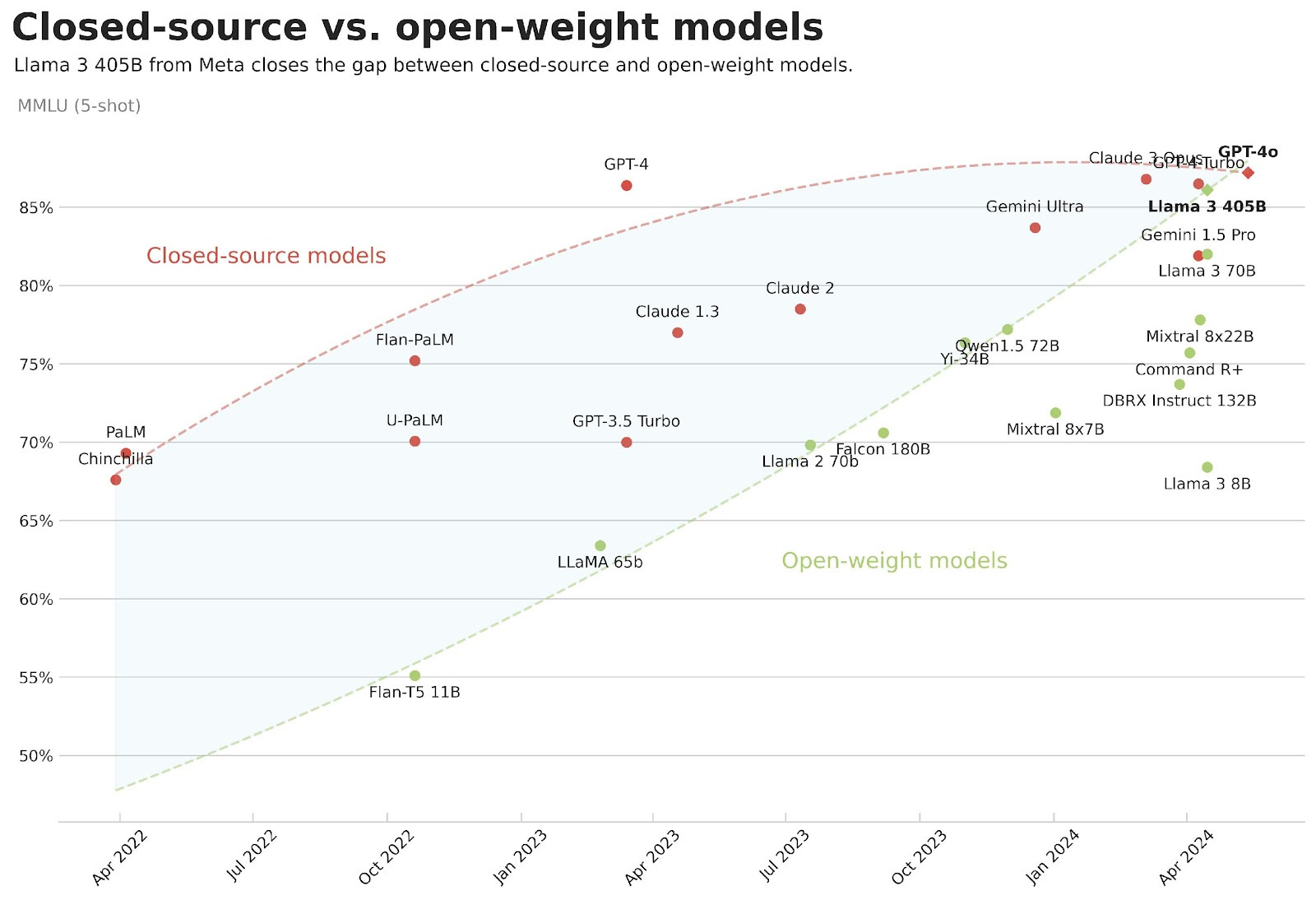
EpochAI's specific methodology — whether it tracks benchmark scores, release dates, or training compute — isn't detailed in the source. The four-month figure likely averages across multiple model families and benchmarks. [Per typical EpochAI analysis], the metric may reflect the time between a closed model's public release and an open model achieving comparable performance on standard evaluations like MMLU, HumanEval, or SWE-Bench. The company did not disclose the full dataset or individual model comparisons.
What to watch
Watch for EpochAI's full published report with model-level breakdowns, and whether next-generation open models (e.g., Llama 4, Mistral Large 2) shrink the gap to three months or less. Also track benchmark-specific deltas on coding and reasoning tasks.
[Updated 30 May via bloomberg_tech]
Meanwhile, Anthropic closed a $65 billion Series H round at a $965 billion valuation, surpassing OpenAI for the first time [per Bloomberg]. The round was led by Altimeter Capital, Dragoneer, Greenoaks, and Sequoia Capital, each investing over $2 billion. This marks a potential final private raise before an anticipated IPO, signaling investor confidence in Anthropic's open-weight strategy.