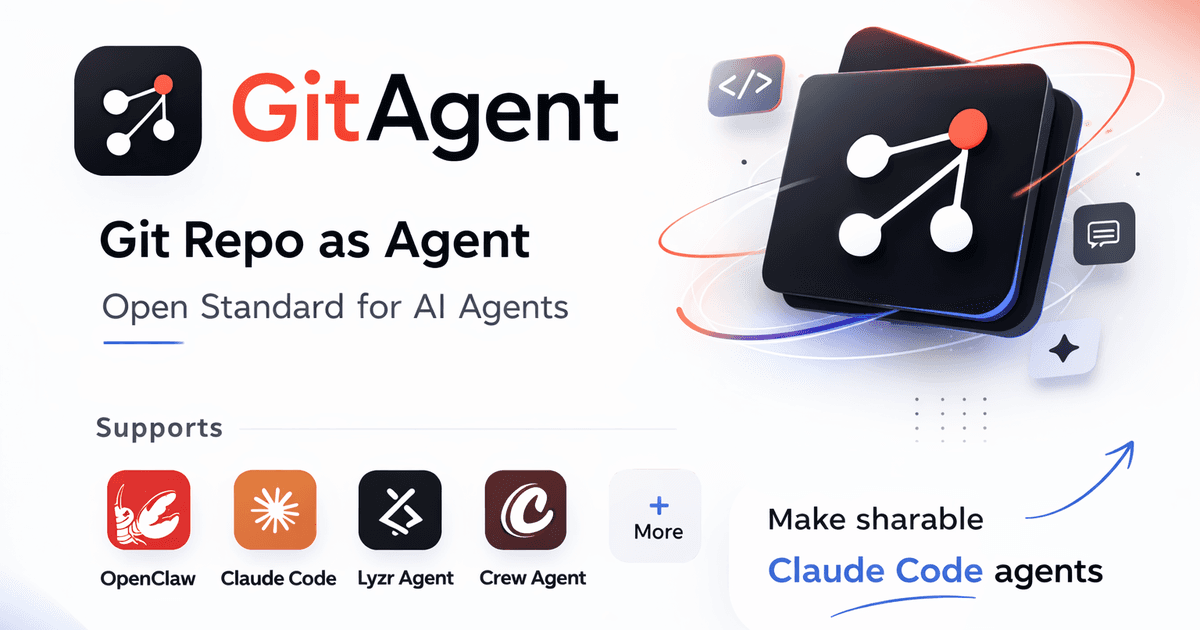
A new open-source project called GitAgent has emerged with an ambitious goal: to standardize how AI agents are defined and deployed across different frameworks. By treating agents as collections of files within a Git repository, the project aims to solve the persistent problem of framework lock-in that has plagued the rapidly evolving AI agent ecosystem.
The Problem of Framework Fragmentation
As the source material explains, the developers built GitAgent because "every agent framework defines agents differently, and switching frameworks means rewriting everything." This fragmentation creates significant overhead for developers and organizations trying to build and maintain AI agents. With major players like OpenAI, Anthropic (creator of Claude), Google, and various open-source projects each developing their own agent frameworks and SDKs, the lack of interoperability has become a major pain point.
How GitAgent Works
GitAgent defines an AI agent through three core files in a Git repository:
- agent.yaml - Contains the agent's configuration
- SOUL.md - Defines the agent's personality and instructions
- SKILL.md - Describes the agent's capabilities
This simple structure creates a portable agent definition that can export to multiple frameworks including Claude Code, OpenAI Agents SDK, CrewAI, Google ADK, LangChain, and others. The command-line interface allows developers to run any agent repository directly with commands like:
npx @open-gitagent/gitagent run -r https://github.com/user/agent -a claude
Git-Native Advantages
The choice to build on Git isn't accidental—it provides several powerful benefits out of the box:
Version Control for Agent Behavior
Developers can roll back problematic prompts or configurations just like reverting a bad commit, providing a safety net for agent experimentation and deployment.
Branching for Environment Promotion
The familiar Git workflow of moving from development to staging to production branches translates naturally to agent deployment pipelines.
Human-in-the-Loop via Pull Requests
When an agent learns a new skill, it can open a branch for human review before merging, maintaining oversight while allowing for autonomous improvement.
Audit Trail and Collaboration
Git's built-in features like git blame and git diff provide transparent audit trails, while forking and remixing capabilities enable community collaboration on public agents.
CI/CD Integration
GitAgent includes validation tools that integrate with GitHub Actions, enabling automated testing and deployment pipelines.
Compliance and Enterprise Features
While optional, GitAgent includes a compliance layer designed for enterprise use cases. This includes risk tier classifications, regulatory mappings for financial services (FINRA, SEC, SR 11-7), and audit report generation via the GitAgent audit command. This addresses growing concerns about AI governance and regulatory compliance, particularly relevant given recent developments where AI agents like Claude have demonstrated capabilities for complex financial analysis comparable to professional analysts.
Industry Context and Timing
The launch of GitAgent comes at a pivotal moment in AI agent development. According to recent knowledge graph context, AI agents crossed a "critical reliability threshold" in December 2026, fundamentally transforming programming capabilities. Meanwhile, major frameworks continue to evolve rapidly—Claude Code recently added inline visualization features and built-in MCP servers, while OpenAI and Google continue advancing their respective agent platforms.
This competitive landscape, where OpenAI competes with both Anthropic and Google across multiple AI product categories, creates exactly the kind of fragmentation that GitAgent aims to solve. By providing a neutral, open standard, GitAgent could reduce switching costs and enable more fluid movement between platforms as different frameworks offer varying strengths.
Community Reception and Future Development
The project has already garnered attention on Hacker News with 84 points and 11 comments at the time of reporting. The developers are actively seeking feedback on the schema design and asking what adapters the community would like to see next. This community-driven approach aligns with the open-source nature of the project and suggests potential for rapid iteration based on real-world use cases.
Implications for AI Development
If GitAgent gains traction, it could significantly lower barriers to entry for AI agent development. Smaller teams and individual developers could more easily experiment with different frameworks without committing to a single vendor's ecosystem. The Git-based approach also makes agent development more accessible to the vast number of developers already familiar with Git workflows.
For enterprises, the standardization and compliance features could accelerate AI adoption while maintaining necessary governance controls. The ability to fork and customize public agents while contributing improvements back to the community could foster a more collaborative ecosystem than the current fragmented landscape.
Looking Forward
The success of GitAgent will depend on several factors: adoption by framework developers, community contributions to the specification, and the development of robust tooling around the standard. However, the fundamental insight—leveraging Git's proven collaboration and version control model for AI agents—addresses real pain points in a growing market.
As AI agents become increasingly capable and integrated into business processes, standards like GitAgent could play a crucial role in ensuring interoperability, maintainability, and responsible development practices. The project represents an interesting convergence of traditional software engineering practices with cutting-edge AI development, suggesting that lessons from decades of software collaboration might help structure the rapidly evolving world of intelligent agents.
Source: GitAgent project documentation and community discussion on Hacker News.