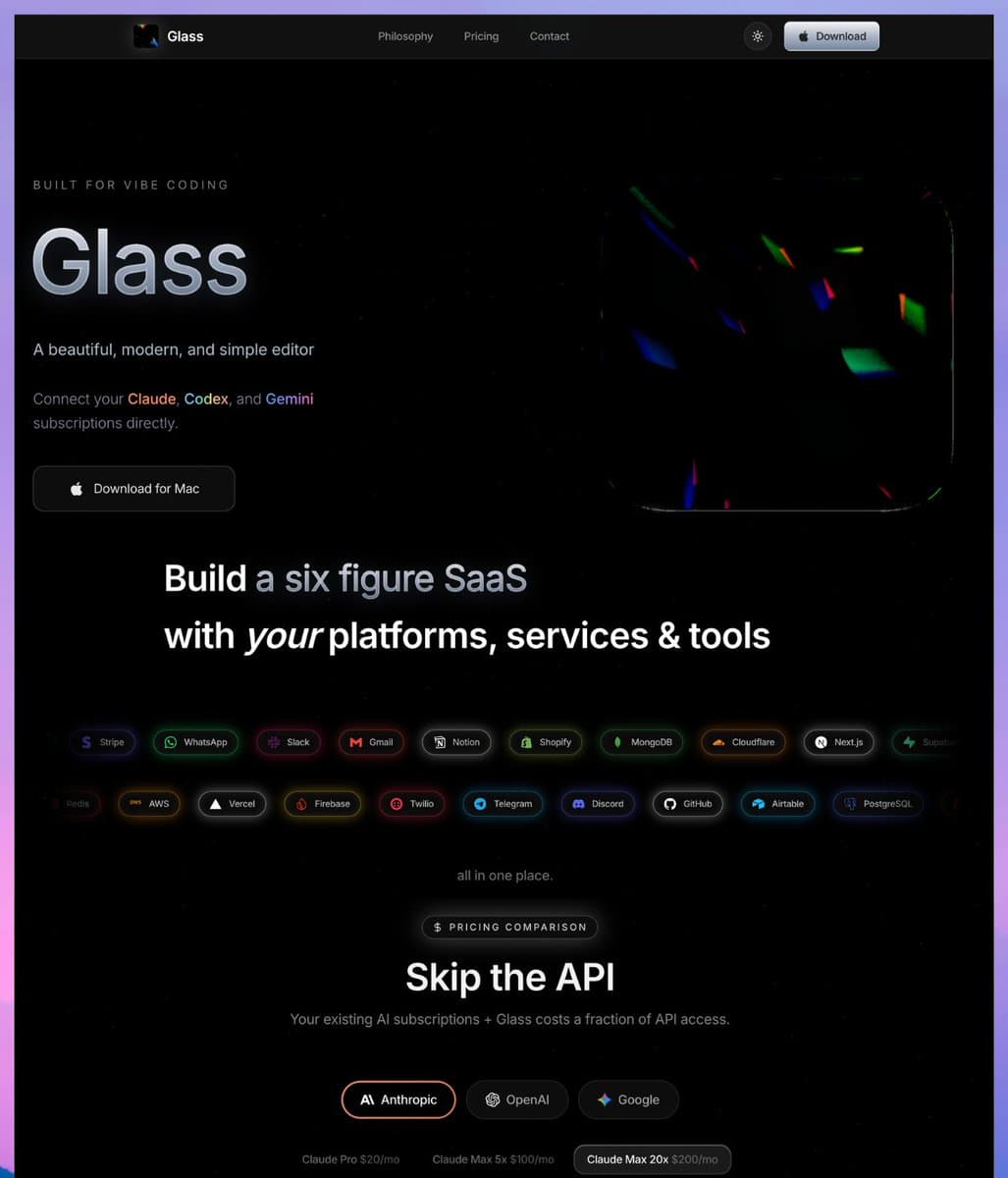
A new entrant in the crowded AI-assisted development space has made a bold claim. A developer, via a social media announcement, has introduced Glass, a coding editor that purportedly allows developers to use several of the most advanced large language models—specifically Claude Opus 4.6, GPT-5.4, and Gemini 3.1 Pro—without incurring any API costs.
The announcement directly positions Glass against established, subscription-based AI integrated development environments (IDEs) like Cursor and Windsurf, calling them a "rip-off" in comparison. The core promise is a significant reduction in the operational cost of AI-powered coding assistance, which typically relies on expensive, per-token API calls to model providers.
What's New?
The primary claim is that Glass provides a unified interface to multiple frontier models without the user paying the underlying API fees. The listed models are notable:
- Claude Opus 4.6: Anthropic's most capable model, known for high-quality reasoning and coding.
- GPT-5.4: Presumably referring to a version of OpenAI's GPT-4 series, a standard in AI coding assistants.
- Gemini 3.1 Pro: Google's latest large-scale model, competitive in coding benchmarks.
If accurate, this represents a major shift in the business model for AI development tools, moving the cost burden from the individual developer to the Glass platform itself.
How It Works (According to the Announcement)
The source provides a high-level explanation "in plain English":
- Glass acts as a client that connects to the user's own accounts with AI providers (e.g., an OpenAI account, Anthropic account, Google AI Studio).
- It then utilizes any available free credits or trial balances within those accounts to make API calls on the user's behalf.
- The editor intelligently routes coding queries to the most suitable model based on the task.
Crucially, the announcement does not claim Glass provides unlimited, paid-for API access. Instead, it leverages the existing free tiers and promotional credits offered by the model providers themselves. Once a user's personal free credits are exhausted, the service would presumably stop working for that model unless the user adds their own paid API key.
Immediate Questions and Caveats
Given the thin nature of the source—a single social media post—significant questions remain unanswered:
- Sustainability: The model is dependent on the continuation of free tiers from OpenAI, Anthropic, and Google. These are subject to change or removal.
- Performance & Integration: No details are provided on the editor's features, latency, codebase awareness, or how it compares technically to Cursor's deep IDE integration or Windsurf's agentic workflows.
- Monetization: The long-term plan for Glass is unspecified. How will the project be funded if it doesn't charge users or API fees?
- Verification: The existence and version numbers of the specific models listed (e.g., "GPT-5.4") require independent verification, as they do not match the official naming conventions from the providers at the time of writing.
The announcement is best viewed as a proof-of-concept or a provocative challenge to the current paid status quo rather than a detailed product launch.
gentic.news Analysis
This development, while preliminary, taps directly into the central tension in the AI tooling market: the high cost of quality. As we covered in our analysis of Cursor's $35M Series A funding, the race is on to build the definitive AI-native developer environment. However, widespread adoption is gated by API costs, which can run into hundreds of dollars per month for active developers. Glass's approach—aggregating and maximizing the use of free credits—is a clever, if potentially fragile, workaround.
This follows a clear trend of developers seeking to decouple powerful AI models from expensive subscription layers. It aligns with the ethos behind tools like continue.dev, an open-source VS Code extension that lets developers use their own API keys with any model. Glass appears to be packaging this self-service model into a more opinionated, standalone product.
The claim also highlights the intense competition between AI infrastructure providers. Anthropic, Google, and OpenAI are all aggressively distributing free credits to attract developers to their platforms and build ecosystem lock-in. Glass attempts to turn this competitive dynamic to the individual developer's advantage, creating a single pane of glass (hence the name) to manage these fragmented incentives. However, this strategy is inherently at the mercy of these larger companies' platform policies. If Glass gains significant traction, it could prompt providers to tighten free tier restrictions, a pattern we've seen before in cloud services.
For now, Glass serves as a pressure point on paid AI IDE vendors. It forces a conversation about value: what premium, beyond API cost passthrough, are tools like Cursor and Windsurf actually providing? Is it deep integration, proprietary agentic workflows, or managed reliability? The success or failure of Glass will help answer whether the market values a pure, low-cost conduit to models or a more curated, full-stack development experience.
Frequently Asked Questions
Is Glass really free to use?
Based on the available information, Glass itself does not charge a fee. However, it operates by spending the free credits available in your personal accounts with OpenAI, Anthropic, and Google. Once those promotional credits are used up, you would need to add your own paid API key to continue using the associated model through Glass, or the feature would become unavailable.
How does Glass compare to Cursor or Windsurf?
Cursor and Windsurf are full-featured, commercial AI IDEs that charge a monthly subscription. They offer deep integration with your codebase, proprietary agentic systems, and assume the cost of API calls on your behalf (baked into the subscription price). Glass, as described, appears to be a lighter-weight editor focused primarily on being a cost-free gateway to multiple LLMs, leveraging your existing free credits. A direct feature-by-feature comparison is not yet possible.
What are the risks of using a tool like Glass?
The main risks are sustainability and stability. Your workflow depends on: 1) The Glass project remaining active and maintained. 2) AI providers (OpenAI, Anthropic, Google) continuing to offer substantial free credit tiers. 3) Those providers not blocking or rate-limiting the type of automated access Glass uses. Any of these factors could change abruptly, potentially breaking your development environment.
Are the model versions (GPT-5.4, Claude Opus 4.6) real?
The naming is unconventional and does not correspond to officially announced model versions from the respective companies. "GPT-5.4" is not an official OpenAI designation; they currently offer GPT-4 and GPT-4 Turbo. "Claude Opus 4.6" also does not match Anthropic's public versioning. It is possible the developer is using internal or shorthand names, or the numbers are placeholders. The core claim—access to the top-tier models from each provider—is what should be evaluated.