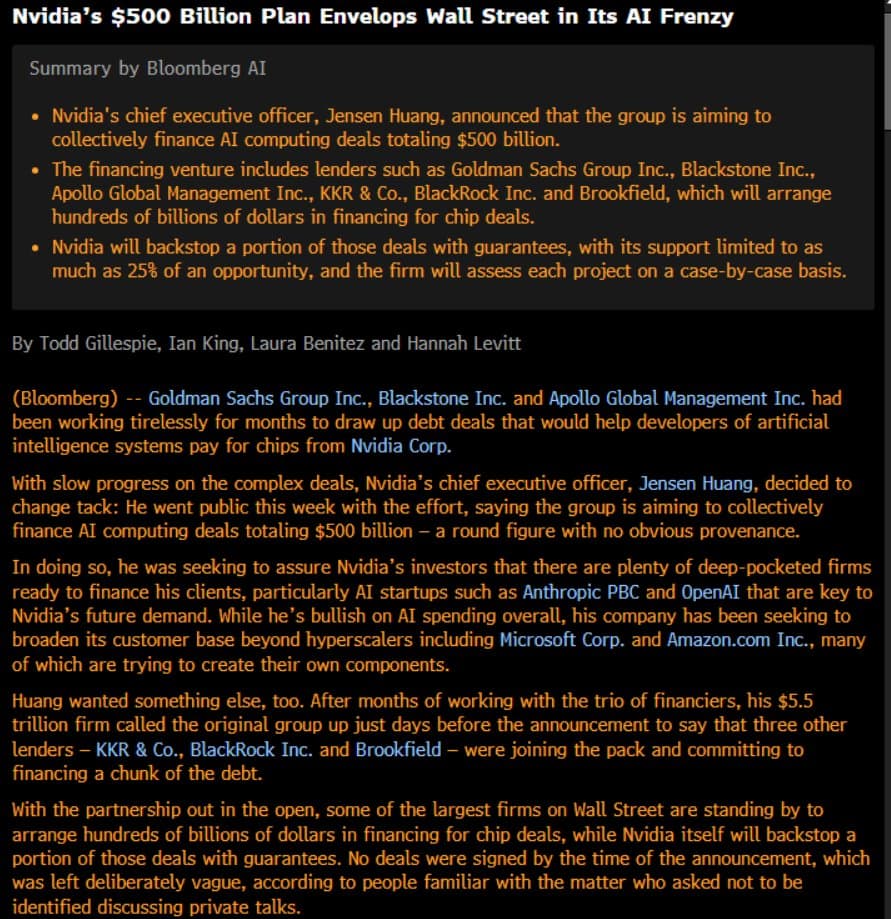
Bloomberg reports Goldman Sachs, Blackstone and Apollo have made 'slow progress' on AI data center debt deals. Nvidia CEO Jensen Huang's $500 billion Stargate announcement has 'no obvious provenance,' per the same report.
Key facts
- $500B — Stargate announcement figure with 'no obvious provenance'
- Goldman, Blackstone, Apollo — reported 'slow progress' on AI data center debt
- Jensen Huang — Nvidia CEO tied to the announcement
- $1B-$5B — typical cost per AI data center
- 50-70% — typical debt share of AI data center capital stack
The gap between announced AI infrastructure and financed AI infrastructure is widening. According to Bloomberg, as cited by @edzitron, Goldman Sachs, Blackstone and Apollo have been having "slow progress" on AI data center debt deals. The report suggests the headline figure may be more aspirational than contractual, with financing not yet committed.
The $500 billion figure attached to the Stargate project — the joint venture announced with OpenAI, Oracle and SoftBank — has "no obvious provenance," per the same report. This matters because the project's credibility rests on committed capital, not press releases.
The market has already started pricing in this skepticism. Publicly traded data center REITs and AI infrastructure names have shown volatility around capacity announcements, with investors increasingly asking who is actually writing the checks.
Ed Zitron, the tech commentator who flagged the Bloomberg report, put it bluntly: "So I guess it was all BS then?" The question is rhetorical, but the underlying concern is real — if the debt markets are hesitant, the equity side will need to carry more of the burden, and that changes the risk profile for everyone involved.
The financing gap
The "slow progress" on debt deals is not a small detail. AI data centers cost $1 billion to $5 billion each, and the industry's buildout plans assume debt will cover 50-70% of that capital stack. If Goldman, Blackstone and Apollo are hesitating, the arithmetic on the entire buildout shifts.
This is not the first sign of strain. [As previously reported], several AI infrastructure SPVs have been restructured or downsized in 2025 when committed equity failed to materialize. The pattern is consistent: announcements outpace funding, and the gap closes only when valuations drop or terms improve for lenders.
For Huang specifically, the risk is reputational. Nvidia has positioned itself as the indispensable supplier to the AI buildout, and the $500 billion Stargate figure has become a talking point in earnings calls. If the number proves soft, the narrative takes a hit — even if Nvidia's actual orders remain strong.
What the banks are saying
Neither Goldman Sachs, Blackstone nor Apollo has publicly commented on the Bloomberg report. The companies did not disclose the figure or the status of specific deals. The "slow progress" characterization suggests the deals are not dead — just moving slower than the announcement cycle would suggest.
The key question is whether this is a timing issue or a structural one. If lenders are waiting for clearer revenue models from AI data center operators, that is a fixable problem. If they are worried about power constraints, equipment depreciation or the sustainability of AI demand, that is more serious.
For now, the market is treating the $500 billion figure as a target, not a commitment. Watch for the next round of earnings calls and any disclosure of actual debt commitments tied to Stargate.
Key Takeaways
- Bloomberg reports Goldman, Blackstone and Apollo have made 'slow progress' on AI data center debt, raising questions about the provenance of Huang's $500B Stargate announcement.
- The financing gap threatens the buildout's credibility.
What to watch
Watch for the next round of Stargate-related earnings calls, specifically any disclosure of committed debt facilities from Goldman, Blackstone or Apollo. A committed facility would validate the $500 billion figure; continued silence would confirm the 'slow progress' characterization and pressure the project's credibility.