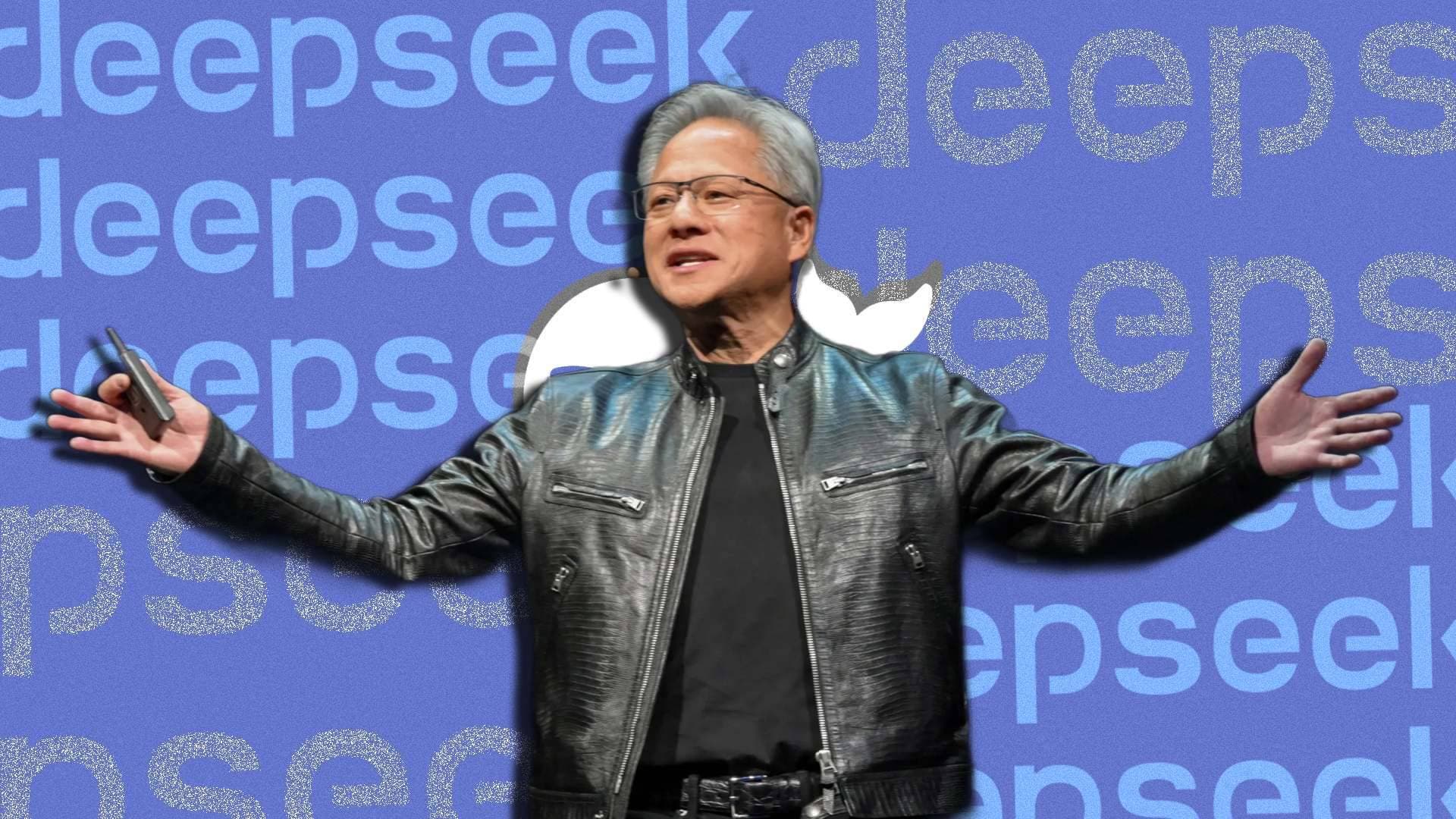
Jensen Huang told Axios that Chinese open models DeepSeek and Kimi are not adversarial to U.S. closed models. Instead, they expand AI usage, which boosts demand for Nvidia's GPUs and data centers.
Key facts
- Huang: DeepSeek and Kimi are 'excellent' models
- Nvidia data center revenue hit $30.8B in Q4 2025
- DeepSeek R1 training cost $5.6M reported
- Kimi uses 1M-token context window
- January 2025 sell-off wiped $589B from Nvidia
Nvidia CEO Jensen Huang pushed back against the narrative that Chinese open-source AI models threaten U.S. companies, arguing in a new Axios interview that they actually expand the market for Nvidia's hardware. According to @rohanpaul_ai, Huang said: "These Chinese models are excellent. The market misunderstood the impact of DeepSeek the first time, and it has misunderstood the impact of another Chinese model, Kimi, again this time."
Huang framed open models as demand drivers rather than competitors. "Great open AI models are good for the whole industry," he said. "Whenever there is more usage, Nvidia will sell many more computers. We will have to build more data centres, offer more services, and the technology will spread into more industries." This is consistent with Nvidia's Q4 2025 earnings call, where the company reported data center revenue of $30.8 billion, up 93% year-over-year, driven by AI inference workloads.
Huang also rejected the binary framing that open models are "adversarial" to closed models from companies like OpenAI and Anthropic. "That is also incorrect," he said. "The person most likely to upgrade to a great model from a company such as Anthropic or OpenAI is someone who already uses AI." This suggests open models serve as an on-ramp, converting non-users into AI consumers who may eventually pay for premium closed models.
The timing is notable: DeepSeek's R1 model, released in January 2025, triggered a $589 billion single-day sell-off in Nvidia shares on January 27, 2025, as investors feared cheaper open models would reduce GPU demand. Huang now argues the opposite — that cheaper inference drives more total compute consumption, a pattern observed in the 2023-2025 GPU shortage where inference workloads grew from 30% to 70% of Nvidia's data center revenue.
Key Takeaways
- Jensen Huang says Chinese open models DeepSeek and Kimi boost Nvidia GPU demand, not threaten it.
- Market misunderstood their impact twice.
The structural logic
Huang's argument rests on a Jevons paradox for AI compute: as the marginal cost of inference falls, total compute demand rises. DeepSeek's reported training cost of $5.6 million (per its technical report) and its 671B-parameter MoE architecture with 37B activated parameters per token made inference dramatically cheaper than GPT-4-class models. Kimi, developed by Moonshot AI, uses a 1M-token context window and has been adopted heavily in Chinese enterprise search. Both models run on Nvidia H100 and B200 GPUs at inference time.
Nvidia's own data supports this: the company's data center revenue grew from $18.4 billion in Q4 2024 to $30.8 billion in Q4 2025, even as open models proliferated. Huang's interview is essentially a public counter-narrative to the "cheap AI kills GPU demand" thesis that briefly wiped $589 billion from Nvidia's market cap in January 2025.
The counterargument
Critics might note that Huang has a direct financial incentive to talk up demand — Nvidia's market cap has recovered to $2.8 trillion as of March 2026. But the structural argument holds: if open models reduce inference costs by 10x, the number of inference queries could grow 100x, requiring more GPUs. The key question is whether the elasticity of demand for AI inference is greater than 1.0 — and Huang is betting it is.
What to watch
Watch Nvidia's Q1 2026 earnings (expected May 2026) for data center revenue growth rate and inference workload share. If inference surpasses 75% of data center revenue, Huang's Jevons paradox thesis is validated.