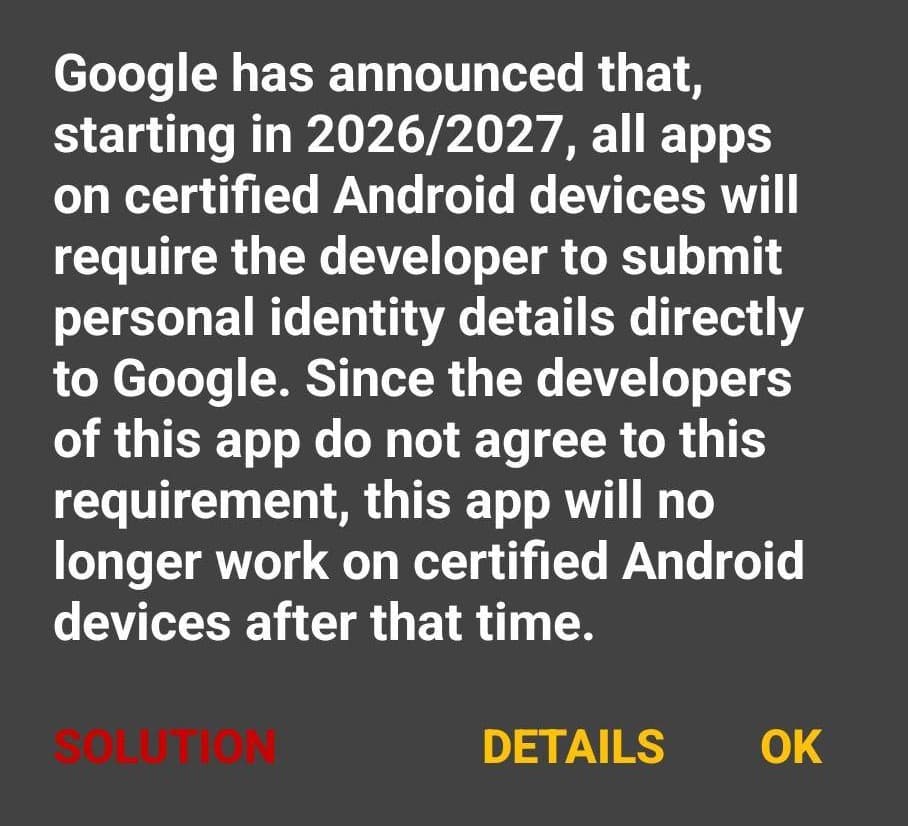
A new notification is appearing for Android developers: verify your identity with a government-issued ID or have your apps removed from the Google Play Store. This policy shift, confirmed by developer reports, marks a significant change in how Google manages its developer ecosystem, moving from an anonymous or pseudonymous model to one requiring formal, government-backed identification.
Key Takeaways
- Google is enforcing a new policy requiring Android app developers to submit government-issued ID for verification.
- Failure to comply results in app removal, impacting developers in regions with low trust in Google.
What Happened
Developers are receiving in-console notifications stating: "Every Android developer must now identify themselves to Google. Or your app gets removed." The verification process requires submitting a passport, driver's license, or other government ID. This is a mandatory requirement, not an optional verification tier. Developers who do not comply by the deadline will have their apps delisted from the Play Store.
The annual $99 developer account fee remains in place. The policy applies globally, irrespective of the developer's location or the app's nature—whether it's a commercial product, a free utility, or a niche tool built for a specific community.
The Developer Backlash
The policy has sparked immediate concern within the developer community. The core complaint isn't necessarily about providing ID to a corporation—many developers state they are willing to do so for financial or high-stakes apps. The issue is the blanket, one-size-fits-all application of the rule.
Critics highlight several key problems:
- Impact on Non-Commercial & Niche Apps: Many developers create apps not for profit but to solve specific problems, help communities, or explore ideas. Forcing ID verification on these individuals creates a significant barrier to participation.
- Global Access Issues: Developers in countries like Russia, China, or nations with strained diplomatic relations with the United States may be justifiably hesitant to submit sensitive identity documents to a US-based tech giant. This could effectively wall off entire regions from contributing to the Android ecosystem.
- Privacy and Data Security: Handing a copy of a government ID to any company, even one with Google's resources, introduces a permanent data privacy risk. A breach of this database would be catastrophic.
- The Fee Remains: Developers are being asked to pay $99 annually and surrender their identity, a combination that feels extractive, especially for those not monetizing their apps.
Google's Likely Rationale
While Google has not issued a detailed public statement on the reasoning behind this specific rollout, the move aligns with a multi-year trend of tightening platform control. The likely drivers are:
- Fraud and Scam Prevention: The Play Store has long battled malicious apps, copycats, and fraudsters. Tying an app to a verified real-world identity makes it harder for bad actors to operate anonymously and re-enter the platform after being banned.
- Regulatory Pressure: Governments worldwide are pushing for more accountability in digital marketplaces. The EU's Digital Services Act (DSA) and similar regulations require "know your business customer" (KYBC) practices. This policy may be a pre-emptive compliance measure.
- Ecosystem Clean-up: By raising the barrier to entry, Google may aim to reduce low-quality, spammy apps, theoretically improving overall store quality.
What Developers Need to Do
Affected developers must log into their Google Play Console. An alert will guide them to the verification section, where they must upload images of their chosen government ID. The verification process is handled by a third-party service. Developers should ensure their developer profile name matches the name on the ID document to avoid delays.
There is currently no publicly stated exemption for open-source projects, individual hobbyists, or legacy developers with long-standing accounts. The policy appears universal.
gentic.news Analysis
This is not an isolated action but the latest step in a sustained platform consolidation trend. It follows Apple's long-standing requirement for D-U-N-S numbers (and now legal entity verification) for its developer program, though Apple's process has been more focused on business verification rather than individual ID. Microsoft and Meta have also escalated identity verification for certain platform features and ad buyers, often in response to specific fraud waves or political advertising regulations.
The critical context here is the asymmetric relationship between platform giants and individual developers. Google sets the rules for a storefront that serves over 3 billion active Android devices. For many developers, especially outside major tech hubs, the Play Store is the only viable distribution channel. This policy change underscores that dependency: comply or lose your audience.
Technologically, this move could have a chilling effect on innovation at the edges. Some of the most interesting and disruptive apps come from solo developers or small teams experimenting in niches that large companies ignore. Adding friction and perceived risk to this process may deter them. Furthermore, it centralizes immense power and sensitive data with Google, creating a single point of failure for both censorship (if a government pressures Google to delist apps from certain developers) and data catastrophe.
From a business perspective, it aligns Google Play more closely with financial industry KYC (Know Your Customer) protocols, potentially paving the way for more integrated financial services within the Android ecosystem. However, applying banking-level identity checks to every single app developer, including a student building a free homework helper, is a drastic over-application of the model.
Frequently Asked Questions
What happens if I don't verify my ID with Google?
If you do not complete the identity verification by the deadline specified in your Play Console notification, Google will remove your apps from the Google Play Store. Your developer account may also be subject to termination.
What documents are accepted for Google Developer verification?
Google accepts government-issued photo identification documents. This typically includes a passport, driver's license, or national identity card. The specific list may vary by country, and you will see the options available within the verification flow in your Play Console.
Can I use a business address or a company ID instead?
Based on current reports and the notification language ("identify themselves"), the policy appears to be targeting individual developer identity verification. It is unclear if verification through a formal business entity (like an LLC or corporation) is an alternative path. Developers should check their specific console notification for guidance.
Is this related to the Google Play fee increase?
The annual developer registration fee of $99 remains unchanged. The ID verification is a new, separate policy requirement. Developers are now required to both pay the fee and submit to identity verification to publish and maintain apps on the Play Store.