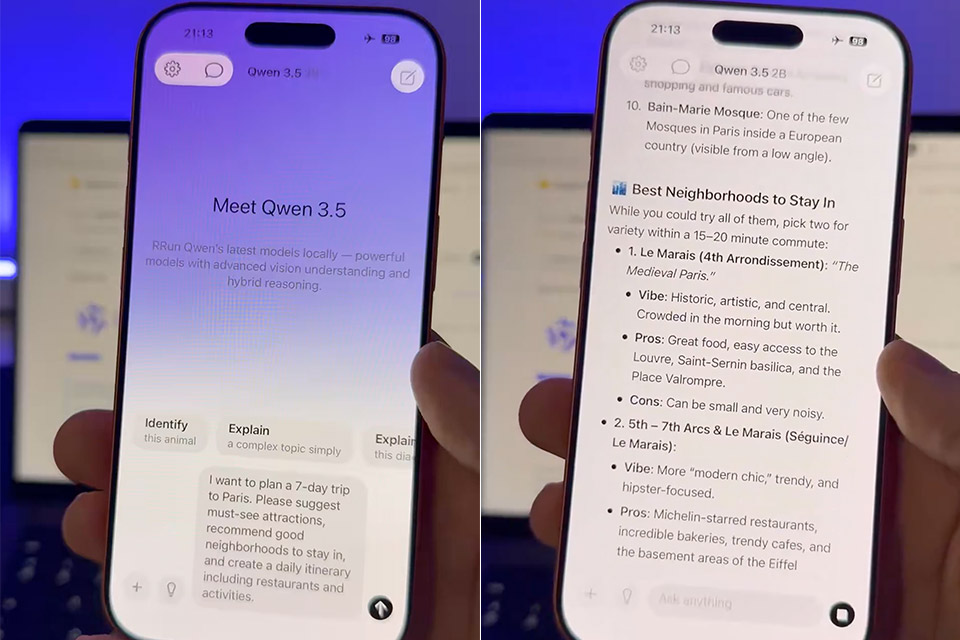
A quantized version of the Qwen2.5-7B-Instruct language model has been released for Apple's MLX framework, making the capable 7-billion-parameter model more accessible for local inference on Macs with Apple Silicon.
Key Takeaways
- A developer has ported a 4-bit quantized Qwen2.5-7B-Instruct model to Apple's MLX framework.
- This makes the capable 7B model more efficient to run on Apple Silicon Macs.
What Happened

Developer N8 Programs has published a repository containing a 4-bit quantized version of the Qwen2.5-7B-Instruct model, specifically optimized for Apple's MLX framework. The model uses a custom quantization scheme where the Multi-Layer Perceptron (MLP) layers are compressed to 4-bit precision, while other components remain at 8-bit. The release notes mention the use of DWQ (Differentiable Weight Quantization) for additional performance gains.
This release follows the original Qwen2.5 model family launch by Alibaba's Qwen team in late 2024, which introduced significant improvements over the Qwen2.0 series, particularly in coding and reasoning tasks.
Technical Details & Context
The Model: Qwen2.5-7B-Instruct is the instruction-tuned variant of the Qwen2.5-7B base model. The 7B parameter size class has become a sweet spot for local deployment, balancing capability with hardware requirements.
The Framework: MLX is Apple's machine learning array framework designed for efficient execution on Apple Silicon (M-series chips). It provides a NumPy-like API and supports model training and inference. Releases like this are part of a growing trend of bringing state-of-the-art open-weight models to the Apple ecosystem for local, private use.
The Quantization: The "4bit MLP, 8bit everything else" scheme is a targeted approach. MLP layers often constitute a large portion of a transformer model's parameters and computational footprint but can be more tolerant of aggressive quantization without severe accuracy loss. Using DWQ suggests a calibration-aware quantization method that may offer better accuracy retention than standard round-to-nearest techniques.
How to Use It

The model is available on Hugging Face under the repository mlx-community/Qwen2.5-7B-Instruct-4bit-DWQ-mlx. Users with an MLX installation can load and run the model locally. This provides an alternative to running models via llama.cpp or other cross-platform inference engines, potentially offering better integration with the MLX toolchain.
gentic.news Analysis
This release is a tactical move in the ongoing democratization of frontier AI models. It directly follows the strategic push by Apple with MLX to create a viable on-device AI ecosystem that reduces dependency on cloud APIs. By targeting the popular Qwen2.5-7B model—a known strong performer in its class—the developer is addressing a clear user demand: running a top-tier open model efficiently on consumer Apple hardware.
The choice of a hybrid 4/8-bit scheme is noteworthy. It reflects a pragmatic engineering approach seen increasingly in the quantization community, moving beyond uniform bit-width across all layers. The mention of DWQ aligns with a broader industry trend towards learned or calibrated quantization methods that seek to minimize the accuracy drop from compression. This is in contrast to simpler post-training quantization (PTQ) methods that were more common just a year ago.
For practitioners, this release signifies the maturation of the MLX model landscape. In early 2025, the selection of models available in MLX format was limited. Now, with community ports of major releases like Qwen, Llama, and Gemma appearing rapidly, MLX is becoming a first-class citizen for local AI deployment on Macs. This also increases competitive pressure on other local inference solutions like Ollama and llama.cpp to maintain performance and usability advantages.
Frequently Asked Questions
What is MLX?
MLX is an array framework for machine learning research and development on Apple Silicon, created by Apple's machine learning research team. It allows developers to build and run models that efficiently leverage the unified memory architecture of M-series chips, often enabling larger models to run compared to frameworks ported from other platforms.
How does 4-bit quantization affect model performance?
Quantization reduces the numerical precision of a model's weights, which decreases memory usage and can increase inference speed. Aggressive quantization to 4-bit typically causes some degradation in output quality (accuracy, coherence). The hybrid 4/8-bit approach and use of DWQ in this release aim to mitigate that loss, targeting the most quantization-tolerant parts of the model (MLP layers) for the deepest compression.
Is Qwen2.5-7B a good model for local use?
Yes. The Qwen2.5-7B model family has demonstrated strong performance, competitive with other leading 7B models like Meta's Llama 3.1 8B and Google's Gemma 2 9B. Its instruction-tuned variant is designed for chat and task completion. The 7B size is generally considered the upper limit for comfortable operation on consumer Macs with 16GB of unified memory, making efficient quantization crucial.
Can I use this model for commercial purposes?
You must check the specific license of the original Qwen2.5-7B-Instruct model, which is typically permissive (often Apache 2.0). The quantization and port to MLX do not change the underlying license. Always verify the license terms in the model's repository before commercial deployment.