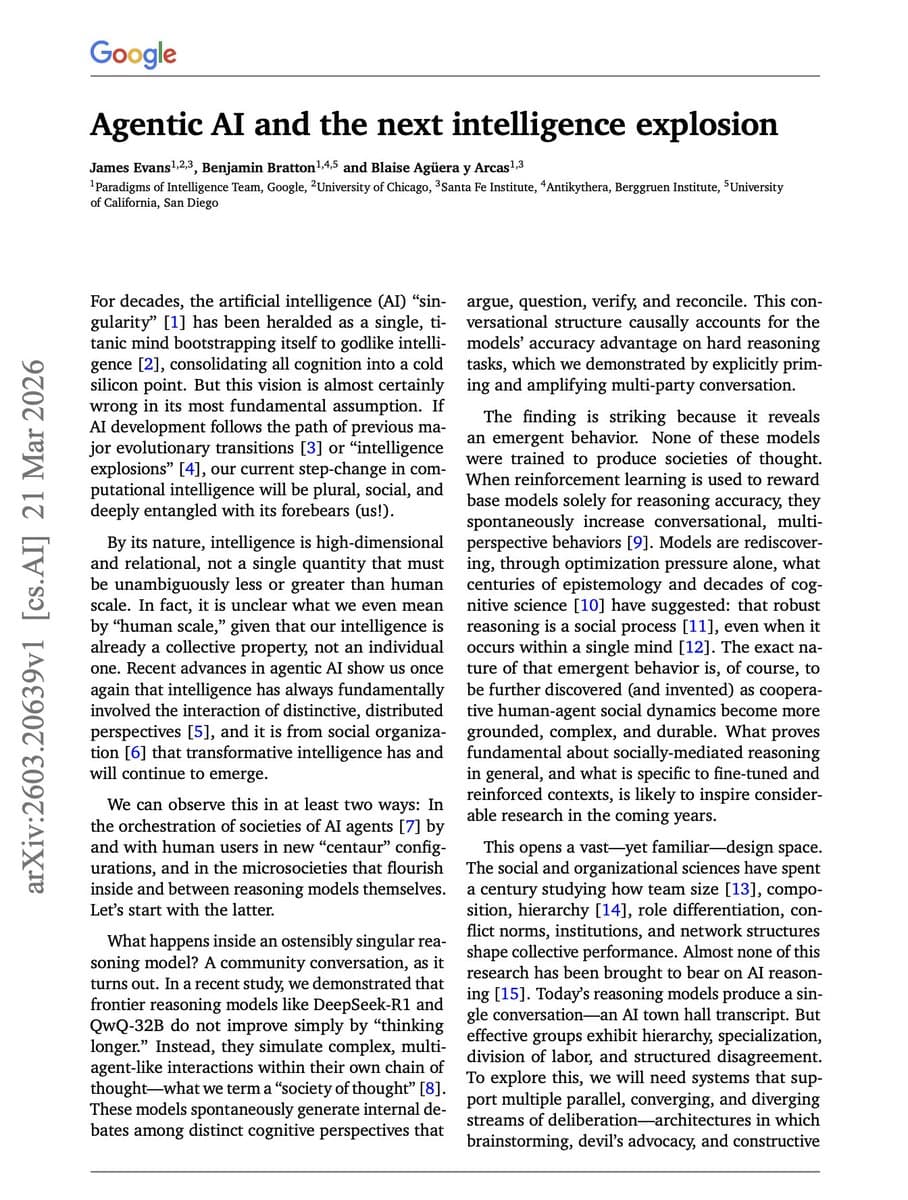
A new report from Google researchers presents a fundamental challenge to the dominant narrative surrounding artificial intelligence's trajectory. The paper argues that every prior intelligence explosion in human history—from language development to scientific revolutions—has been social, not individual. Applying this lens to AI, the authors contend that the popular "singularity" concept—framed as a single superintelligent mind bootstrapping itself to godlike capabilities—is fundamentally misguided.
Instead, they observe that current frontier reasoning models, specifically mentioning DeepSeek-R1, spontaneously develop internal "societies of thought" through reinforcement learning alone. These models engage in what appears to be multi-agent debates among different cognitive perspectives internally before producing outputs.
What the Researchers Argue
The core thesis challenges a foundational assumption in AI safety and development strategy. Rather than viewing intelligence as a property that scales linearly within individual systems, the researchers propose intelligence emerges from configured social systems. This perspective shifts the focus from building increasingly large monolithic models ("bigger oracles") to designing human-AI configurations and agent institutions.
They specifically mention that DeepSeek-R1's internal "societies of thought" emerge without explicit architectural design for multi-agent reasoning—suggesting social intelligence may be an emergent property of sufficiently advanced reasoning systems.
Implications for AI Development and Governance
This reframing has immediate practical consequences:
For AI Scaling Strategy: The path forward shifts from "build bigger models" to "compose richer social systems." This suggests investment should flow toward multi-agent architectures, communication protocols between specialized models, and human-AI collaborative frameworks rather than exclusively toward parameter count increases.
For AI Governance: The paper argues governance should follow institutional design principles rather than individual alignment approaches. This means implementing checks and balances, role protocols, and organizational structures among AI agents—similar to how human societies manage collective intelligence through constitutions, separation of powers, and procedural rules.
For Multi-Agent System Design: The observation that frontier models spontaneously develop internal multi-agent reasoning suggests designers should explicitly architect for these social dynamics rather than treating them as emergent curiosities.
The Technical Evidence: DeepSeek-R1's "Societies of Thought"
While the paper doesn't provide extensive technical details about DeepSeek-R1's internal mechanisms, the mention is significant. DeepSeek-R1 is DeepSeek's recently released reasoning model that has shown competitive performance on coding and mathematical benchmarks. The researchers' observation suggests that during reinforcement learning, the model develops what appears to be internal debate mechanisms where different "perspectives" or "cognitive approaches" compete or collaborate to arrive at solutions.
This aligns with recent research showing that chain-of-thought prompting and self-debate techniques improve model performance. The Google researchers' contribution is suggesting these social dynamics emerge spontaneously in sufficiently advanced models without explicit prompting or architectural design.
Why This Matters Now
This perspective arrives as the AI community faces diminishing returns from pure scale and increasing concerns about alignment of monolithic systems. If intelligence fundamentally emerges from social configurations, then:
- Safety becomes more tractable through institutional design rather than perfect individual alignment
- Capabilities can advance through better multi-agent composition rather than just larger training runs
- Human-AI collaboration becomes central rather than peripheral to intelligence amplification
gentic.news Analysis
This Google report represents a significant conceptual shift that connects several threads we've been tracking. First, it directly challenges the superintelligent singleton hypothesis that has dominated existential risk discussions for decades—a hypothesis recently reinforced by OpenAI's Superalignment team's focus on controlling a single superintelligent system. Instead, it aligns with Anthropic's constitutional AI approach that emphasizes process-based governance, though extends it from individual model training to multi-agent systems.
The mention of DeepSeek-R1 is particularly noteworthy given our coverage of China's rapid advances in reasoning models. DeepSeek (深度求索) has emerged as a serious competitor to Western frontier models, with DeepSeek-R1 demonstrating strong performance on SWE-Bench and mathematical reasoning. The Google researchers' observation that this model spontaneously develops internal "societies of thought" suggests these social dynamics may be a general property of advanced reasoning systems, not specific to any particular architecture or training approach.
This report also connects to the growing multi-agent systems trend we've documented, including xAI's Grok-1.5's early multi-agent capabilities and Meta's recent work on agentic workflows. What's novel here is the argument that social intelligence isn't just a useful engineering pattern but may be fundamental to intelligence itself.
From a timeline perspective, this follows Google's increased focus on AI safety and governance after the Gemini controversies, suggesting the company is investing in foundational research that could inform both technical development and policy positions. The social systems approach also offers a potential path through current impasses in AI alignment—by designing institutions with checks and balances rather than trying to perfectly align individual monolithic systems.
Frequently Asked Questions
What does "societies of thought" mean in AI models?
"Societies of thought" refers to the observation that advanced reasoning models like DeepSeek-R1 appear to develop internal multi-agent dynamics during processing. Instead of following a single reasoning path, the model engages what looks like internal debates between different cognitive perspectives or approaches before arriving at an answer. This emerges spontaneously through reinforcement learning without explicit architectural design for multi-agent reasoning.
How does this change AI safety approaches?
If intelligence emerges from social systems rather than individual minds, safety approaches shift from trying to perfectly align single systems ("AI alignment") to designing institutional safeguards for multi-agent systems. This means implementing checks and balances, role-based permissions, transparency protocols, and governance structures among AI agents—similar to how human organizations manage collective decision-making with reduced risk of unilateral harmful actions.
What are the practical implications for AI developers?
Developers should focus less on simply scaling model size and more on designing effective multi-agent systems, communication protocols between specialized models, and human-AI collaboration frameworks. The research suggests composing multiple smaller models with clear roles and interaction patterns may yield better results than continually scaling monolithic systems. This also means investing in tools for managing multi-agent workflows and institutional governance mechanisms.
Does this mean the AI singularity won't happen?
The researchers argue the singularity concept needs redefinition rather than dismissal. Instead of a single system rapidly self-improving to superintelligence, they suggest intelligence explosions will occur through increasingly sophisticated social configurations of AI agents and humans. The acceleration would come from better composition and coordination rather than from a single system's recursive self-improvement. This makes the trajectory potentially more predictable and governable through institutional design.