Skip to content
gentic.news — AI News Intelligence Platform
Connecting to the Living Graph…

Listen to today's AI briefing

Daily podcast — 5 min, AI-narrated summary of top stories

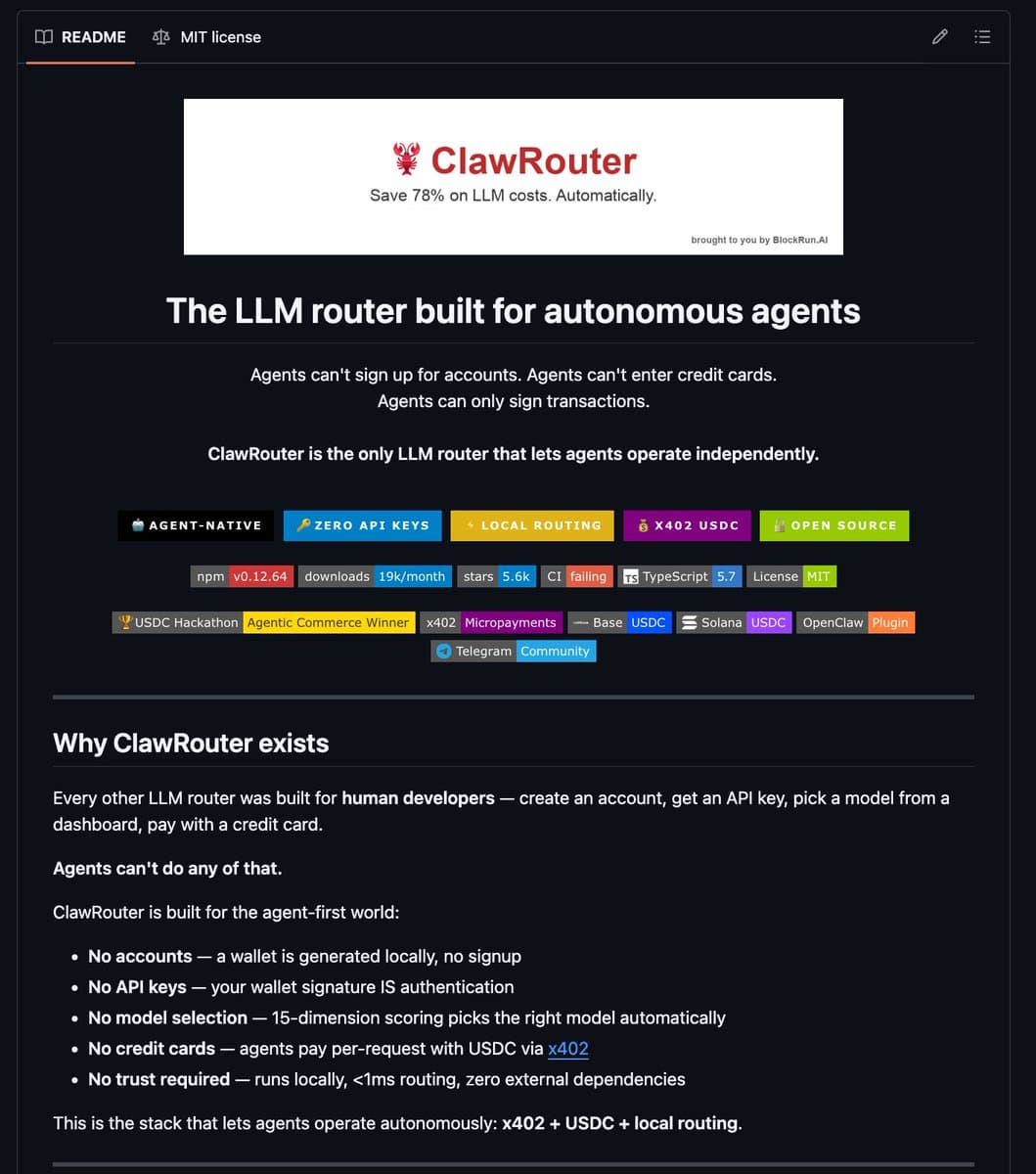
Dashboard displaying ClawRouter's model routing interface with latency bars and cost comparisons across OpenAI…

ClawRouter: Open-Source Tool Routes AI Requests to Cheapest Model in Under 1ms

ClawRouter automatically routes AI prompts to the cheapest capable model among 30+ options from OpenAI, Anthropic, Google, and others. It analyzes prompts across 14 dimensions locally and charges per request via USDC with no API keys or subscriptions.

·Mar 21, 2026·2 min read··180 views·AI-Generated·Report error
Share:

What Happened

A new open-source tool called ClawRouter has been announced that automatically routes AI prompts to the cheapest capable model among more than 30 options from major providers. According to the announcement, the system analyzes each request across 14 dimensions in under 1 millisecond and routes it accordingly—simple questions to the cheapest models, complex coding tasks to Claude or GPT, and mathematical proofs to specialized reasoning models.

The tool supports models from OpenAI, Anthropic, Google, DeepSeek, xAI, and Moonshot through a single wallet interface. Users pay per request using USDC cryptocurrency, with no API keys, accounts, or subscriptions required. The announcement claims $5 is sufficient for thousands of requests.

Technical Details

ClawRouter operates entirely locally, performing its routing analysis without external calls. The system evaluates prompts across 14 unspecified dimensions to determine the appropriate model for each task. While the announcement doesn't specify the exact models available or pricing details, it positions the tool as a cost-optimization layer for AI API consumption.

The project is released under the MIT License, making it freely available for modification and distribution. The open-source nature suggests developers can inspect the routing logic, contribute improvements, or deploy their own instances.

Context

As AI API costs become a significant expense for developers and businesses, tools that optimize spending have emerged as a practical necessity. ClawRouter follows a similar pattern to other API routing and optimization tools but distinguishes itself through its local processing, cryptocurrency payment system, and broad model support.

The announcement positions ClawRouter as a solution to what the author calls "throwing away money" when using ChatGPT and other AI services without considering cost-effective alternatives for different types of tasks.

Source: gentic.news · · author= · citation.json

AI-assisted reporting. Generated by gentic.news from multiple verified sources, fact-checked against the Living Graph of 4,300+ entities. Edited by Ala SMITH.

Following this story?

Get a weekly digest with AI predictions, trends, and analysis — free.

AI Analysis

ClawRouter addresses a genuine pain point in the current AI development ecosystem: the fragmentation of model providers and the cognitive overhead of manually selecting the most cost-effective option for each task. The local routing decision in under 1ms is technically plausible for a lightweight scoring system, though the specific 14 dimensions would need examination to assess their effectiveness. The business model—pay-per-request with USDC—is interesting but faces adoption hurdles. While cryptocurrency payments eliminate traditional payment processing, they also limit the tool's accessibility to users comfortable with crypto wallets. The lack of API keys is a genuine simplification, but it likely means ClawRouter itself manages authentication behind the scenes, creating a single point of failure. For practitioners, the value proposition depends entirely on execution. If the routing logic is sophisticated enough to reliably match tasks to appropriate models without quality degradation, this could significantly reduce costs for high-volume users. However, without published benchmarks comparing quality-adjusted costs across different routing strategies, it's difficult to assess whether this represents a meaningful advance over existing optimization approaches or simple manual model selection.
This story is part of
The Instruction Hierarchy Crisis: OpenAI's Internal Fix for a Systemic AI Safety Failure
As public chatbots fail safety tests, OpenAI's quiet IH-Challenge project reveals a deeper struggle to control model agency.
Compare side-by-side
Anthropic vs Google
Enjoyed this article?
Share:

AI Toolslive

Five one-click lenses on this article. Cached for 24h.

Pick a tool above to generate an instant lens on this article.

Related Articles

From the lab

The framework underneath this story

Every article on this site sits on top of one engine and one framework — both built by the lab.

More in Products & Launches

View all