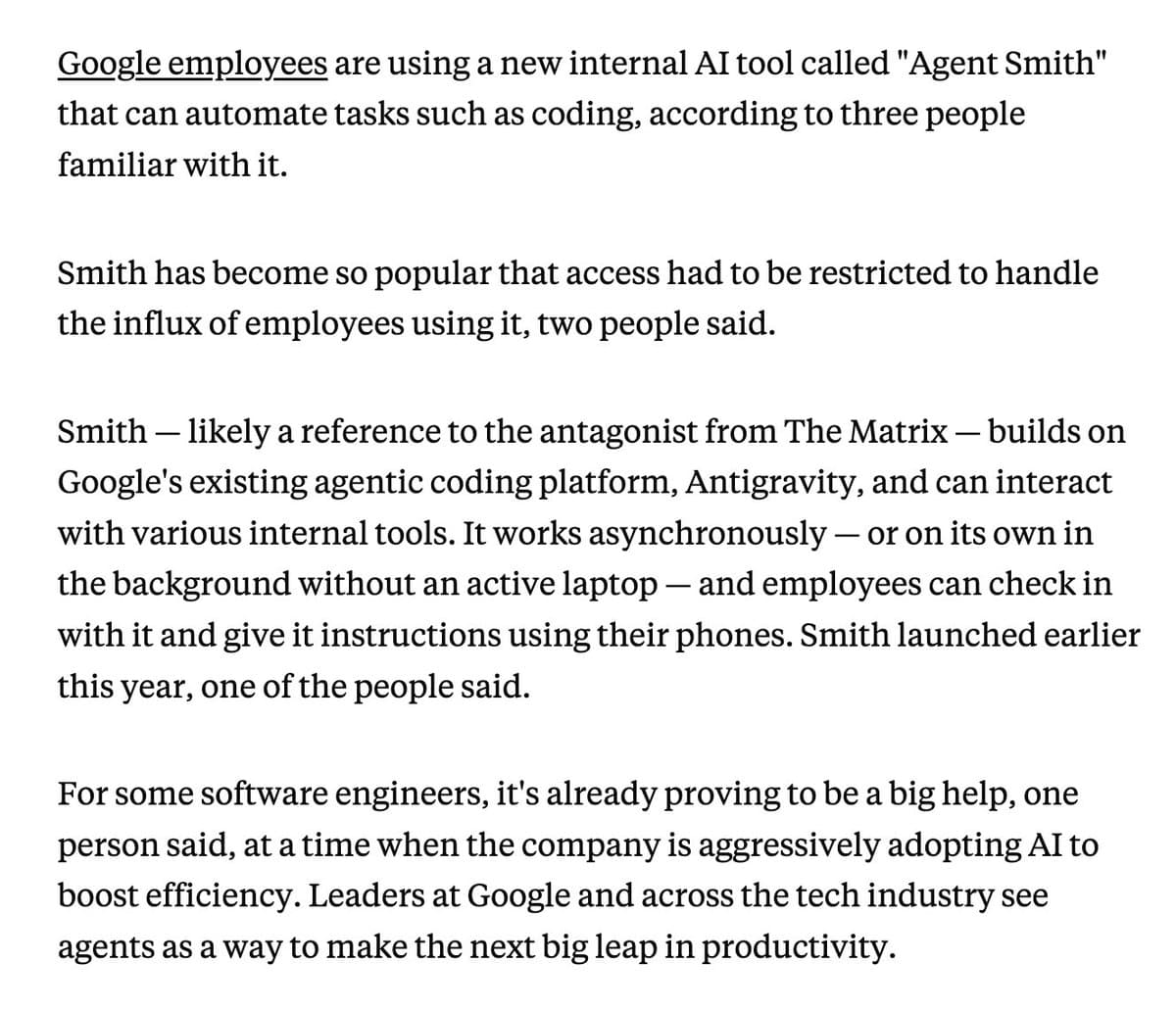
A recent social media leak from an account claiming insider knowledge has outlined a potential timeline for upcoming internal AI tools from major labs. According to the post, Google is developing a new internal AI tool codenamed "Agent Smith." The tool is described as being "very popular within the company."
The leak positions this development within a broader competitive context, listing three anticipated tools:
- OpenAI's "Spud": Allegedly arriving in "a few weeks."
- Anthropic's Claude "Mythos": Targeted for Q3 2026.
- Google's "Agent Smith": Expected "later this year."
The source provides no technical details, benchmarks, or specific features for any of the named projects. The information should be treated as an unverified rumor.
What the Leak Suggests
The core claim is that Google is actively building and testing an AI-powered tool for internal use, following a well-established industry pattern. Tech giants frequently develop proprietary tools to streamline their own engineering, operations, and research workflows before potentially releasing public-facing products. The reported popularity of "Agent Smith" within Google could indicate it is a highly effective productivity enhancer for software development, data analysis, or internal knowledge management.
The naming of OpenAI's "Spud" and Anthropic's "Mythos" alongside it frames this as a quiet, behind-the-scenes race. The development of such tools is a logical step for AI labs: they are their own first and most demanding customers. Using advanced AI to accelerate their own research and development creates a potential compounding advantage.
Context of Internal AI Tooling
The race for superior internal tooling is a critical, if less publicized, front in the AI competition. These tools are used to:
- Accelerate research: Automating literature reviews, experiment tracking, or code generation for training frameworks.
- Improve developer productivity: Generating boilerplate code, debugging, or writing documentation.
- Manage knowledge: Synthesizing information across vast internal wikis, codebases, and research papers.
A successful internal tool directly translates to faster iteration cycles and lower operational costs, which can be decisive in a fast-moving field.
What We Don't Know
Crucially, the leak reveals nothing about:
- The technical foundation of "Agent Smith" (e.g., is it a fine-tuned Gemini variant, a new architecture, or an agentic system?).
- Its specific use cases.
- Whether it will ever be released as a public product or API.
- The credibility of the source or the accuracy of the timelines for "Spud" and "Mythos."
gentic.news Analysis
This rumor, while thin on details, fits perfectly into the established competitive dynamics we track. If accurate, "Agent Smith" represents Google's countermove in the internal infrastructure war. This follows Google's historical pattern of building powerful internal systems (like Borg for cluster management) that later informed public cloud products. The reported late-2024 timeline for Google aligns with the intense pressure to improve efficiency following the Gemini 1.5 Pro launch and the restructuring of its AI teams under DeepMind leadership earlier this year.
The mention of OpenAI's "Spud" arriving in weeks is particularly notable. It aligns with the trend of OpenAI increasing its operational tempo, as we covered in our analysis of their spring updates and the o1 model family. An internal tool named "Spud" could be a specialized agent or code model designed to streamline their own development, possibly building on the reasoning capabilities demonstrated by o1. This creates a recursive loop: better AI builds better AI, faster.
Anthropic's 2026 timeline for "Mythos" suggests a longer-term, possibly more ambitious project. Given Anthropic's focus on Constitutional AI and safety, "Mythos" could be an internal tool designed for scalable oversight, model monitoring, or alignment research—critical infrastructure for developing the next generation of Claude models safely.
Ultimately, this leak highlights that the AI race is not just about public-facing chatbots or APIs. A significant battle is being fought over who can best use AI to build AI. The winner of this meta-race could gain a decisive, sustained advantage in the public arena.
Frequently Asked Questions
What is Google's Agent Smith AI?
Based on an unverified leak, "Agent Smith" is the internal codename for a new AI tool under development at Google. It is reported to be popular with employees, suggesting it is a productivity tool for engineering or research tasks. No technical specifications or public release plans have been confirmed.
Is OpenAI releasing a tool called Spud?
A social media leak claims OpenAI has an internal AI tool codenamed "Spud" that may be released in a matter of weeks. OpenAI has not announced any product by this name. The name "Spud" is likely an internal codename, and if real, its public branding and features would be different.
What is Claude Mythos from Anthropic?
The same leak references "Claude Mythos" as a future project from Anthropic targeted for Q3 2026. This is the first mention of this name, and Anthropic has made no official statement. Given the distant timeline, "Mythos" could represent a next-generation AI system or a major internal research platform, but details are purely speculative.
Are these AI tools going to be released to the public?
There is no information confirming that "Agent Smith," "Spud," or "Mythos" will become public products. They are described as internal tools. Historically, successful internal tools at major tech companies sometimes evolve into public-facing products or services, but this is not guaranteed.