A recent report, citing internal discussions, indicates that OpenAI has made a significant strategic shift in its resource allocation, prioritizing its next large language model over a standalone video generation application.
What Happened
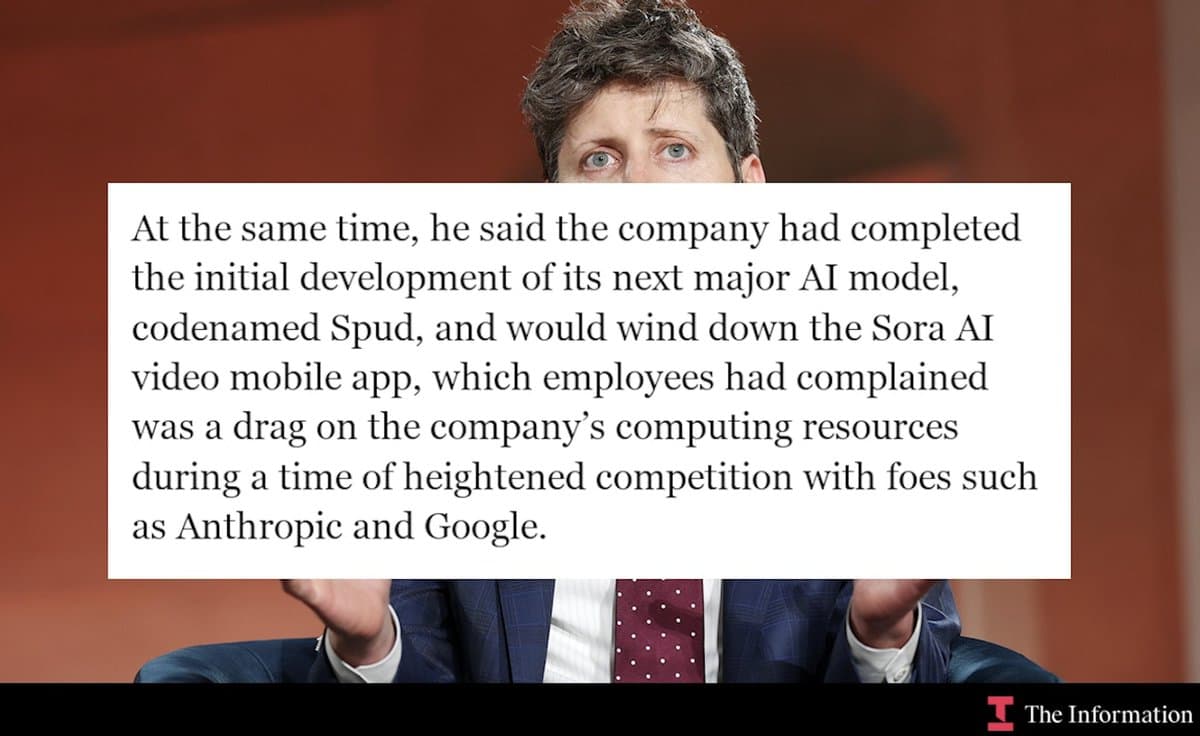
According to the report, OpenAI has completed the initial development phase of its next major AI model, internally codenamed "Spud." Concurrently, the company is winding down the Sora AI video mobile app. The decision was reportedly driven by employee complaints that the Sora app was consuming a disproportionate amount of the company's computing resources. This compute crunch is occurring during what OpenAI perceives as a period of heightened competition with rivals like Anthropic (maker of Claude) and Google (developer of Gemini).
The source suggests that the compute power freed up from shutting down the Sora app will be redirected to support the continued training and development of the "Spud" model.
Context
This development highlights the intense and costly infrastructure race underlying the current AI landscape. Training state-of-the-art frontier models requires massive clusters of expensive GPUs (like NVIDIA's H100s), making compute time a scarce and strategically vital resource. Companies must constantly make trade-offs about which projects to fuel with this limited resource.
OpenAI's Sora, first unveiled in February 2024, is a diffusion transformer model capable of generating high-fidelity, minute-long videos from text prompts. While the underlying Sora model remains a research preview, the standalone mobile app appears to have been deemed a lower priority than advancing the company's core competency in large language models.
The move to consolidate resources toward "Spud" suggests OpenAI is doubling down on its LLM roadmap to maintain or extend its lead against Claude 3.5 Sonnet and the Gemini family. The codename "Spud" follows OpenAI's tradition of using vegetable names for internal projects (e.g., "Strawberry" was a rumored earlier project focused on reasoning).
gentic.news Analysis
This compute reallocation is a pragmatic, if unsurprising, reflection of the current economic and competitive realities of scaling AI. As we covered in our analysis of Anthropic's Claude 3.5 Sonnet launch, the benchmark pressure in the LLM space is relentless. With Claude 3.5 Sonnet matching or exceeding GPT-4o on several key benchmarks, OpenAI cannot afford to let its core product stagnate. Diverting compute from a resource-intensive video application to the next LLM iteration is a direct competitive response.
The report also implicitly confirms a trend we've noted across the industry: the consolidation towards AI "superapps." The speculation that Sora's capabilities may be re-integrated into a future "ChatGPT Superapp" aligns with strategies from Google (integrating Gemini across Workspace, Search, and Android) and even Meta. This follows OpenAI's own pattern of gradually folding standalone tools like DALL-E and browsing into the main ChatGPT interface. The goal is clear: create a single, multi-modal hub to maximize user engagement and data flywheel effects, while simplifying infrastructure management.
Financially, this decision underscores the immense operating costs highlighted in our reporting on OpenAI's reported $5.2 billion annual run-rate. When compute is your primary capital expenditure, every flop (floating-point operation) must be justified by strategic ROI. A standalone video app, likely with niche usage compared to ChatGPT's hundreds of millions of users, is a logical candidate for optimization when the board and leadership are scrutinizing burn rates ahead of a potential IPO or further funding rounds.
Frequently Asked Questions
What is OpenAI's "Spud" model?
"Spud" is the internal codename for OpenAI's next major large language model, which has reportedly completed its initial development phase. No technical details, capabilities, or release timeline have been officially announced. The name follows OpenAI's pattern of using vegetable codenames for research projects.
Is the Sora video model gone forever?
No. The report specifically states the company is winding down the Sora AI video mobile app. The underlying Sora video generation model remains a research preview. The strategic move suggests OpenAI may plan to integrate Sora's capabilities directly into a future version of ChatGPT or a broader "superapp," rather than maintaining it as a separate, compute-intensive application.
Why is compute so important for AI companies?
Training and running state-of-the-art AI models like GPT-4 or Sora requires processing power on a colossal scale, utilizing tens of thousands of high-end GPUs running for weeks or months. This computing infrastructure is extraordinarily expensive to build and operate. Compute time has become the most critical and scarce resource in AI development, forcing companies to make strict prioritization decisions about which models and services to allocate it to.
Who are OpenAI's main competitors mentioned?
The report explicitly names Anthropic (creator of the Claude model family) and Google (developer of the Gemini model family and the Vertex AI platform) as OpenAI's primary foes in the current competitive landscape. The compute reallocation to "Spud" is a direct effort to keep pace with or surpass advancements from these rivals.