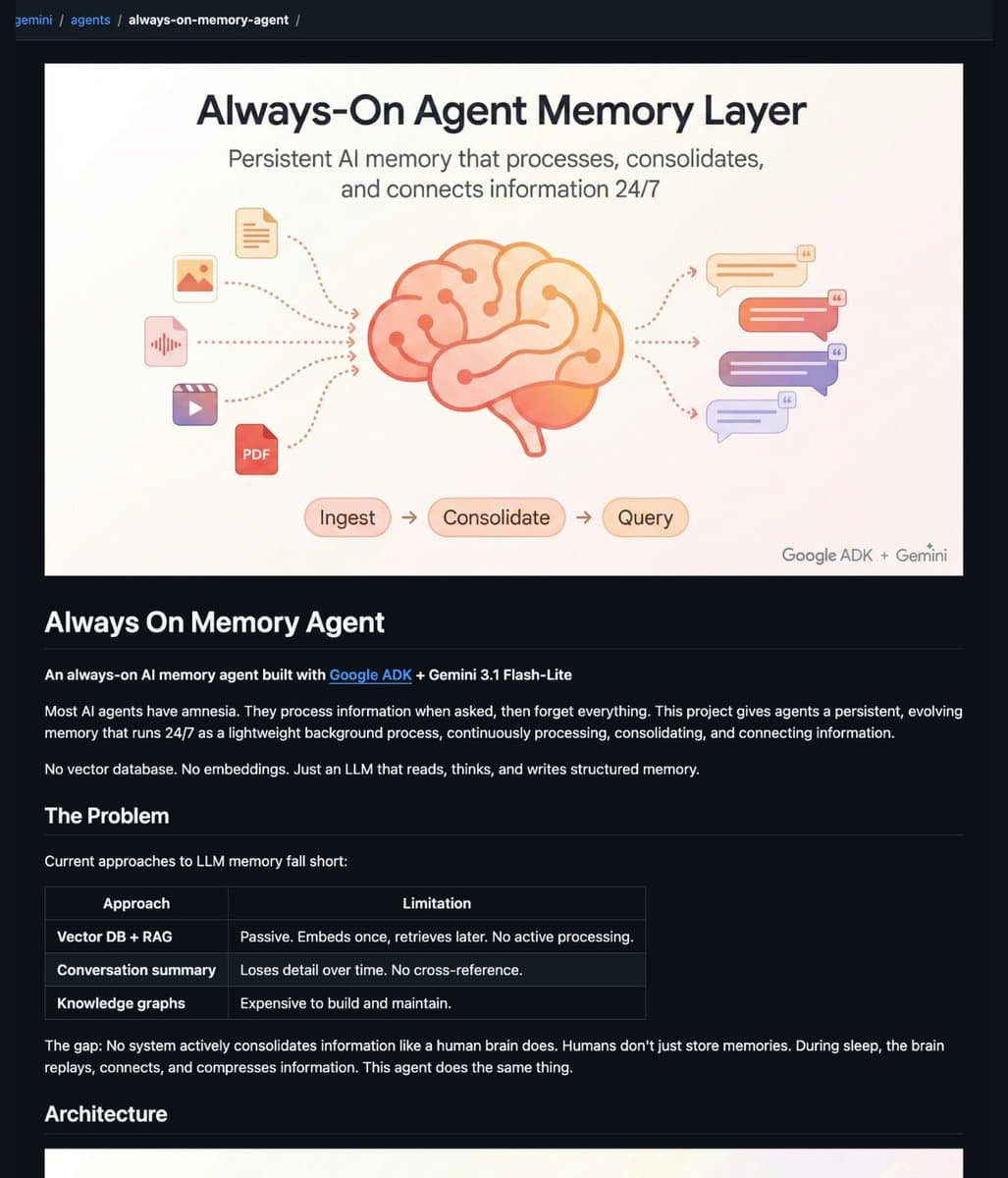
In a significant move toward more persistent and personalized artificial intelligence, Google has introduced the Always-On Memory Agent, an open-source system designed to give AI models continuous memory that operates around the clock. This development, highlighted in a recent announcement, addresses a fundamental limitation of current AI tools: their tendency to forget context once a session ends. Paired with the efficient Gemini 3.1 Flash-Lite model, the agent promises to run continuously with minimal cost, no complex setup, and no reliance on specialized databases.
How the Always-On Memory Agent Works
The system employs a trio of specialized helper modules that operate seamlessly in the background:
The File Reader: This component continuously monitors designated folders, ingesting various file types—including notes, images, audio, and videos—within seconds of being added. This allows the AI to build a rich, multimodal understanding of a user's information landscape.
The Connector: Operating autonomously, this helper analyzes and draws connections between the ingested information. Notably, it performs this synthesis periodically (reportedly every 30 minutes), even during inactive periods, mimicking the brain's consolidation process during sleep.
The Answer Engine: When queried, this module leverages the entire accumulated and interconnected knowledge base to provide responses, ensuring that every interaction is informed by the full history of learned content.
This architecture moves beyond the traditional stateless interaction model, where each conversation with an AI begins from scratch. Instead, it creates a persistent knowledge entity that grows and evolves over time.
The Significance of Persistent Memory
The "always-on" capability represents a paradigm shift. Most contemporary AI assistants, including chatbots and copilots, are session-based. They process prompts in isolation, lacking a lasting memory of past interactions unless explicitly programmed to retain context within a limited window. This limitation hinders the development of truly personalized AI that can understand a user's long-term goals, preferences, and evolving projects.
Google's agent aims to solve this by maintaining a continuous learning loop. The comparison to the human brain's nocturnal processing is apt; by connecting ideas during downtime, the AI can surface insights and relationships that might not be immediately apparent, potentially enhancing creativity and problem-solving.
Integration with Gemini 3.1 Flash-Lite
A key to the system's practicality is its pairing with Gemini 3.1 Flash-Lite, Google's lightweight and cost-optimized model. This combination is engineered for efficiency, enabling the "all day and all night" operation at a low cost. The Flash-Lite model is designed to handle sustained, background tasks without the computational expense of larger models, making persistent AI memory economically feasible for broader adoption.
Open-Source Strategy and Implications
By releasing the Always-On Memory Agent as 100% open-source, Google is taking a strategic approach that could accelerate innovation and standardization in AI memory systems. This move allows developers and researchers to inspect, modify, and build upon the architecture, potentially leading to faster iterations, improved security audits, and wider integration across different AI platforms and applications.
This openness lowers the barrier to entry for creating personalized AI experiences and could foster a new ecosystem of tools and services built around persistent AI memory.
Potential Applications and Future Outlook
The implications are vast. Such technology could power:
- Ultra-personalized assistants that remember every detail of your work, hobbies, and conversations.
- Project management AI that continuously integrates new documents, emails, and notes into a coherent knowledge graph of a long-term initiative.
- Creative companion tools that learn an artist's or writer's style and themes over years, offering deeply contextual suggestions.
- Research aids that tirelessly connect dots across thousands of papers and notes.
However, this power comes with significant considerations around privacy, data security, and user control. An AI that never forgets everything it learns requires immense trust. Users will need transparent controls over what is remembered, how it is used, and the ability to edit or delete memories. The local-folder-based ingestion described is a start, but robust data governance will be critical.
Google's Always-On Memory Agent, especially as an open-source project paired with an efficient model, marks a concrete step toward the long-envisioned future of AI as a persistent, evolving extension of human cognition. Its success will depend not just on technical performance, but on navigating the crucial ethical and practical frameworks for a world where our digital assistants truly never forget.
Source: Initial announcement via X/Twitter by @hasantoxr, detailing Google's Always-On Memory Agent.