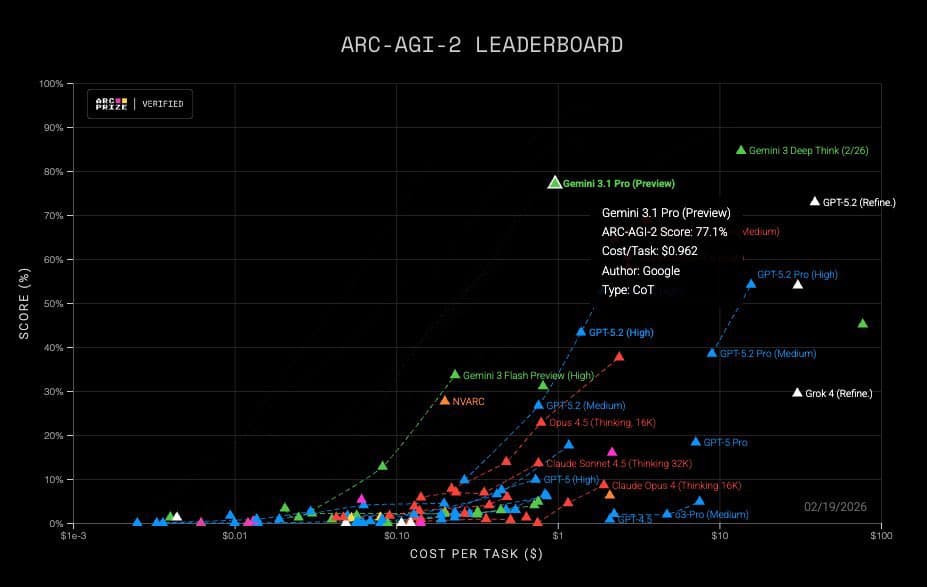
A seismic shift appears to be underway in the economics of artificial intelligence. According to emerging reports and analysis from industry observers, Google's newly announced Gemini 3.1 model delivers performance within a few percentage points of leading frontier models while operating at approximately one order of magnitude (10x) lower cost. This development, if confirmed through broader benchmarking, represents not just another incremental improvement but a potential inflection point in AI accessibility.
The observation, highlighted by AI commentator @kimmonismus on social media platform X, suggests Gemini 3.1 performs "just a few percent below DeepThink" while costing roughly ten times less. The implications are profound enough that the commentator noted: "At this rate, intelligence will literally be too cheap to meter in a few months."
The Performance-Cost Equation Redefined
For years, the AI industry has operated under an implicit assumption: superior performance required exponentially greater computational resources, translating directly to higher costs for both developers and end-users. This created a natural economic moat around the most capable models, limiting their deployment to well-funded enterprises and research institutions.
Gemini 3.1 appears to challenge this paradigm directly. If a model can achieve 95-98% of the performance of a frontier system at 10% of the cost, the entire value proposition of AI deployment changes. Suddenly, applications that were marginally economical become viable, and existing applications can scale dramatically without proportional cost increases.
The Technical Architecture Behind the Efficiency
While Google hasn't released full architectural details, the efficiency gains likely stem from several technical advances:
Model Distillation & Optimization: Techniques that transfer knowledge from larger, more expensive models into smaller, more efficient architectures without catastrophic performance loss.
Inference Optimization: Improvements in how models process queries (inference) rather than just how they're trained, reducing computational overhead per token generated.
Hardware-Software Co-design: Tighter integration between Google's TPU hardware and their model software stack, squeezing out inefficiencies that generic hardware solutions might introduce.
Algorithmic Improvements: More efficient attention mechanisms, better weight initialization, or improved training methodologies that achieve similar capabilities with fewer parameters.
Immediate Market Implications
The potential market disruption is multi-faceted:
Cloud Pricing Pressure: Google's move directly pressures competitors like OpenAI, Anthropic, and Amazon to either match these efficiency gains or justify premium pricing for marginal performance advantages.
Democratization of Access: Startups and smaller enterprises that previously couldn't afford state-of-the-art AI capabilities may now access them, potentially unleashing a wave of innovation from outside the tech giants.
Edge Deployment Possibilities: Significantly reduced computational requirements make deploying capable models on edge devices (phones, IoT devices, vehicles) more feasible, reducing latency and privacy concerns associated with cloud-only AI.
The "Too Cheap to Meter" Trajectory
The reference to intelligence becoming "too cheap to meter" echoes predictions made about computing and bandwidth during earlier technological revolutions. While likely hyperbolic in the short term, it points toward a fundamental trend: the marginal cost of AI inference approaching zero for many applications.
This doesn't mean AI development becomes free—training frontier models still requires massive investment—but the deployment and utilization of already-trained models could become so inexpensive that pricing shifts from per-token or per-API-call models toward flat-rate subscriptions or even free tiers supported by adjacent revenue streams.
Competitive Landscape Reshuffle
Google's aggressive pricing move through efficiency gains represents a strategic pivot. After facing criticism for being slower to market with consumer-facing AI products compared to OpenAI, Google appears to be leveraging its deep infrastructure advantages—particularly its custom TPU hardware and decades of large-scale systems expertise—to compete on economics rather than just raw capability.
This creates a difficult dilemma for competitors: match Google's efficiency (requiring similar hardware-software integration) or differentiate on other dimensions like specialized capabilities, privacy guarantees, or unique data access.
Long-Term Societal Implications
As AI capabilities become radically more accessible, several societal considerations emerge:
Job Market Transformation: Widespread, inexpensive AI could accelerate automation across knowledge work sectors, requiring proactive policy responses around retraining and economic transition.
Information Ecosystem: The barrier to generating sophisticated content—text, images, code, analysis—plummets, challenging traditional content moderation and authenticity verification systems.
Innovation Diffusion: Developing nations and underserved communities gain access to tools previously limited to well-resourced organizations, potentially reducing global inequalities in innovation capacity.
Environmental Impact: While more efficient models reduce energy consumption per query, dramatically increased usage could offset these gains, making continued efficiency improvements crucial for sustainable AI growth.
The Verification Challenge
As with any performance claim in the competitive AI landscape, independent verification remains essential. The AI community will need to:
- Benchmark Gemini 3.1 across standardized tasks against established models
- Evaluate performance-cost tradeoffs across diverse use cases
- Assess whether efficiency gains apply equally to all capabilities or favor certain task types
Early adopters and enterprise customers will serve as the ultimate validators, determining through real-world deployment whether the performance-cost claims hold across their specific applications.
Looking Forward: The Next Efficiency Frontier
If Gemini 3.1's efficiency gains are as substantial as reported, they establish a new baseline for what's possible in AI economics. The industry's focus may shift from pure performance benchmarks toward performance-per-dollar metrics, rewarding innovations that deliver capability more affordably.
This could accelerate several trends:
- Specialized models optimized for particular domains at even greater efficiency
- Multi-modal models that maintain efficiency while handling diverse input types
- On-device AI becoming standard rather than exceptional
- AI integration into everyday applications becoming economically trivial
Google's apparent breakthrough suggests we may be entering an era where AI capability becomes a commodity—not in the sense of being undifferentiated, but in being widely accessible at minimal marginal cost. The implications for businesses, developers, and society at large could be as transformative as the internet's own journey from expensive novelty to ubiquitous utility.
Source analysis based on reporting from @kimmonismus and Google's Gemini announcements.