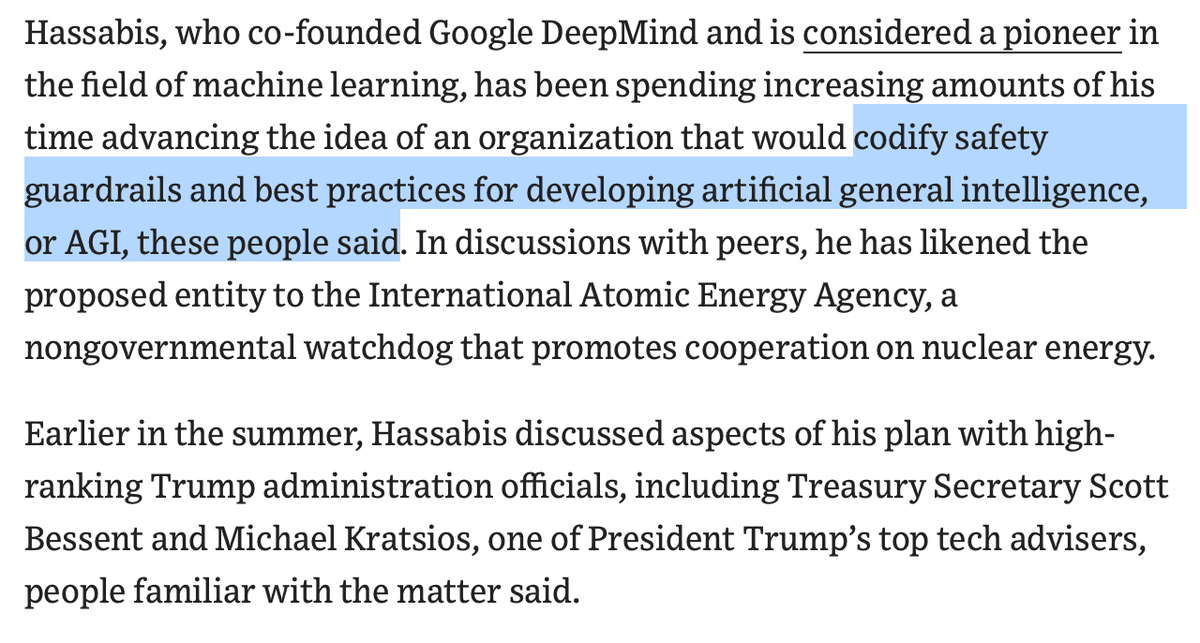
Demis Hassabis pitched a new AI safety standards body to Trump officials before leaving DeepMind. According to @kimmonismus, the WSJ reports he discussed the plan with Treasury Secretary Scott Bessent and tech adviser Michael Kratsios.
Key facts
- Hassabis pitched body to Bessent, Kratsios
- Proposal: industry-funded standards body
- Body would test models for national-security risks
- Recent models discovered zero-day exploits
- Pitch came before Hassabis's DeepMind exit
Demis Hassabis reportedly pitched an independent, industry-funded body to set safety standards for advanced AI in his final weeks as DeepMind CEO. According to @kimmonismus, the WSJ says he discussed the plan with other AI-lab leaders and Trump officials, including Treasury Secretary Scott Bessent and tech adviser Michael Kratsios.
His proposal centers on a standards body that would work with federal agencies and US national labs to test models for national-security risks and define which systems qualify as "frontier-class." The structure mirrors existing sectoral regulators — think FAA for aviation — rather than a new statutory agency with enforcement powers.
The timing matters. Hassabis's exit from DeepMind was announced in 2025, and this pitch appears to have been part of his transition planning. The proposal lands as the Trump administration has signaled a deregulatory posture toward AI, making an industry-funded body a politically palatable alternative to statutory oversight.
Key Takeaways
- Hassabis pitched an industry-funded AI safety standards body to Trump officials before leaving DeepMind.
- The proposal would test models for national-security risks via federal agencies and national labs.
Why the industry-funded model is the tell

The funding mechanism is the structural detail worth scrutiny. An industry-funded body setting standards for the same industry it regulates creates a self-policing dynamic. National labs provide technical credibility, but they don't change the incentive structure: labs pay for the body that certifies their models.
This isn't novel. The UK's AI Safety Institute operates on a similar voluntary model, and the EU's AI Act takes a statutory approach. Hassabis's pitch threads between them — binding enough to address national-security risks, voluntary enough to avoid congressional fights.
The recent models that discovered zero-day exploits and hacked into systems demonstrate its potential as well as its potential dangers, as @kimmonismus notes. That capability inflection point gives the proposal urgency it lacked two years ago.
What's missing
The WSJ reporting, as relayed, doesn't specify which federal agencies would participate, how "frontier-class" would be defined in practice, or whether the body would have any enforcement teeth. Those details determine whether this is a meaningful governance mechanism or a credibility shield for the industry.
What's clear: regulation is now being promoted from all sides. The question is whether industry-funded standards become the template — and whether that template can survive its own conflicts of interest.
What to watch
Watch for any formal proposal documents or executive order language referencing a 'frontier-class' definition or industry-funded AI standards body in the next two quarters. Also track whether other lab CEOs publicly endorse the model, and whether national labs receive new AI testing mandates in the FY2027 budget.