Key Takeaways
- NVIDIA's technical blog details how generative recommenders are redefining RecSys at scale.
- It highlights a shift from two-stage pipelines to sequence-to-sequence transformers for large-scale platforms.
What Happened

NVIDIA's technical blog, "How Generative Recommenders Are Redefining RecSys at Scale," outlines a significant architectural shift in building recommendation systems. The piece details how generative models—specifically sequence-to-sequence (seq2seq) transformers—are being applied to the core problem of recommendation, moving away from the traditional two-stage retrieval-and-ranking pipeline that has dominated the industry for years.
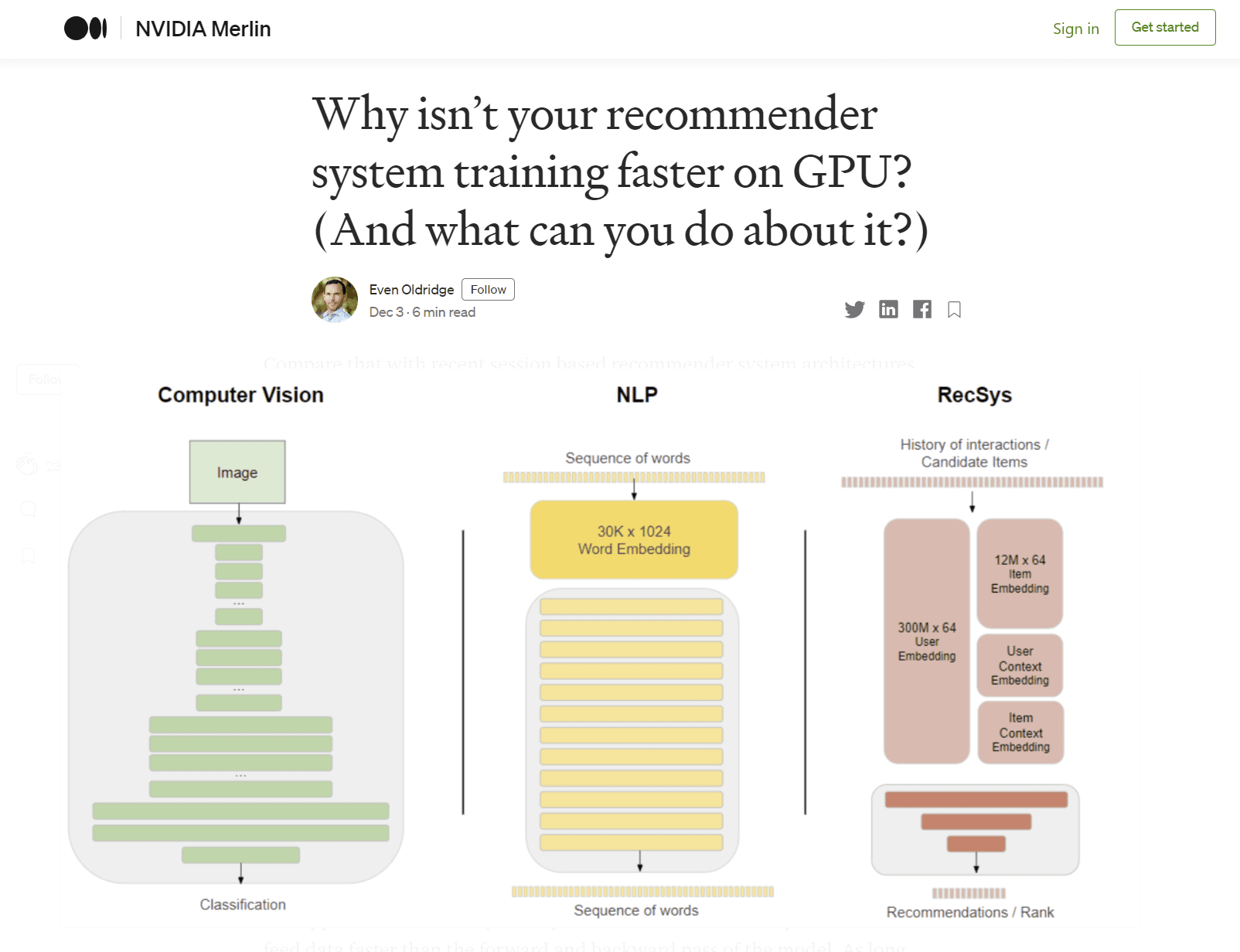
The core idea is to treat the user's interaction history (clicks, purchases, views) as a sequence of tokens, similar to how a language model processes text. A generative recommender is then trained to predict the next item in that sequence, effectively framing recommendation as a text generation task. This allows the model to leverage the full power of transformer architectures, which have proven incredibly effective at capturing long-range dependencies and complex patterns in sequential data.
Technical Details
The traditional RecSys architecture consists of two distinct stages: retrieval, which narrows down a massive corpus of items (e.g., billions) to a few thousand candidates, and ranking, which precisely orders those candidates to produce the final top-N list. This two-stage design is a compromise between computational cost and accuracy.
Generative recommenders collapse this process into a single, unified model. The user's behavior sequence is encoded, and the model generates the next item (or a sequence of items) directly. This is a more holistic approach, as the model can theoretically consider the entire item corpus when making a prediction, rather than being constrained by the quality of the initial retrieval step.
The blog highlights the use of seq2seq transformers for this task. These models are well-suited for mapping an input sequence (user history) to an output sequence (recommendations). The approach promises several benefits:
- Improved Personalization: By modeling the entire interaction history, the model can capture nuanced user preferences that might be missed by simpler, feature-based models.
- End-to-End Optimization: The model is trained on the final objective (predicting the next item) rather than optimizing retrieval and ranking separately, which can lead to better overall performance.
- Scalability: Transformers are highly parallelizable, making them suitable for training on massive datasets and serving recommendations for billions of users.
The blog is part of a broader trend in the AI industry toward applying large language model (LLM) techniques to domains beyond text. NVIDIA's focus on this area is significant, as it signals that the hardware vendor sees generative recommenders as a key workload for its data center GPUs, alongside LLMs and other AI workloads.
Retail & Luxury Implications
The implications for retail and luxury e-commerce are substantial, though the technology is still in its early stages. For companies like Kering, Richemont, and Burberry, the promise of generative recommenders is a more intelligent and personalized shopping experience.
Consider a luxury fashion customer who frequently buys from a specific designer but has recently started viewing more sustainable materials. A traditional recommender might suggest other items from that designer or similar brands. A generative recommender, however, could learn this evolving preference and generate a recommendation for a sustainable piece from a new, niche brand, creating a more serendipitous and satisfying discovery experience.
The ability to handle long interaction histories is also crucial. Luxury customers often have long, sparse purchase histories. Generative models are better at extracting signals from this kind of data than traditional collaborative filtering methods. They can also better incorporate contextual signals like seasonality, current trends, and even real-time events.
However, there are significant hurdles. The computational cost of training and serving these models is high, requiring substantial GPU infrastructure. For many retailers, this is a significant investment. Moreover, the technology is nascent; most deployments are still in research or pilot phases at major tech companies.
The move towards generative recommenders also signals a potential shift in the competitive landscape. Companies like NVIDIA are building the infrastructure, while Google (with its Transformer architecture and TPUs) and other cloud providers are offering the platforms. Retailers will need to decide whether to build in-house expertise or rely on cloud-based solutions.
Business Impact

The business impact is potentially transformative. Better recommendations directly drive higher conversion rates, increased average order value, and improved customer lifetime value. For luxury brands, where personalization is a core part of the brand promise, this technology offers a path to deliver on that promise at a scale that was previously impossible with human stylists.
That said, the source material does not provide quantified results. The claims are about architectural benefits and potential, not about measured improvements in metrics like click-through rate or revenue. This is an important distinction for AI leaders to keep in mind.
Implementation Approach
The implementation approach is not trivial. It requires:
- Significant GPU Compute: Training a seq2seq transformer on billions of user interactions requires a large cluster of GPUs, such as NVIDIA's H100 or A100. The recently delayed next-gen rack system could impact availability plans.
- Data Engineering: The user interaction data must be formatted as sequences of tokens. This requires a robust data pipeline to handle the scale and velocity of e-commerce data.
- ML Engineering Expertise: Teams need deep experience with transformer architectures, distributed training, and model serving. This is a specialized skill set that is in high demand.
- Serving Infrastructure: The inference latency for generating recommendations must be low to provide a seamless user experience. This may require optimized inference engines and careful model quantization.
Governance & Risk Assessment
The technology is still in its early maturity phase. The risks include:
- High Cost: The infrastructure and expertise required are expensive, potentially limiting adoption to the largest players.
- Explainability: Generative models are black boxes. For luxury brands, where brand image and curation are paramount, the inability to explain why a recommendation was made could be a challenge.
- Data Privacy: These models rely on vast amounts of user data, raising concerns about privacy and compliance with regulations like GDPR.
- Bias: Like all AI models, generative recommenders can amplify biases present in the training data, potentially leading to unfair or exclusionary recommendations.
Despite these challenges, the direction is clear. Generative AI is moving from text and images to the core of the digital economy: the recommendation engines that drive commerce. NVIDIA's focus on this area is a strong signal that this is a major trend to watch.
Source: news.google.com