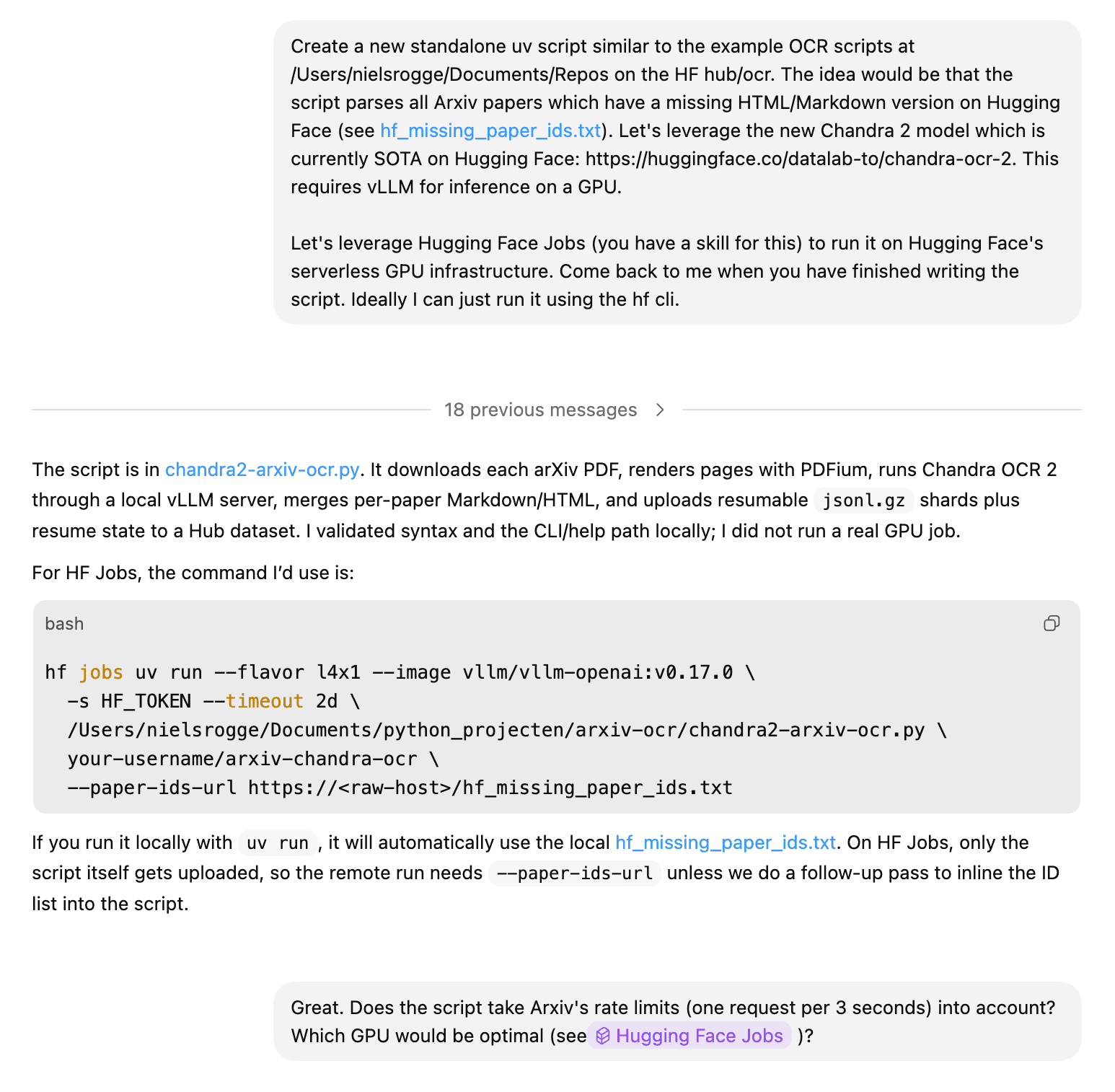
Hugging Face has executed a large-scale document processing project, converting 27,000 arXiv papers from PDF to structured Markdown format. The effort, announced by CEO Clement Delangue, utilized an open-source 5-billion parameter model, 16 parallel Hugging Face Jobs running on L40S GPUs, and a mounted file system to handle the volume.
Key Takeaways
- Hugging Face CEO Clement Delangue announced the OCR conversion of 27,000 arXiv papers to Markdown using an open 5B-parameter model and 16 parallel jobs on L40S GPUs.
- This demonstrates a scalable, open-source pipeline for large-scale academic document processing.
What Happened

The project represents a significant batch operation in academic text extraction. The core technical stack consisted of:
- Model: An unspecified open-source model with 5 billion parameters, likely fine-tuned for Optical Character Recognition (OCR) and document layout understanding.
- Infrastructure: 16 parallel Hugging Face Jobs, a managed service for running containerized workloads, utilizing NVIDIA L40S GPUs. The L40S is a data center GPU optimized for AI inference and visual computing.
- Data Pipeline: A "mounted" file system, indicating a scalable storage solution (like an NFS or cloud storage volume) to manage the input PDFs and output Markdown files.
The output is clean Markdown, which preserves structure, code, tables, and mathematical notation far better than raw text, making the papers more accessible for search, analysis, and AI training.
Context & Implications
Large-scale conversion of academic PDFs is a persistent challenge in AI research. PDFs are presentation formats that obscure semantic structure, making it difficult to build clean corpora for training models on scientific knowledge. Proprietary services and models often handle this task, but Hugging Face's use of an open 5B model highlights a push for replicable, transparent pipelines.
The scale—27,000 papers—is notable. Assuming an average of 10 pages per paper, this represents roughly 270,000 pages processed. Using parallel jobs on L40S GPUs suggests a focus on cost-effective throughput. The L40S, while less discussed than H100s, offers a balance of GPU memory and integer/floating-point performance suitable for inference-heavy batch jobs.
This work directly feeds into the ecosystem for open AI. Clean, structured Markdown versions of arXiv papers are valuable for:
- Training Scientific LLMs: Models like Meta's Galactica or Google's Minerva require high-quality scientific text.
- Improving Search & Discovery: Structured text allows for better keyword indexing, citation extraction, and formula search.
- Accessibility: Markdown is easier for screen readers and other assistive technologies to parse than PDFs.
gentic.news Analysis

This move by Hugging Face is a tactical infrastructure play that reinforces its position as the central hub for open-source AI. It's not just about releasing models; it's about building the data pipelines that make those models powerful. Processing 27,000 arXiv papers creates a immediately useful dataset that can be hosted on the Hugging Face Hub, attracting researchers and solidifying the platform's utility.
Technically, the choice of a 5B parameter model is interesting. It signals a shift towards efficiency. In late 2024 and 2025, the trend was towards massive, monolithic OCR/ document understanding models. Using a smaller, competent model across massively parallel jobs suggests an optimization for total cost and speed of processing, rather than chasing marginal accuracy gains with a giant model. This is a production engineering mindset applied to a research problem.
This project also subtly competes with other closed and open initiatives. Google's DeepMind has invested heavily in processing scientific data for models like AlphaFold and Gemini. Startups like Scite or Semantic Scholar have their own pipelines. By open-sourcing the methodology and likely the resulting dataset, Hugging Face undercuts proprietary approaches and leverages its community. It follows their broader strategy of commoditizing the infrastructure layer of AI, as seen with their previous launches of the Inference Endpoints service and the Datasets library. This work makes the next open-source scientific LLM easier to train, which in turn generates more activity on their platform.
Frequently Asked Questions
What model did Hugging Face use for OCR?
The announcement specifies an "open 5B model" but does not name it. Given Hugging Face's ecosystem, likely candidates include a fine-tuned version of a dense text model like Qwen2.5-7B or a vision-language model like LLaVA-NeXT that has been specialized for document understanding. The 5B parameter size suggests a model balancing capability with inference efficiency for batch processing.
Why convert PDFs to Markdown instead of plain text?
Markdown preserves critical structural elements that plain text loses: section headers, lists, code blocks, tables, and most importantly, inline and block mathematical notation (e.g., $E=mc^2$). This structure is essential for machine reading comprehension of scientific literature, as the formatting carries semantic meaning about the type of content.
Will the 27,000 processed papers be released as a dataset?
While not explicitly stated, Hugging Face's standard practice is to open-source the outputs of such projects. It is highly probable the processed Markdown corpus will be released on the Hugging Face Hub as a dataset, similar to existing collections like arxiv-dataset. This would provide a significant, high-quality resource for the community.
How does this compare to other PDF extraction tools?
Traditional tools like pdftotext or cloud APIs (Amazon Textract, Adobe PDF Services) extract text but often fail at structure and LaTeX math. AI-powered tools like ScienceParse or GROBID are more advanced but can be complex to run at scale. Hugging Face's approach appears to integrate a modern vision-language model into a scalable, cloud-native pipeline, aiming for better accuracy and scalability than traditional rule-based parsers, but with more openness and control than a closed API.